

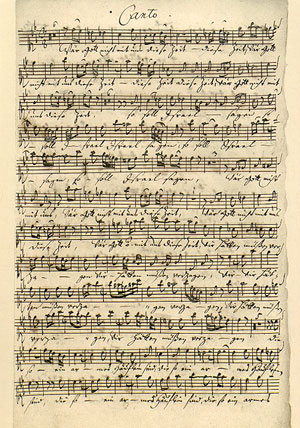
Were God not with us here today
Cantata for the 4th Sunday after Epiphany BWV 14, 1735
Explore
 Additional material
-
 Digital text (without sheet music) incl. printing licence, html file, singing text, english translationhtml file, singing text, english translation (Sample)1 Coro
Were God not with us here today,
2 Aria (Soprano)
when foes so sore assail us,
fainthearted, would we all then say:
“Our courage surely will fail us”;
for we were but a feeble band,
despised by foes on ev’ry hand,
did not thy might avail us.Our own might is far too weak
3 Recitativo (Tenore)
from our foes itself to fend us.
Stood not he, in majesty,
there to foil their tyranny,
soon into atoms they would rend us.Yea, had not God his folk defended,
long, long ago our lives were ended,
for they would tear us limb from limb,
their fury is so fierce and grim.
Our foes would have our blood...
-
Digital text (without sheet music) incl. printing licence, html file, singing text, originalhtml file, singing text, original (Sample)1 Coro
Wär Gott nicht mit uns diese Zeit,
so soll Israel sagen,
wir hätten müssen verzagen,
die so ein armes Häuflein sind,
veracht‘ von so viel Menschenkind,
die an uns setzen alle.
2 Aria (Soprano) Unsre Stärke heißt zu schwach,
3 Recitativo (Tenore)
unserm Feind zu widerstehen.
Stünd uns nicht der Höchste bei,
würd uns ihre Tyrannei
bald bis an das Leben gehen.Ja, hätt es Gott nur zugegeben,
wir wären längst nicht mehr am Leben,
sie rissen uns aus Rachgier hin,
so zornig ist auf uns ihr Sinn.
Es hätt uns ihre Wut...
-
Digital text (without sheet music) incl. printing licence, html file, Introductory text, englishhtml file, Introductory text, english (Sample)Abridged Foreword of the Edition Carus 31.014/03
Ulrich Leisinger
Translation: John CoombsWith the appointment of Johann August Ernesti on the 16th November 1734 as headmaster of the Thomasschule and therefore successor to Matthias Gessner, who had recently received the prestigious appointment as founding rector of the University of Göttingen, the balance of power in the Leipzig Thomasschule altered considerably. As Bach knew since 1731 through his position as second master, the younger Ernesti was far more interested in the sciences than in the fine arts. It must therefore have appeared to Bach all the more important to produce new church compositions which would add lustre to what he considered to be the honourable tradition of the Thomasschule. For the Sundays and feast days of the period between Christmas Day 1734 and Epiphany 1735 he wrote the Christmas Oratorio. Which section of that work was performed on each of the Sundays after Epiphany can no longer be ascertained, but for the Sunday after Epiphany, which in 1735 fell on the 30th January, Bach produced a new, highly ambitious work, the cantata Wär Gott nicht mit uns diese Zeit (Were God not with us here today), BWV 14. This is one of the last of Bach’s
...
-
Digital text (without sheet music) incl. printing licence, html file, Introductory text, germanhtml file, Introductory text, german (Sample)Gekürztes Vorwort der Ausgabe Carus 31.014/03
Ulrich Leisinger
Mit der Wahl von Johann August Ernesti am 16. November 1734 als Rektor der Thomasschule und damit Nachfolger von Matthias Gessner, der kurz zuvor die ehrenvolle Berufung zum Gründungsrektor der Universität Göttingen erhalten hatte, verschoben sich die Kräfteverhältnisse in der Leipziger Thomasschule erheblich. Der jüngere Ernesti war, wie Bach aus dessen Wirken als Konrektor seit 1731 wusste, an den Wissenschaften weit mehr als an den schönen Künsten interessiert. Umso wichtiger musste es Bach daher erscheinen, mit neuen, repräsentativen Kirchenkompositionen aufzuwarten, um den Stellenwert, den die Musik seiner Überzeugung nach an der ehrwürdigen Thomasschule behalten sollte, zu unterstreichen. Für die Sonn- und Festtage der Zeit vom 1. Weihnachtstag 1734 bis zum Epiphaniasfest 1735 ist das Weihnachtsoratorium entstanden. Welche Werke an den ersten Sonntagen nach dem Epiphaniasfest erklungen sind, ist heute nicht mehr auszumachen. Doch schon zum 4. Sonntag nach Epiphanias, der im Jahr 1735 am 30. Januar begangen wurde, trat Bach wiederum mit einem neuen, höchst ambitionierten Werk auf, der Kantate Wär Gott nicht mit uns diese Zeit BWV 14. Das Werk gehört
...
Purchase
Additional product information
-
Composer
Johann Sebastian Bach
| 1685-1750Johann Sebastian Bach is one of the most important composers of Western music history. He came from a widely ramified musical dynasty, which produced numerous musicians and organists in the Thuringian-Saxon area.
Bach vocal
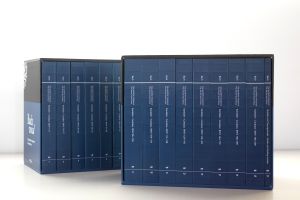
Ever since Carus-Verlag was founded in 1972, publishing the music of Johann Sebastian Bach has been a special focus for us. In the 2017 Reformation anniversary year we completed the Bach vocal project. Bach’s complete sacred vocal works are now available in modern “Urtext” editions, together with performance material. A complete edition of all the full scores is also available in a high quality box set.
Personal details
-
Songwriter / Librettist
Martin Luther
| 1483-1546
-
Translator
Henry Drinker
Reviews on our website can only be submitted by customers with a registered user account. A check whether the rated products were actually purchased does not take place.
No feedback available for this product.
Frequent questions about this work
 There are no questions and answers available so far or you were unable to find an answer to your specific question about this work? Then click here and send your specific questions to our Customer Services!