

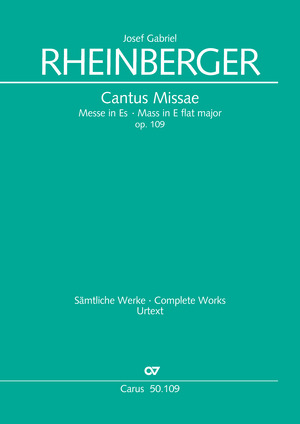
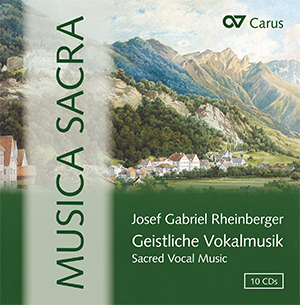
La Messe en mi bémol majeur (Cantus Missae) op. 109 tient une place particulière parmi les 18 messes composées par Rheinberger parce qu’elle est écrite entièrement a cappella et sa structure pour double chœur rappelle l’ancienne technique de composition des chœurs alternés des compositeurs de la Renaissance. Même si Rheinberger marque aussi son intérêt pour la polyphonie vocale de la Renaissance dans cette messe, les parties reposent pourtant sur un socle d’accords dans la tonalité majeure-mineure selon le traité d’harmonie classique. Les modulations subtiles et les successions de notes constituent un défi pour les choristes de chaque registre, malgré la sobriété de l’œuvre.
Il suffit de s'exercer. Partout. A tout moment.
Que ce soit à la maison sur votre tablette ou votre PC ou en déplacement sur votre smartphone : avec carus music, the Choir Coach, vous avez toujours vos œuvres chorales avec vous pour vous entraîner ! Avec l'application chorale de carus music, vous pouvez écouter votre partition ainsi qu'un enregistrement de première qualité sur n'importe quel appareil et vous entraîner facilement à votre propre partie de chœur avec un coach. Avec carus music, la préparation de vos concerts est facile, efficace et amusante à maîtriser !
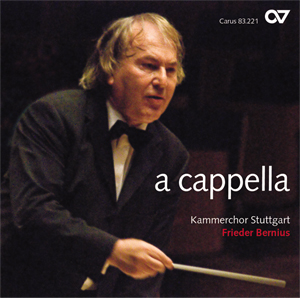
Interprètes: Kammerchor Stuttgart, Ensemble Stuttgart – Frieder Bernius
Découvrir
 Ecouter
(2)
Ecouter
(2)
- Kyrie
- Credo
 Compléments
- Acheter des compléments au format téléchargement.
-
 Texte numérique (sans notes), licence d'impression incluse, fichier html, paroles, traduction en anglaisfichier html, paroles, traduction en anglais (Extrait)Kyrie
Lord, have mercy on us.
Gloria
Christ, have mercy on us.
Lord, have mercy on us.Glory be to God on high
and on earth peace to men of good will.
We praise thee; we bless thee; we adore thee; we glorify thee.
We give thee thanks for thy great glory.
Lord God, heavenly King,
God the almighty Father.
O Lord, the only-begotten Son, Jesus Christ,
O Lord God, Lamb of God,...
-
Texte numérique (sans notes), licence d'impression incluse, fichier html, paroles, traduction allemandefichier html, paroles, traduction allemande (Extrait)Kyrie
Herr, erbarme dich unser.
Gloria
Christus, erbarme dich unser.
Herr, erbarme dich unser.Ehre sei Gott in der Höhe
und Friede auf Erden den Menschen, die guten Willens sind.
Wir loben dich, wir preisen dich, wir beten dich an, wir rühmen dich.
Wir danken dir, denn groß ist deine Herrlichkeit.
Herr und Gott, König des Himmels,
Gott, allmächtiger Vater.
Herr Jesus Christus, eingeborener Sohn,
Herr und Gott, Lamm Gottes,...
-
Texte numérique (sans notes), licence d'impression incluse, fichier html, paroles, originalfichier html, paroles, original (Extrait)Kyrie
Kyrie eleison,
Gloria
Christe eleison,
Kyrie eleison,Gloria in excelsis Deo.
Et in terra pax hominibus bonae voluntatis.
Laudamus te, benedicimus te, adoramus te, glorificamus te,
gratias agimus tibi propter magnam gloriam tuam.
Domine Deus, Rex coelestis,
Deus Pater omnipotens.
Domine Fili unigenite, Jesu Christe.
Domine Deus, Agnus Dei,...
-
Texte numérique (sans notes), licence d'impression incluse, fichier html, Texte introductif, en anglaisfichier html, Texte introductif, en anglais (Extrait)Text from the CD Carus 83.113
Annett Reischert-Bruckmann (1999)
Translation: John CoombsAfter the mid-18th century the place of women in the world of music underwent a remarkable change. Until then women had restricted their music making to a domestic setting, but from the middle of the century onwards they appeared more and more frequently as participants in public performances. Music education for girls was expressly included in the syllabus of schools, and in 1834 singing even became a compulsory subject in the elementary schools in Berlin.
This development led to an increase in the activity of female-voice choirs during the late 19th and early 20th centuries, since composers of repute such as Hector Berlioz, Johannes Brahms, Claude Debussy, Franz Liszt, Gustav Mahler and Giuseppe Verdi wrote works for female-voice choirs. Nevertheless, male-voice choirs still remained predominant. While the number of male-voice
...
-
Texte numérique (sans notes), licence d'impression incluse, fichier html, Texte introductif, en allemandfichier html, Texte introductif, en allemand (Extrait)Booklet-Text der CD Carus 83.113
Annett Reischert-Bruckmann (1999)
Seit Mitte des 18. Jahrhunderts veränderte sich die Stellung der Frau im gesellschaftlichen Musikleben in bemerkenswerter Weise. Hatten sich Frauen bis dahin darauf beschränkt, im häuslichen Kreis zu musizieren, traten sie nun auch als Musikerinnen mehr und mehr an die Öffentlichkeit. Im Lehrplan der Schulen sah man jetzt ausdrücklich Musikerziehung für Mädchen vor, und im Jahre 1834 wurde das Singen nach Noten sowie das Chorsingen an den Elementarschulen Berlins sogar zu Pflichtfächern erhoben.
Diese Entwicklung setzte sich fort in einem Aufschwung des Frauenchorgesangs Ende des 19. und Anfang des 20. Jahrhunderts, als namhafte Komponisten wie Hector Berlioz, Johannes Brahms, Claude Debussy, Franz Liszt, Gustav Mahler und Giuseppe Verdi Werke für Frauenchor verfassten. Dennoch blieb das Männerchorwesen
...
Acheter
Informations complémentaires sur l'œuvre

-
Compositeur
Josef Gabriel Rheinberger
| 1839-1901Josef Gabriel Rheinberger, né en 1839 à Vaduz, mort en 1901 à Munich. Élève de J.G. Herzog, J.J. Maier et Fr. Lachner. Considéré comme l'une des personnalités les plus importantes de l'enseignement du 19e siècle ; a travaillé à partir de 1859 comme professeur à l'école royale de musique de Munich, puis comme professeur de composition et d'orgue ; maître de chapelle de la cour en 1877. De son vaste opus se distinguent les 20 sonates pour orgue ; outre ses œuvres de musique de chambre, ses œuvres chorales sacrées et profanes sont également précieuses. Plus d'information sur la personne
-
Chœur
Kammerchor Stuttgart
The Kammerchor Stuttgart is regarded as one of the best ensembles of its kind. Over its fifty-year existence, Frieder Bernius has developed the choir into an exceptional ensemble acclaimed by audiences and press alike. This has led to invitations for the choir to perform at all the important European festivals. In Germany the chamber choir performs at festivals and in concert halls in repertoire ranging from the 17th to the 21st century. Frieder Bernius and his ensemble have received numerous accolades for their contribution to new music. The Kammerchor Stuttgart has made over 80 CDs and LPs, numerous of which have been awarded international recording prizes (including the Edison award, Diapason d’or, Gramophone Choice, Classical Internet Award, International Classical Music Award, and German Record Critics’ Award prizes). The International Federation for Choral Music has invited the ensemble to sing at the 1st, 4th and 10th World Symposia on Choral Music in Vienna, Sydney and Seoul. Regular tours of North America and Asia since 1988 and a South America tour reflect the Kammerchor Stuttgart’s international reputation. Since 1984 the top ensemble has also been invited to Israel biennially. Plus d'information sur la personne
-
Ensemble
Ensemble Stuttgart
The Ensemble Stuttgart (Ensemble '76) was founded by Wolfgang Rösch in 1976 and is made up of solo players, musicians from Stuttgart orchestras and music students. Its repertoire comprises pieces for chamber orchestra, including the Bach Brandenburg Concertos as well as symphonies by Haydn, Mozart and Schubert, and chamber music, including the sextets of Brahms and Tchaikovsky and the Mendelssohn Octet. In addition it plays contemporary pieces, some of which were written for this ensemble. The Ensemble Stuttgart gives concerts in Germany, France, Italy and Belgium, and has been involved in many CD and radio productions. Plus d'information sur la personne
-
Chef d'orchestre
Frieder Bernius
| 1947Le travail de Frieder Bernius jouit d’une grande reconnaissance à l’échelle mondiale. Il est très sollicité à l’international, tant comme chef d’orchestre que comme professeur. Ses partenaires artistiques sont principalement le Chœur de chambre de Stuttgart, l’Orchestre baroque de Stuttgart, la Hofkapelle de Stuttgart et la Philharmonie classique de Stuttgart. C’est en 1968, avec la création du Chœur de chambre de Stuttgart, qu’il a posé les bases de sa carrière exceptionnelle, qu’il a rapidement fait de cet ensemble l’un des plus éminents de son genre. Qu’il s’agisse d’œuvres vocales de Monteverdi, Bach, Haendel, Mozart, Beethoven, Fauré et Ligeti, de musiques de théâtre de Mendelssohn ou de symphonies de Haydn, Burgmüller et Schubert, le travail de Frieder Bernius vise toujours un son à la fois fidèle à l’idéal sonore original et d’une personnalité incomparable. Il se consacre aussi bien à la redécouverte d’opéras du XVIIIe siècle qu’aux créations de compositions contemporaines. Il porte un intérêt particulier à l’histoire de la musique du sud-ouest de l’Allemagne. Le travail de Frieder Bernius est largement documenté sur disques et CD sous le label Carus. De nombreux enregistrements ont été récompensés par des prix internationaux. Dans le cadre du Festival choral allemand de Stuttgart, Frieder Bernius s’est vu décerner un CD d’or par les éditions Carus pour son intégrale de la musique vocale sacrée de Felix Mendelssohn Bartholdy. Plus d'information sur la personne
Les évaluations sur notre site web ne peuvent être effectuées que par des clients disposant d'un compte d'utilisateur enregistré. Il n'est pas vérifié si les produits évalués ont été effectivement achetés.
Aucune évaluation disponible pour ce produit.
Questions fréquentes sur l'œuvre
 Il n'y a pas encore de questions et réponses concernant cette œuvre ou vous n'avez pas trouvé la réponse à votre question sur l'œuvre ? Cliquez ici et envoyez votre question spécifique à notre service clients.