Les Sept Dernières Paroles du Christ en croix
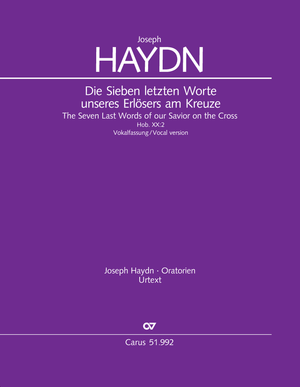
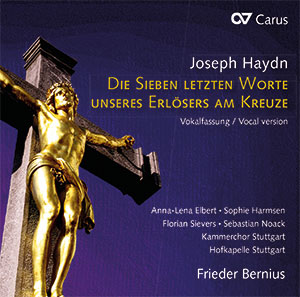
Frieder Bernius et le Kammerchor Stuttgart abordent une des passions les plus intéressantes de l’histoire de la musique : Die Sieben letzten Worte unseres Erlösers am Kreuze (Les sept dernières paroles du Christ en croix) ont dû avoir une importance toute particulière pour Haydn lui-même. Il a en effet réalisé trois versions différentes de cette œuvre et créé la version vocale enregistrée ici comme forme ultime.
Ce nouvel enregistrement avec Anna-Lena Elbert, Sophie Harmsen, Florian Sievers, Sebastian Noack et le Kammerchor Stuttgart sous la direction de Frieder Bernius atteint un niveau d’émotion difficilement égalable.
 Ecouter
(10)
Ecouter
(10)
- Introduzione
- Pater, dimite illis
- Hodie mecum eris in paradiso
- Mulier, ecce Filius tuus
- Deus meus, ut qui dereliquisti me
- Introduzione
- Sitio
- Consummatum est
- In manus tuas, Domine, commende spiritum meum
- Il Terremoto
 Compléments
-
 Texte numérique (sans notes), licence d'impression incluse, fichier html, paroles, originalfichier html, paroles, original (Extrait)Unbenanntes Dokument 1. Pater, dimitte illis
Vater, vergib ihnen, denn sie wissen nicht, was sie tun.
Vater im Himmel, o sieh hernieder vom ewigen Thron!
2. Hodie mecum eris in paradiso
Vater der Liebe, dein Eingeborner, er fleht für Sünder,
für deine Kinder, erhöre den Sohn!
Ach, wir sind tief gefallen, wir sündigten schwer;
doch allen zum Heil, uns allen, floss deines Sohnes Blut.
Das Blut des Lamms schreit nicht um Rach’; es tilgt die Sünden.
Vater der Liebe, lass uns Gnade finden, erhöre den Sohn!
O Vater, o Vater, erhöre den Sohn!Fürwahr, ich sag es dir: Heute wirst du bei mir im Paradiese sein.
Ganz Erbarmen, Gnad’ und Liebe, bist du Mittler, Gotteslamm.
...
-
Texte numérique (sans notes), licence d'impression incluse, fichier html, paroles, traduction en anglaisfichier html, paroles, traduction en anglais (Extrait)Unbenanntes Dokument 1. Pater, dimitte illis
Father of heaven, look down in mercy, in mercy from thy throne!
2. Hodie mecum eris in paradiso
Father, all gracious, thine only Son implores for sinners,
for us thy children, thine only Son.
Ah! Wither are we fallen, how dire’s our offence;
and yet for our salvation thy Jesus sheds his precious blood.
Thy justice claimes this sacrifice, his precious blood for sin it flows.
Father allgracious, look down in mercy and hear thou thy son.
O Father, hear thy Son!
Father of heaven, look down in mercy from thy throne!
Thine only Son implores for sinners. O Father, hear thy Son!Lord of mercy, grace and love, Lord of love and grace and mercy,
...
-
Compositeur
Joseph Haydn
| 1732-1809En tant que maître de chapelle du prince Esterházy, Haydn a créé, outre de nombreuses musiques instrumentales et divers opéras, d'importantes contributions à la musique sacrée, entre autres les quatorze messes en latin, dont seules douze sont authentiques ou achevées, des motets et des offertoires, deux importantes mises en musique du Te Deum, deux Salve Regina, un Stabat Mater ainsi que les différentes versions des Sept Paroles du Sauveur sur la croix. A l'exception des années 1783-1795, les messes ont été composées de manière continue entre 1749 et 1802 et constituent ainsi le genre auquel Haydn s'est consacré le plus longtemps. Les six messes (authentiques ou complètes) composées jusqu'en 1782 sont de styles très différents ; à côté de courtes Missae breves, on trouve également des messes étendues avec un riche effectif orchestral ; en revanche, les six messes dites tardives, composées à partir de 1796, forment un groupe relativement homogène d'œuvres à grand effectif et de grande envergure. Avec ses deux grands oratorios La Création (1798) et Les Saisons (1801), Haydn fonde la tradition de l'oratorio bourgeois allemand. Plus d'information sur la personne
-
Chœur
Kammerchor Stuttgart
The Kammerchor Stuttgart is regarded as one of the best ensembles of its kind. Over its fifty-year existence, Frieder Bernius has developed the choir into an exceptional ensemble acclaimed by audiences and press alike. This has led to invitations for the choir to perform at all the important European festivals. In Germany the chamber choir performs at festivals and in concert halls in repertoire ranging from the 17th to the 21st century. Frieder Bernius and his ensemble have received numerous accolades for their contribution to new music. The Kammerchor Stuttgart has made over 80 CDs and LPs, numerous of which have been awarded international recording prizes (including the Edison award, Diapason d’or, Gramophone Choice, Classical Internet Award, International Classical Music Award, and German Record Critics’ Award prizes). The International Federation for Choral Music has invited the ensemble to sing at the 1st, 4th and 10th World Symposia on Choral Music in Vienna, Sydney and Seoul. Regular tours of North America and Asia since 1988 and a South America tour reflect the Kammerchor Stuttgart’s international reputation. Since 1984 the top ensemble has also been invited to Israel biennially. Plus d'information sur la personne
-
Orchestre
Hofkapelle Stuttgart
La Hofkapelle Stuttgart, créée en 2006 par Frieder Bernius pour compléter le Barockorchester Stuttgart, se consacre au répertoire du 19ème siècle sur des instruments historiques. Un centre de gravité est la redécouverte de trésors de l’histoire de la musique, notamment dans la région du sud-ouest de l’Allemagne (Kalliwoda, Knecht, Holzbauer). Hofkapelle et Barockorchester Stuttgart sont les hôtes réguliers de festivals internationaux (Rome, Salzbourg, Göttingen, Dresde). Leurs productions pour le CD se sont vues décerner des prix à plusieurs reprises : la Missa Dei Patris de Jan Dismas Zelenka a été nominée pour le Cannes Classical Award, la musique de scène du Songe d’une Nuit d’été de Félix Mendelssohn Bartholdy d’après Shakespeare a été distinguée par Rondo et a remporté l’Étoile du mois de la revue Fono Forum. Le Requiem de W.A. Mozart a obtenu le Diapason d’or de l’année 2003, l’opéra de Johann Gottlieb Naumann Aci e Galatea a été nommé enregistrement d’opéra de l’année dans la revue spécialisée Opernwelt, l’Oratorio de Pâques de Bach figure dans la liste des meilleurs enregistrements du prix de la Critique allemande du disque. L’enregistrement de la Messe en si mineur de Bach a été editors choice de la revue Gramophone. Plus d'information sur la personne
-
Chef d'orchestre
Frieder Bernius
| 1947Le travail de Frieder Bernius jouit d’une grande reconnaissance à l’échelle mondiale. Il est très sollicité à l’international, tant comme chef d’orchestre que comme professeur. Ses partenaires artistiques sont principalement le Chœur de chambre de Stuttgart, l’Orchestre baroque de Stuttgart, la Hofkapelle de Stuttgart et la Philharmonie classique de Stuttgart. C’est en 1968, avec la création du Chœur de chambre de Stuttgart, qu’il a posé les bases de sa carrière exceptionnelle, qu’il a rapidement fait de cet ensemble l’un des plus éminents de son genre. Qu’il s’agisse d’œuvres vocales de Monteverdi, Bach, Haendel, Mozart, Beethoven, Fauré et Ligeti, de musiques de théâtre de Mendelssohn ou de symphonies de Haydn, Burgmüller et Schubert, le travail de Frieder Bernius vise toujours un son à la fois fidèle à l’idéal sonore original et d’une personnalité incomparable. Il se consacre aussi bien à la redécouverte d’opéras du XVIIIe siècle qu’aux créations de compositions contemporaines. Il porte un intérêt particulier à l’histoire de la musique du sud-ouest de l’Allemagne. Le travail de Frieder Bernius est largement documenté sur disques et CD sous le label Carus. De nombreux enregistrements ont été récompensés par des prix internationaux. Dans le cadre du Festival choral allemand de Stuttgart, Frieder Bernius s’est vu décerner un CD d’or par les éditions Carus pour son intégrale de la musique vocale sacrée de Felix Mendelssohn Bartholdy. Plus d'information sur la personne
-
Solist - soprano
Anna-Lena Elbert
-
Solist - alto
Sophie Harmsen
-
Solist - ténor
Florian Sievers
-
Solist - basse
Sebastian Noack
The baritone Sebastian Noack was born in Berlin and studied singing with Dietmar Hackel, Ingrid Figur and Dietrich Fischer-Dieskau. He became known after being awarded 1st prize at the Bundeswettbewerb Gesang; other prizes followed. Since then he has made a name for himself, particularly as a concert singer, performing under renowned conductors such as Frieder Bernius, Marcus Creed, Christoph Eschenbach, and Roy Goodman. His repertoire includes all of the significant oratorios from the Renaissance to the present time. On numerous tours he has travelled through all of Europe, the USA and Southeast Asia. He is a welcome guest at international festivals. Noack sings with the large broadcasting networks and well-known Baroque orchestras as well as with chamber music ensembles, e.g., the Sharoun Ensemble or Sabine Meyer’s Trio di Clarone. He has participated in CD productions under Philippe Herreweghe and Andreas Spering. Noack is particularly interested in lieder. Together with the pianist Manuel Lange, he founded the new concert series “Meisterlied im Musikinstrumenten-Museum”, for which – in addition to his own recitals – he has already been able to engage renowned guests. After having previ - ously performed concertante or semi-scenic operas, Noack made his stage debut in Donizetti’s Viva la Mamma at the Berlin State Opera in June 2009. He is a visit ing professor at the Hochschule für Musik Hanns Eisler in Berlin. Plus d'information sur la personne
Critiques
This is a cool, immaculate performance in which every element is perfectly balanced and every phrase neatly turned.
Choir & Organ, November 2022, Vol. 30, Nr. 9
Der Kammerchor Stuttgart präsentiert sich in seiner üblichen Klangschönheit und Ausdrucksstärke, die Interpretation, angeleitet von Frieder Bernius, zeugt von starker Auseinandersetzung mit dem Inhalt des Werk...
Singende Kirche, Sept 2022, Heft 3, 69. Jahrgang
Das gelingt hier alles ganz hervorragend, durch allseitig schlanke Tongebung und vor allem durch die weite Verteilung metrischer Schwerpunkte.
CHOR aktuell, Juni 2022
...erreicht eine kaum zu übertreffende Emotionalität.
Kirche in Bistum Aachen, April 2022
Klassiknews, März 2022
Les évaluations sur notre site web ne peuvent être effectuées que par des clients disposant d'un compte d'utilisateur enregistré. Il n'est pas vérifié si les produits évalués ont été effectivement achetés.
Questions fréquentes sur l'œuvre
 Il n'y a pas encore de questions et réponses concernant cette œuvre ou vous n'avez pas trouvé la réponse à votre question sur l'œuvre ? Cliquez ici et envoyez votre question spécifique à notre service clients.