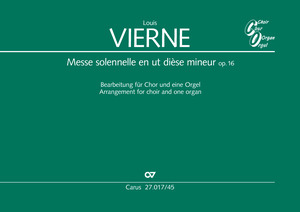
Messe solennelle en ut dièse mineur
op. 16
La Messe solennelle op. 16 pour chœur mixte et deux orgues de Louis Vierne fut composée en 1899. Lors de sa création à St. Sulpice en décembre 1901, Charles-Marie Widor était à l'orgue principal et Vierne à l'orgue du chœur. Cette œuvre compte parmi les sommets du genre de la messe avec orgue du romantisme tardif, et est de plus agréable à chanter pour le chœur.
La présente édition s'appuie sur la première édition parue à Paris en 1900 chez Pérégally & Fils. Pour des raisons pratiques – la version avec deux orgues est difficilement réalisable – l'éditeur propose en plus de l'édition originale (éd. Jon Laukvik) un arrangement pour chœur et orgue de Zsigmond Szathmáry.
La présente édition s'appuie sur la première édition parue à Paris en 1900 chez Pérégally & Fils. Pour des raisons pratiques – la version avec deux orgues est difficilement réalisable – l'éditeur propose en plus de l'édition originale (éd. Jon Laukvik) un arrangement pour chœur et orgue de Zsigmond Szathmáry.



Acheter
Informations complémentaires sur l'œuvre
-
Compositeur
Louis Vierne
| 1870-1937Louis Vierne, who was from birth practically blind with cataracts, received his first piano instruction at the early age of six. His first moving encounter with the sound of a church organ also dates from this time. From October 1880 he studied with the blind piano teacher, Louis Specht, who taught at the Institution Nationale des Jeunes Aveugles (National Institute for Young Blind People) in Paris. When Vierne first heard César Franck (later his teacher at the Conservatoire for a short time) at the organ of Sainte-Clotilde, it was a profound experience for him: “I was left speechless and went into a kind of ecstasy.” Following the death of César Franck, it was Charles-Marie Widor who continued to further his development as an organist. In 1892 he appointed him as his assistant at the great Cavaillé-Coll organ in Saint-Sulpice. Although he was passed over several times when applying for positions as organist, in May 1900 he was unanimously elected by a prominent jury as organist of Notre Dame Cathedral, a position he held until the day he died. Travelling was a burden to him, but despite this in the 1920s he went on concert tours of Europe, Canada and the USA, where he was acclaimed as a composer and organist. He used these trips to collect contributions for the maintenance and rebuilding of his organ at Notre Dame. On 2 June 1937 Vierne presented an organ concert in Notre Dame together with Maurice Duruflé. As he was about to begin an improvisation he suffered a heart attack from which he died soon after. The funeral service was held in Notre Dame Cathedral on 5 June - his organ remained silent. // Complete Organ Works, see Carus 18.150 Plus d'information sur la personne
-
Éditeur
Jon Laukvik
| 1952
Les évaluations sur notre site web ne peuvent être effectuées que par des clients disposant d'un compte d'utilisateur enregistré. Il n'est pas vérifié si les produits évalués ont été effectivement achetés.
Aucune évaluation disponible pour ce produit.
Questions fréquentes sur l'œuvre
 Il n'y a pas encore de questions et réponses concernant cette œuvre ou vous n'avez pas trouvé la réponse à votre question sur l'œuvre ? Cliquez ici et envoyez votre question spécifique à notre service clients.