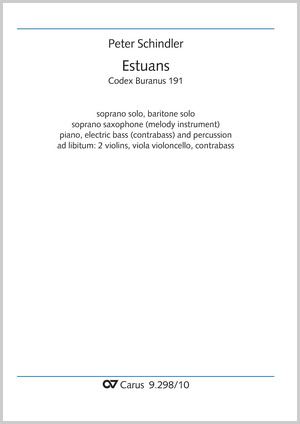
Composer Peter Schindler on this separate edition from Perpetuum mobile:
The text “Estuans intrinsecus” (no. 191 in the Codex Buranus) is attributed to a poet whose name has come down to us as Archipoeta. The “arch-poet” was born between 1125 and 1135 and died some time after 1165. Archipoeta was an important Latin-language poet of the twelfth century and a representative of goliardic or wandering poetry. His songs were widespread in the Middle Ages. To this day “Estuans intrinsecus” (Blazing within) is one of the most famous secular texts in the Codex Buranus, where the original song is a whole twenty-five verses long! It imitates or parodies the form of confession, which is why it is also known as the vagrant's confession. It is a masterful poem that can be interpreted in many ways. Is the inner conflict the expression of someone in despair? Or do the verses reveal a free thinker in a cultivated, witty game where he wasn’t taking seriously the strict moral teachings of his time? Is it irony or honest remorse?
Conceived as a duet between man and woman, the flowing song is not self-accusing, but should be interpreted with the self-confident attitude, “It can't be bad to live my life according to my own nature.” Centuries later, Lessing said: “It is no crime to have loved; it’s even less a crime to have been loved.” And lyricist Bruno Balz, then an unknown world star, triggered a very similar discussion with his 1938 hit film Kann denn Liebe Sünde sein? (Can love be a sin?)
Découvrir


 Ecouter
(1)
Ecouter
(1)
- Estuans
Acheter
Informations complémentaires sur l'œuvre
-
Compositeur
Peter Schindler
| 1960Peter Schindler a étudié la musique scolaire, la composition et l'orgue ainsi que le jazz et la musique populaire à la Musikhochschule de Stuttgart. Parmi ses œuvres, on trouve des chansons, des pièces instrumentales, des œuvres religieuses, de la musique pour ballet et théâtre ainsi que des comédies musicales, des pièces de chant et des chansons pour enfants et adolescents. En tant qu'organiste et pianiste, il joue avec différents ensembles et interprètes, principalement ses propres compositions, en Allemagne et à l'étranger. Des tournées de concerts avec le quintette Saltacello qu'il a fondé et le groupe Pipes and Phones l'ont conduit en Chine, au Danemark, en France, en Italie, en Corée, en Autriche, en Pologne, en Scandinavie, à Taiwan, en République tchèque ainsi qu'en Suisse et aux États-Unis. Il a enregistré et publié de nombreux morceaux en tant que soliste ou en collaboration avec différents partenaires.
Pour plus d'informations, consultez le site www.peter-schindler.de.
Nous avons posé 6 questions au compositeur, à lire ici sur notre blog (en anglais) : https://blog.carus-verlag.com/en/personalities/5-questions-for-peter-schindler/
Plus d'information sur la personne
Les évaluations sur notre site web ne peuvent être effectuées que par des clients disposant d'un compte d'utilisateur enregistré. Il n'est pas vérifié si les produits évalués ont été effectivement achetés.
Aucune évaluation disponible pour ce produit.
Questions fréquentes sur l'œuvre
 Il n'y a pas encore de questions et réponses concernant cette œuvre ou vous n'avez pas trouvé la réponse à votre question sur l'œuvre ? Cliquez ici et envoyez votre question spécifique à notre service clients.