
Composer Peter Schindler on this separate edition from Perpetuum mobile:
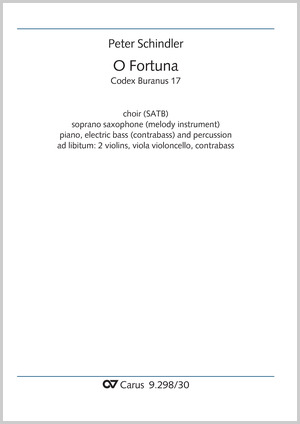
“O Fortuna” (text no. 17 in the Codex Buranus) is a rhythmic strophic song. The text has been world famous since Carl Orff used it at the beginning of his work Carmina Burana in 1935. At the time it was still assumed that the manuscript began with this text and the miniature illumination of the Wheel of Fortune. This error was later corrected, when it was established that the original order of the manuscript's 112 parchment pages had been disturbed over the centuries.
The famous miniature of the wheel of fortune is decorated with a rhymed hexameter: “regnabo, regno, regnavi, sum sine regno” (I will rule, I rule, I have ruled, I am without dominion). This incisive illustration with Fortuna, the mistress of the world (Imperatrix mundi) in the center, was originally to be found in the middle of the group of moral-satirical poems.
In the poem, the rotating wheel of the goddess Fortuna is allegorically represented in the first stanza by the moon with its changing phases. By the next stanza the poem is already taking the form of a personal lament. In the third stanza there is a call to join in the grief over the unlucky fallen ones, a typical feature of laments. The accentuated and receding setting in a marking of allegro con bravura expresses the constant changes, circling, drifting and succeeding phases of world events.
Découvrir


 Ecouter
(1)
Ecouter
(1)
- O Fortuna
Acheter
Informations complémentaires sur l'œuvre
-
Compositeur
Peter Schindler
| 1960Peter Schindler a étudié la musique scolaire, la composition et l'orgue ainsi que le jazz et la musique populaire à la Musikhochschule de Stuttgart. Parmi ses œuvres, on trouve des chansons, des pièces instrumentales, des œuvres religieuses, de la musique pour ballet et théâtre ainsi que des comédies musicales, des pièces de chant et des chansons pour enfants et adolescents. En tant qu'organiste et pianiste, il joue avec différents ensembles et interprètes, principalement ses propres compositions, en Allemagne et à l'étranger. Des tournées de concerts avec le quintette Saltacello qu'il a fondé et le groupe Pipes and Phones l'ont conduit en Chine, au Danemark, en France, en Italie, en Corée, en Autriche, en Pologne, en Scandinavie, à Taiwan, en République tchèque ainsi qu'en Suisse et aux États-Unis. Il a enregistré et publié de nombreux morceaux en tant que soliste ou en collaboration avec différents partenaires.
Pour plus d'informations, consultez le site www.peter-schindler.de.
Nous avons posé 6 questions au compositeur, à lire ici sur notre blog (en anglais) : https://blog.carus-verlag.com/en/personalities/5-questions-for-peter-schindler/
Plus d'information sur la personne
Les évaluations sur notre site web ne peuvent être effectuées que par des clients disposant d'un compte d'utilisateur enregistré. Il n'est pas vérifié si les produits évalués ont été effectivement achetés.
Aucune évaluation disponible pour ce produit.
Questions fréquentes sur l'œuvre
 Il n'y a pas encore de questions et réponses concernant cette œuvre ou vous n'avez pas trouvé la réponse à votre question sur l'œuvre ? Cliquez ici et envoyez votre question spécifique à notre service clients.