

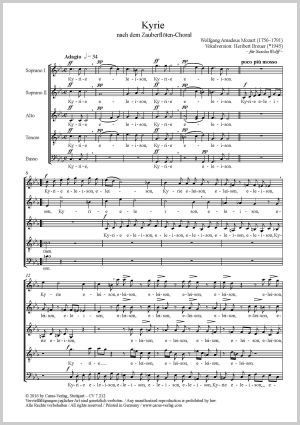
Kyrie, Agnus Dei (Vokalversionen arr. Breuer)
From the outset my two vocal versions of Mozart orchestral works were conceived as twins. Both models shared not only key of C minor, but the fact that they were composed towards the end of Mozart’s life seemed to suggest they were predestined to be arranged as a pair; and finally, their formal structure and, above all, the quotation of a cantus firmus in each piece seemed to bind these two works together. It was more difficult to consider which text was now suitable to render vocally what previously was an orchestral movement. Naturally it should stand out and textually the movement should be raised to another level. The answer was to use another language here. Therefore, I chose the texts “Kyrie eleison” and “Agnus Dei,” i.e., the opening and concluding texts of the Ordinary of the Mass. For a performance of both vocal versions in concert I suggest joining them by playing Mozart‘s great F minor Fantasy K. 608 as an instrumental intermezzo between them. (Heribert Breuer)
Kyrie: Vocal arrangement of the Choral of the "Zauberflöte"
Agnus Dei: Vocal arrangement of "Maurerische Trauermusik" KV 477
Découvrir
 Consulter

Acheter
Informations complémentaires sur l'œuvre
Sommaire
-
Compositeur
Wolfgang Amadeus Mozart
| 1756-1791Fils du vice-maître de chapelle du prince-archevêque de Salzbourg, Mozart a été constamment entouré de musique sacrée dès sa jeunesse. Au cours de ses voyages, Mozart découvrit la musique sacrée italienne, et plus tard, à Vienne, il étudia les œuvres de Bach et de Haendel. Après son installation à Vienne, il se lance de nouveaux défis avec l'opéra et le concerto pour piano. Il est significatif que la « Messe en ut mineur » KV 427, la plus grande œuvre de musique sacrée des premières années viennoises, reste inachevée. La dernière période de sa vie montre à nouveau une orientation vers la musique sacrée : Mozart postule avec succès pour succéder à Leopold Hoffmann, malade à l'article de la mort, en tant que maître de chapelle à la cathédrale Saint-Étienne, mais il ne peut pas prendre le poste, car il meurt avant Hoffmann. Un joyau comme l'« Ave verum » KV 618 et le Requiem KV 626, resté inachevé, laissent entrevoir ce que Mozart aurait encore pu accomplir en tant que compositeur d'église s'il était parvenu à ce poste à responsabilité. Plus d'information sur la personne
Les évaluations sur notre site web ne peuvent être effectuées que par des clients disposant d'un compte d'utilisateur enregistré. Il n'est pas vérifié si les produits évalués ont été effectivement achetés.
Aucune évaluation disponible pour ce produit.
Questions fréquentes sur l'œuvre
 Il n'y a pas encore de questions et réponses concernant cette œuvre ou vous n'avez pas trouvé la réponse à votre question sur l'œuvre ? Cliquez ici et envoyez votre question spécifique à notre service clients.