

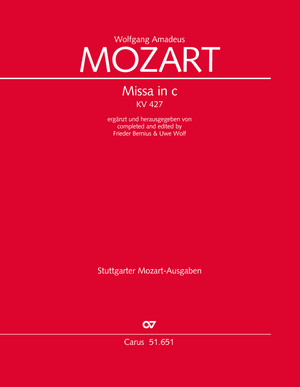
Missa in c (version Bernius/Wolf)
édité et complété par Frieder Bernius & Uwe Wolf KV 427
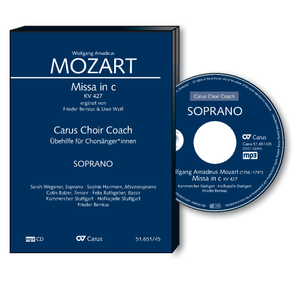
La Missa in c KV 427 de Wolfgang Amadeus Mozart est fascinante. Le seul fait de parler de « la » Messe est inexact, puisque au fond il ne s'agit pas d'autre chose qu'une ébauche musicale, pleine de mystères et de problèmes, et pleine de musique fantastique.
Depuis le XIXe siècle, on tente de rendre l'œuvre inachevée de Mozart exécutable. Selon la date de création et le parcours de l'arrangeur, ces reconstitutions sont très différentes. La marque personnelle de chaque arrangeur est souvent manifeste. Frieder Bernius et Uwe Wolf viennent de présenter une nouvelle édition de la Messe de Mozart, qui essaye de permettre sa représentation dans un grand respect du matériel existant, sans masquer le style musical de Mozart avec leur propre contribution. La version commune d'Uwe Wolf, musicologue renommé, et de Frieder Bernius, expert de l'interprétation documentée, se base sur une connaissance approfondie des compositions de Mozart, de ses habitudes de notation et de la pratique de la musique d'église à l'époque de Mozart. Elle correspond aussi parfaitement aux exigences de la pratique musicale d'aujourd'hui.
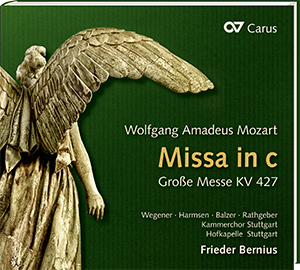
En plus de la partition de direction cartonnée, une version reliée (toile) est disponible, contenant en plus un ensemble de fac-similés avec une sélection de reproduction des sources. Le premier enregistrement avec le Kammerchor de Stuttgart et le Barockorchester de Stuttgart sous la direction de Frieder Bernius est disponible.
Découvrir
 Consulter


 Ecouter
(13)
Ecouter
(13)
 S`exercer
-
 carus music, the Choir Coach
Üben mit carus music
carus music, the Choir Coach
Üben mit carus music
-
Aides à l'apprentissage
-
Aides à l'apprentissage voix soprano
- Kyrie (Choir Coach)
- Kyrie (Choir Coach, Slow mode)
- Gloria (Choir Coach)
- Gloria (Choir Coach, Slow mode)
- Gratias (Choir Coach, soprano 1)
- Gratias (Choir Coach, soprano 2)
- Gratias (Choir Coach, Slow mode, soprano 1)
- Gratias (Choir Coach, Slow mode, soprano 2)
- Qui tollis (Choir Coach, soprano 1)
- Qui tollis (Choir Coach, soprano 2)
- Qui tollis (Choir Coach, Slow mode, soprano 1)
- Qui tollis (Choir Coach, Slow mode, soprano 2)
- Jesu Christe, Cum Sancto Spiritu (Choir Coach)
- Jesu Christe, Cum Sancto Spiritu (Choir Coach, Slow mode)
- Credo (Choir Coach, soprano 1)
- Credo (Choir Coach, soprano 2)
- Credo (Choir Coach, Slow mode, soprano 1)
- Credo (Choir Coach, Slow mode, soprano 2)
- Sanctus, Hosanna (Choir Coach, soprano 1)
- Sanctus, Hosanna (Choir Coach, soprano 2)
- Sanctus, Hosanna (Choir Coach, Slow mode, soprano 1)
- Sanctus, Hosanna (Choir Coach, Slow mode, soprano 2)
- Benedictus, Hosanna (Choir Coach, soprano 1)
- Benedictus, Hosanna (Choir Coach, soprano 2)
- Benedictus, Hosanna (Choir Coach, Slow mode, soprano 1)
- Benedictus, Hosanna (Choir Coach, Slow mode, soprano 2)
-
Aides à l'apprentissage voix alto
- Kyrie (Choir Coach)
- Kyrie (Choir Coach, Slow mode)
- Gloria (Choir Coach)
- Gloria (Choir Coach, Slow mode)
- Gratias (Choir Coach)
- Gratias (Choir Coach, Slow mode)
- Qui tollis (Choir Coach, Alto 1)
- Qui tollis (Choir Coach, Alto 2)
- Qui tollis (Choir Coach, Slow mode, Alto 1)
- Qui tollis (Choir Coach, Slow mode, Alto 2)
- Jesu Christe, Cum Sancto Spiritu (Choir Coach)
- Jesu Christe, Cum Sancto Spiritu (Choir Coach, Slow mode)
- Credo (Choir Coach)
- Credo (Choir Coach, Slow mode)
- Sanctus, Hosanna (Choir Coach, Alto 1)
- Sanctus, Hosanna (Choir Coach, Alto 2)
- Sanctus, Hosanna (Choir Coach, Slow mode, Alto 1)
- Sanctus, Hosanna (Choir Coach, Slow mode, Alto 2)
- Benedictus, Hosanna (Choir Coach, Alto 1)
- Benedictus, Hosanna (Choir Coach, Slow mode, Alto 1)
- Benedictus, Hosanna (Choir Coach, Alto 2)
- Benedictus, Hosanna (Choir Coach, Slow mode, Alto 2)
-
Aides à l'apprentissage voix tenore
- Kyrie (Choir Coach)
- Kyrie (Choir Coach, Slow mode)
- Gloria (Choir Coach)
- Gloria (Choir Coach, Slow mode)
- Gratias (Choir Coach)
- Gratias (Choir Coach, Slow mode)
- Qui tollis (Choir Coach, Tenore 1)
- Qui tollis (Choir Coach, Tenore 2)
- Qui tollis (Choir Coach, Slow mode, Tenore 1)
- Qui tollis (Choir Coach, Slow mode, Tenore 2)
- Jesu Christe, Cum Sancto Spiritu (Choir Coach)
- Jesu Christe, Cum Sancto Spiritu (Choir Coach, Slow mode)
- Credo (Choir Coach)
- Credo (Choir Coach, Slow mode)
- Sanctus, Hosanna (Choir Coach, Tenore 1)
- Sanctus, Hosanna (Choir Coach, Tenore 2)
- Sanctus, Hosanna (Choir Coach, Slow mode, Tenore 1)
- Sanctus, Hosanna (Choir Coach, Slow mode, Tenore 2)
- Benedictus, Hosanna (Choir Coach, Tenore 1)
- Benedictus, Hosanna (Choir Coach, Tenore 2)
- Benedictus, Hosanna (Choir Coach, Slow mode, Tenore 1)
- Benedictus, Hosanna (Choir Coach, Slow mode, Tenore 2)
-
Aides à l'apprentissage voix basse
- Kyrie (Choir Coach)
- Kyrie (Choir Coach, Slow mode)
- Gloria (Choir Coach)
- Gloria (Choir Coach, Slow mode)
- Gratias (Choir Coach)
- Gratias (Choir Coach, Slow mode)
- Qui tollis (Choir Coach, Basse 1)
- Qui tollis (Choir Coach, Basse 2)
- Qui tollis (Choir Coach, Slow mode, Basse 1)
- Qui tollis (Choir Coach, Slow mode, Basse 2)
- Jesu Christe, Cum Sancto Spiritu (Choir Coach)
- Jesu Christe, Cum Sancto Spiritu (Choir Coach, Slow mode)
- Credo (Choir Coach)
- Credo (Choir Coach, Slow mode)
- Sanctus, Hosanna (Choir Coach, Basse 1)
- Sanctus, Hosanna (Choir Coach, Basse 2)
- Sanctus, Hosanna (Choir Coach, Slow mode, Basse 1)
- Sanctus, Hosanna (Choir Coach, Slow mode, Basse 2)
- Benedictus, Hosanna (Choir Coach, Basse 1)
- Benedictus, Hosanna (Choir Coach, Basse 2)
- Benedictus, Hosanna (Choir Coach, Slow mode, Basse 1)
- Benedictus, Hosanna (Choir Coach, Slow mode, Basse 2)
-
 Compléments
- Acheter des compléments au format téléchargement.
-
 Texte numérique (sans notes), licence d'impression incluse, fichier html, paroles, traduction en anglaisfichier html, paroles, traduction en anglais (Extrait)Kyrie 1. Kyrie (Solo S, Coro SATB)
Lord, have mercy on us.
Gloria 2. Gloria (Coro SATB)
Christ, have mercy on us.
Lord, have mercy on us.Glory be to God on high.
3. Laudamus te (Solo S)
And on earth peace to men of good will.We praise thee; we bless thee; we adore thee; we glorify thee.
4. Gratias (Coro SSATB)We give thee thanks for thy great glory.
...
-
Texte numérique (sans notes), licence d'impression incluse, fichier html, paroles, traduction allemandefichier html, paroles, traduction allemande (Extrait)Kyrie 1. Kyrie (Solo S, Coro SATB)
Herr, erbarme dich unser.
Gloria 2. Gloria (Coro SATB)
Christus, erbarme dich unser.
Herr, erbarme dich unser.Ehre sei Gott in der Höhe.
3. Laudamus te (Solo S)
Und Friede auf Erden den Menschen, die guten Willens sind.Wir loben dich, wir preisen dich, wir beten dich an, wir rühmen dich.
4. Gratias (Coro SSATB)Wir danken dir, denn groß ist deine Herrlichkeit.
...
-
Texte numérique (sans notes), licence d'impression incluse, fichier html, paroles, originalfichier html, paroles, original (Extrait)Kyrie 1. Kyrie (Solo S, Coro SATB)
Kyrie eleison.
Gloria 2. Gloria (Coro SATB)
Christe eleison.
Kyrie eleison.Gloria in excelsis Deo.
3. Laudamus te (Solo S)
Et in terra pax hominibus bonae voluntatis.Laudamus te. Benedicimus te. Adoramus te. Glorificamus te.
4. Gratias (Coro SSATB)Gratias agimus tibi propter magnam gloriam tuam.
...
-
Texte numérique (sans notes), licence d'impression incluse, fichier html, Texte introductif, en anglaisfichier html, Texte introductif, en anglais (Extrait)Text from the CD Carus 83.284
Uwe Wolf
Translation: Elizabeth RobinsonWhat a story! Mozart makes a vow to compose a mass after the successful birth of his first-born child. The performance is planned on the occasion of his first journey with his wife to Salzburg so he can introduce her to his family – both personally and musically, for Constanze is to sing one of the demanding soprano parts. But the baby, left behind with a wet-nurse in Vienna, then dies, and Mozart stops work on the composition – precisely at the Et incarnatus est, one of the most beautiful and heartfelt movements by Mozart, dealing with the subject of the incarnation, that is, birth. Too much of a coincidence? Probably.
But there is some truth in this touching, very personal story. A letter from Mozart to his father in January 1783, the only document from the time of the composition of the Mass which refers to the vow, is anything but clear – and consequently any connection between the C Minor Mass and the birth of little Raimund Leopold (17.6.1783–19.8.1783) is frequently questioned. But various later statements by Constanze Mozart (who survived her husband by more than 50 years) regularly repeat this story over a long period of time. It is mentioned in
...
-
Texte numérique (sans notes), licence d'impression incluse, fichier html, Texte introductif, en allemandfichier html, Texte introductif, en allemand (Extrait)Booklet-Text der CD Carus 83.284
Uwe Wolf
Was für eine Geschichte! Mozart legt das Gelübde ab, nach der glücklich überstandenen Geburt seines Erstgeborenen eine Messe zu komponieren. Die Aufführung ist geplant anlässlich der ersten Reise mit seiner Frau nach Salzburg, um diese seiner Familie vorzustellen – auch musikalisch, denn eine der anspruchsvollen Sopranpartien soll Constanze singen. Doch dann stirbt das bei einer Amme in Wien zurückgelassene Baby und Mozart bricht die Komposition ab – genau im Et incarnatus est, einer der schönsten, innigsten Sätze Mozarts, in dem es auch noch ausgerechnet um die Menschwerdung, also Geburt geht! Zu passend, um wahr zu sein? Wahrscheinlich.
Doch etwas ist dran an dieser rührenden, ganz persönlichen Geschichte. Ein Brief Mozarts an seinen Vater vom Januar 1783, das einzige Dokument für das Gelöbnis aus der Entstehungszeit der Messe selbst, ist alles andere als eindeutig – und folglich wird jener Zusammenhang zwischen der c-Moll-Messe und der Geburt des kleinen Raimund Leopold (17.6.1783–19.8.1783) regelmäßig in Zweifel gezogen. Doch diverse spätere Äußerungen Constanze Mozarts (die ihren Mann um mehr als 50 Jahre überlebte) wiederholen über einen langen Zeitraum diese
...
Acheter
Informations complémentaires sur l'œuvre
Sommaire

-
Compositeur
Wolfgang Amadeus Mozart
| 1756-1791Fils du vice-maître de chapelle du prince-archevêque de Salzbourg, Mozart a été constamment entouré de musique sacrée dès sa jeunesse. Au cours de ses voyages, Mozart découvrit la musique sacrée italienne, et plus tard, à Vienne, il étudia les œuvres de Bach et de Haendel. Après son installation à Vienne, il se lance de nouveaux défis avec l'opéra et le concerto pour piano. Il est significatif que la « Messe en ut mineur » KV 427, la plus grande œuvre de musique sacrée des premières années viennoises, reste inachevée. La dernière période de sa vie montre à nouveau une orientation vers la musique sacrée : Mozart postule avec succès pour succéder à Leopold Hoffmann, malade à l'article de la mort, en tant que maître de chapelle à la cathédrale Saint-Étienne, mais il ne peut pas prendre le poste, car il meurt avant Hoffmann. Un joyau comme l'« Ave verum » KV 618 et le Requiem KV 626, resté inachevé, laissent entrevoir ce que Mozart aurait encore pu accomplir en tant que compositeur d'église s'il était parvenu à ce poste à responsabilité. Plus d'information sur la personne
-
Éditeur
Uwe Wolf
| 1961Uwe Wolf est un musicologue spécialisé dans les 17e et 18e siècles. Ses domaines de travail s'étendent de l'époque de Monteverdi et de Schütz au classicisme viennois en passant par Bach et la génération des fils et élèves de Bach. Depuis octobre 2011, il dirige le lectorat de la maison d'édition Carus. Auparavant, il a travaillé pendant plus de 20 ans dans la recherche sur Bach. Plus d'information sur la personne
-
Éditeur
Frieder Bernius
| 1947Frieder Bernius’s work has earned great worldwide recognition. He is in demand internationally as a conductor and as a teacher. His principal artistic collaborators are the ensembles he founded himself, the Kammerchor Stuttgart, the Barockorchester Stuttgart, the Hofkapelle Stuttgart and the Klassische Philharmonie Stuttgart. As a guest conductor, he has collaborated repeatedly with, for example, the SWR Vokalensemble Stuttgart, the Deutsche Kammerphilharmonie Bremen, the Stuttgarter Kammerorchester and the Streicherakademie Bozen. Great stylistic versatility is Frieder Bernius’s hallmark. Whether he conducts vocal works by Monteverdi, Bach, Händel, Mozart, Beethoven, Fauré and Ligeti, stage music by Mendelssohn or symphonies by Haydn, Burgmüller and Schubert, his work always aims for a sound that is at once unmistakably personal and at the same time oriented towards the original period sound ideal. He devotes himself equally to the rediscovery of 18th century operas and to first performances of contemporary compositions. He is particularly interested in the musical history of southwestern Germany. Carus-Verlag has awarded Frieder Bernius a Golden CD for his complete recording of the sacred music of Felix Mendelssohn Bartholdy. The award was presented to him during the German Choir Festival in Stuttgart 2016. The sale of over 250,000 recordings, which has been acclaimed with a number of awards, has made a not insignificant contribution to what today is the obvious presence of Mendelssohn's complete œuvre in the concert repertoire. Plus d'information sur la personne
-
Arrangeur
Uwe Wolf
| 1961Uwe Wolf est un musicologue spécialisé dans les 17e et 18e siècles. Ses domaines de travail s'étendent de l'époque de Monteverdi et de Schütz au classicisme viennois en passant par Bach et la génération des fils et élèves de Bach. Depuis octobre 2011, il dirige le lectorat de la maison d'édition Carus. Auparavant, il a travaillé pendant plus de 20 ans dans la recherche sur Bach. Plus d'information sur la personne
-
Arrangeur
Frieder Bernius
| 1947Frieder Bernius’s work has earned great worldwide recognition. He is in demand internationally as a conductor and as a teacher. His principal artistic collaborators are the ensembles he founded himself, the Kammerchor Stuttgart, the Barockorchester Stuttgart, the Hofkapelle Stuttgart and the Klassische Philharmonie Stuttgart. As a guest conductor, he has collaborated repeatedly with, for example, the SWR Vokalensemble Stuttgart, the Deutsche Kammerphilharmonie Bremen, the Stuttgarter Kammerorchester and the Streicherakademie Bozen. Great stylistic versatility is Frieder Bernius’s hallmark. Whether he conducts vocal works by Monteverdi, Bach, Händel, Mozart, Beethoven, Fauré and Ligeti, stage music by Mendelssohn or symphonies by Haydn, Burgmüller and Schubert, his work always aims for a sound that is at once unmistakably personal and at the same time oriented towards the original period sound ideal. He devotes himself equally to the rediscovery of 18th century operas and to first performances of contemporary compositions. He is particularly interested in the musical history of southwestern Germany. Carus-Verlag has awarded Frieder Bernius a Golden CD for his complete recording of the sacred music of Felix Mendelssohn Bartholdy. The award was presented to him during the German Choir Festival in Stuttgart 2016. The sale of over 250,000 recordings, which has been acclaimed with a number of awards, has made a not insignificant contribution to what today is the obvious presence of Mendelssohn's complete œuvre in the concert repertoire. Plus d'information sur la personne
Critiques
... Scored for double-choir, SSTB soloists, flute, 2 oboes, 2 bassoons, 2 horns, 2 trumpets, 3 trombones, timpani, strings, and continuo, this work is not for the faint of heart. That being said, it is indubitably a treasure in the world of choral-orchestral music. Considering this new edition, the work is even more accessible than previous completions, and is well worth programming.
Kevin Dibble, Choral Journal, November 2018
... Sie [Bernius und Wolf] ergänzen behutsam, orientieren sich an Klangbildern, die der reife Mozart insgesamt entwirft, bemühen sich um Idiomatik, versteigen sich nicht in eigene kompositorische Ideen und schaffen so eine ebenso praxistaugliche wie künstlerisch diskutable Neugestaltung von Mozarts fragmentarischen Messeteilen. Sie verdient es, ihre Qualitäten in Aufführungen erweisen zu dürfen.
Ulrich Konrad, Musica Sacra, 1/2018
... eine Fassung ..., die neue Massstäbe setzt in einer - leider viel zu selten praktizierten - kongenialen Zusammenarbeit von Wissenschaft und Praxis.
Schweizer Musikzeitung, Dezember 2017
... Dieser interessante Weg, auf dem ein Wissenschaftler und ein Dirigent ein Werk gemeinsam herausgeben, sollte in Zukunft häufiger beschriften werden.
Kirchenmusikalische Mitteilungen der Erzdiözese Freiburg, November 2017
... Praktiker und Musikwissenschaftler haben hier zu einer bewundernswerten Zusammenarbeit gefunden, die schon als solche nicht genug honoriert werden kann. Ein umfangreiches Vorwort und der Kritische Bericht ergänzen die Partitur in der bei Carus gewohnten hohen Qualität.
Rainer Goede, Forum Kirchenmusik, März/April 2017
Sowohl im Hinblick auf die Art der Vervollständigung als auch auf die Interpretation setzt diese c-Moll-Messe neue Maßstäbe.
Chorzeit, März 2017
Fazit: eine echte Entdeckung. Nicht nur für Mozart-Freaks.
Christian Albrecht, Musik & Liturgie, 2/2017
...Gemeinsam haben Wolf (von der quellenkundlichen Seite) und Bernius (aus aufführungspraktischer Sicht) an der Instrumentierung der von Mozart nur unvollständig hinterlassenen Teile getüftelt, was zu einem wirklich überzeugenden Ergebnis geführt hat.
Bernhard Schrammek, RBB kulturradio, 23.01.2017
Das Duo Bernius & Wolf erliegt keineswegs der Hybris, ein Genie wie Mozart aktionistisch vervollständigen oder gar, was noch anmaßender wäre, verbessern zu wollen. Die beiden Herausgeber gingen mit Empathie und akribischer Sorgfalt zu Werke, brachten ihre ganze Kompetenz ein. Mozart kann Mozart sein, und die c-Moll-Messe, deren Komposition der Salzburger, aus welchen Gründen auch immer, abgebrochen hatte, wird aufführbar(er).
Johannes Adam, Badische Zeitung, 14.01.2017
Les évaluations sur notre site web ne peuvent être effectuées que par des clients disposant d'un compte d'utilisateur enregistré. Il n'est pas vérifié si les produits évalués ont été effectivement achetés.
Aucune évaluation disponible pour ce produit.
Questions fréquentes sur l'œuvre
 Il n'y a pas encore de questions et réponses concernant cette œuvre ou vous n'avez pas trouvé la réponse à votre question sur l'œuvre ? Cliquez ici et envoyez votre question spécifique à notre service clients.