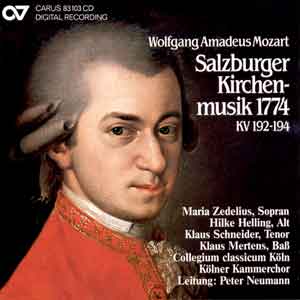
Salzburger Kirchenmusik 1774
 Ecouter
(15)
Ecouter
(15)
- Sancta Maria, Mater Dei
- Dixit
- Magnificat
- Kyrie
- Gloria
- Credo
- Sanctus
- Benedictus
- Agnus Dei
- Kyrie
- Gloria
- Credo
- Sanctus
- Benedictus
- Agnus Dei
 Compléments
-
 Texte numérique (sans notes), licence d'impression incluse, fichier html, paroles, originalfichier html, paroles, original (Extrait)Dixit Dominus
Dixit Dominus Domino meo:
Sede a dextris meis,
Donec ponam inimicos tuos,
scabellum pedum tuorum,
Virgam virtutis tuae
emittet Dominus ex Sion:
dominare in medio inimicorum tuorum.Tecum principium in die virtutis tuae
in splendoribus sanctorum:
ex utero ante luciferum
genuite.
Juravit Dominus,
et non poenitebit eum:
Tu es sacerdos in aeternum
secundum ordinem Melchisedech.Dominus a dextris tuis,
confregit in die irae suae reges.
Judicabit in nationibus,
implebit ruinas:...
-
Texte numérique (sans notes), licence d'impression incluse, fichier html, Texte introductif, en anglaisfichier html, Texte introductif, en anglais (Extrait)Foreword of the edition Carus 40.052
Jochen Reutter
Translation: John CoombsThe liturgy of the Roman Catholic Church is divided into two parts, the Mass and the Divine Office, the "Canonical Hours." Among these services that of Vespers is particularly important, as it has become what might be called the afternoon pendant to the morning Mass. It is therefore not surprising that in addition to the ordinarium missae composers have frequently turned their attention to writing music for Vespers; one remembers in particular Monteverdi's magnificent "Vespers of the Blessed Virgin."
Vespers, like the Mass, is divided into Ordinarium and Proprium sections, that is to say those which remain essentially unaltered, and those which change from day to day. At Vespers in the 18th century the set pieces of the Ordinarium, like those in the Mass, were generally set to music. They always consist of five psalms and the Canticum Beatae Mariae Virginis, the Magnificat. For normal Sundays and most feast days Psalms 109 (110) Dixit Dominus, 110 (111) Confitebor tibi Domine, 111 (112) Beatus vir, 112 (113) Laudate pueri, and 113 (114) In exitu Israel are appointed, for feast days of the Virgin Mary
...
-
Texte numérique (sans notes), licence d'impression incluse, fichier html, Texte introductif, en allemandfichier html, Texte introductif, en allemand (Extrait)Vorwort der Ausgabe Carus 40.052
Jochen Reutter
Die Liturgie der römisch-katholischen Kirche teilt sich in Messe und Stundengebet. Unter den verschiedenen Gebetszeiten des Stundenoffiziums bildet die Vesper einen besonderen Höhepunkt, den man in gewissem Sinne als nachmittägliches Pendant zur vormittäglichen Messe bezeichnen könnte. Insofern nimmt es nicht Wunder, dass die Komponisten neben dem ordinarium missae den Gesängen der Vesper immer wieder ihr Interesse gewidmet haben; man denke nur an Claudio Monteverdis grandiose Marienvesper.
Die Vesper unterscheidet wie die Messe ein Ordinarium und ein Proprium, also im wesentlichen feststehende und von Tag zu Tag wechselnde Teile. Wie bei der Messe werden bei der Vesper im 18. Jahrhundert vorzugsweise die Gesänge des Ordinariums vertont. Dies sind fünf Psalmen und das Canticum Beatae Mariae Virginis, das Magnificat. Für die regulären Sonn- und Feiertage sind die Psalmen 109 (Dixit Dominus), 110 (Confitebor tibi Domine), 111 (Beatus vir), 112 (Laudate pueri) und 113 (In exitu Israel) vorgesehen, für Marienfeste die Psalmen 109 (Dixit Dominus), 112
...
-
Texte numérique (sans notes), licence d'impression incluse, fichier html, paroles, originalfichier html, paroles, original (Extrait)
Sancta Maria Mater Dei,
ego omnia tibi debeo
sed ab hac hora singulariter,
me tuis servitiis devoveo, singulariter devoveo,
te patronam, te sospitatricem, patronam eligo,
te sospitatricem, te patronam,
sospitatricem eligo, te, te patronam eligo,
te, te sospitatricem eligo.Tuus honor et cultus
aeternum mihi cordi fuerit,
quem ego nunquam deseram,
neque ab aliis mihi subditis
verbo factoque violari patiar.Sancta Maria, tu pia,
me pedibus tuis advolutum recipe,
in vita protege,
in mortis discrimine defende.
Amen....
-
Texte numérique (sans notes), licence d'impression incluse, fichier html, Texte introductif, en allemandfichier html, Texte introductif, en allemand (Extrait)Gekürztes Vorwort der Ausgabe Carus 40.053/03
Willi Schulze
Mozarts Sancta Maria (KV 273) gehört zu denjenigen Gesängen der Liturgie, die sich nach der Zeit des Kirchenjahres oder dem jeweiligen Heiligenfest richten: Proprium de tempore et de Sanctis. Ordinarium und Proprium bildeten die feste Ordnung des Messgottesdienstes, die der Komponist kirchlicher Musik zu respektieren hatte. Während jedoch das Ordinarium in seinem Aufbau vom Kyrie bis zum Agnus Dei keine Veränderungen zuließ (dass Gloria und Credo zu bestimmten Zeiten wegfielen, war ebenfalls durch die liturgische Ordnung geregelt), war zu Mozarts Zeit im Proprium eine gewisse Freizügigkeit gestattet. So konnten freie Motetten oder Instrumentalstücke an Stelle der vorgeschriebenen liturgischen Gesänge verwendet werden. Mozarts Kirchensonaten, genauer als Epistelsonaten bezeichnet, gehen auf diese freie liturgische Ordnung zurück. Sie erklangen als Überleitungsmusik zwischen den Lesungen der Epistel und des Evangeliums. Ähnlich frei verfuhr man in der Wiedergabe des Offertoriums. Hier erfreuten sich Kompositionen über nichtliturgische Texte in lateinischer Sprache einer wachsenden Beliebtheit. Es ist heute nicht
...
-
Texte numérique (sans notes), licence d'impression incluse, fichier html, paroles, originalfichier html, paroles, original (Extrait)Kyrie (Soli SA, Coro)
Kyrie eleison.
Gloria (Soli SATB, Coro)
Christe eleison.
Kyrie eleison.[Gloria in excelsis Deo]
Et in terra pax hominibus bonae voluntatis.
Laudamus te. Benedicimus te.
Adoramus te. Glorificamus te.
Gratias agimus tibi propter magnam gloriam tuam.
Domine Deus, Rex caelestis,
Deus Pater omnipotens.
Domine Fili unigenite, Jesu Christe.
Domine Deus, Agnus Dei, Filius Patris.
Qui tollis peccata mundi,
miserere nobis.
Qui tollis peccata mundi,
suscipe deprecationem nostram.
Qui sedes ad dexteram Patris,
miserere nobis....
-
Texte numérique (sans notes), licence d'impression incluse, fichier html, Texte introductif, en anglaisfichier html, Texte introductif, en anglais (Extrait) Abridged foreword of the Edition Carus 40.624
Jochen Reutter
Translation: John CoombsDuring the summer of 1774 W. A. Mozart wrote two Masses within a few weeks: the Missa brevis in F major, K. 192 (186f), and the Missa brevis in D major, K. 194 (186h). A feature common to both compositions as well as to the Dixit et Magnificat K. 193 (186g), written at about the same time, and the "Trinitatis" Mass K. 167 of the previous year, is a more or less strongly evident tendency towards contrapuntal writing. However, while the Dixit et Magnificat and the "Trinitatis" Mass approach the late-baroque style, in these two brevis Masses Mozart sought to combine traditional polyphonic techniques with a more modern musical language.
The Missa brevis in F major was completed on the 24th June 1774, as is stated on the autograph score. It is clear from an authentic set of performing parts, containing markings in Mozart's hand, that this work was intended for Salzburg Cathedral. In accordance with the modest requirements of a missa brevis, the orchestra consists only of two violins, bass and organ, the so-called "church trio." They were augmented, as the local performing practice demanded,...
-
Texte numérique (sans notes), licence d'impression incluse, fichier html, Texte introductif, en allemandfichier html, Texte introductif, en allemand (Extrait)Gekürztes Vorwort der Ausgabe Carus 40.624
Jochen Reutter
Im Sommer 1774 schrieb W. A. Mozart in unmittelbarer zeitlicher Nachbarschaft zwei Messen, die Missa brevis in F KV 192 (186f) und die Missa brevis in D KV 194 (186h). Beiden Kompositionen eigen ist wie dem etwa gleichzeitig entstandenen Dixit et Magnificat KV 193 (186g) und der aus dem Vorjahr stammenden Trinitatismesse KV 167 eine jeweils mehr oder weniger stark ausgeprägte Neigung zur kontrapunktischen Schreibweise. Während sich jedoch Dixit et Magnificat und die Trinitatismesse dem spätbarocken Stil nähern, sucht Mozart in den beiden brevis-Messen die althergebrachten polyphonen Techniken mit einer moderneren Tonsprache zu verbinden.
Die Missa brevis in F wurde, so das Datum auf der autographen Partitur, am 24. Juni 1774 beendet. Sie war, wie eine authentische Stimmenabschrift mit eigenhändigen Eintragungen Mozarts bezeugt, für den Salzburger Dom bestimmt. Dem bescheideneren Anspruch einer Missa brevis gemäß ist das Orchester nur mit zwei Violinen, Bass und Orgel, dem sog. "Kirchentrio", besetzt. Hinzu kommen der lokalen Aufführungspraxis entsprechend...
-
Texte numérique (sans notes), licence d'impression incluse, fichier html, paroles, originalfichier html, paroles, original (Extrait)Kyrie
Kyrie eleison.
Gloria
Christe eleison.
Kyrie eleison.Et in terra pax hominibus bonae voluntatis.
Laudamus te. Benedicimus te. Adoramus te. Glorificamus te.
Gratias agimus tibi propter magnam gloriam tuam.
Domine Deus, Rex caelestis, Deus Pater omnipotens.
Domine Fili unigenite, Jesu Christe.
Domine Deus, Agnus Dei, Filius Patris.
Qui tollis peccata mundi, miserere nobis,
Qui tollis peccata mundi,
suscipe deprecationem nostram.
Qui sedes ad dexteram Patris, miserere nobis.
Quoniam tu solus Sanctus.
Tu solus Dominus.Tu solus Altissimus, Jesu Christe.
Cum Sancto Spiritu, in gloria Dei Patris.
Amen....
-
Texte numérique (sans notes), licence d'impression incluse, fichier html, Texte introductif, en anglaisfichier html, Texte introductif, en anglais (Extrait)Foreword of the edition Carus 40.625
Jochen Reutter
Translation: John CoombsDuring the summer of 1774 W. A. Mozart wrote two Masses within a few weeks: the Missa brevis in F major, K. 192 (186f), and the Missa brevis in D major, K. 194 (186h). A feature common to both compositions as well as to the Dixit et Magnificat K. 193 (186g), written at about the same time, and the "Trinitatis" Mass K. 167 of the previous year, is a more or less strongly evident tendency towards contrapuntal writing. However, while the Dixit et Magnificat and the "Trinitatis" Mass approach the late-baroque style, in these two brevis Masses Mozart sought to combine traditional polyphonic techniques with a more modern musical language.
The Missa brevis in D major, K. 194 (186h), was written shortly after its sister-work in F major. Mozart's autograph score is dated the 8th August 1774. This work, like K. 192 (186f), was intended for Salzburg Cathedral. Corresponding to the restricted scale of a missa brevis, Mozart wrote the F major Mass, and also the present work, for a small ensemble of four voices (SATB), choral and solo, two violins, bass and organ, together with the three trombones
...
-
Texte numérique (sans notes), licence d'impression incluse, fichier html, Texte introductif, en allemandfichier html, Texte introductif, en allemand (Extrait)Vorwort der Ausgabe Carus 40.625
Jochen Reutter
Im Sommer 1774 schrieb W.A. Mozart in unmittelbarer zeitlicher Nachbarschaft zwei Messen, die Missa brevis in FKV 192 (186f) und die Missa brevis in D KV 194 (186h). Beiden Kompositionen eigen ist wie dem etwa gleichzeitig entstandenen Dixit et Magnificat KV 193 (186g) und der aus dem Vorjahr stammenden Trinitatismesse KV 167 eine jeweils mehr oder weniger stark ausgeprägte Neigung zur kontrapunktischen Schreibweise. Während sich jedoch Dixit et Magnificat und die Trinitatismesse dem spätbarocken Stil nähern, sucht Mozart in den beiden brevis-Messen die althergebrachten polyphonen Techniken mit einer moderneren Tonsprache zu verbinden.
Die Missa brevis in D KV 194 (186h) entstand nur wenige Wochen nach ihrer F-Dur-Schwester. Mozarts autographe Partitur ist auf den 8. August 1774 datiert. Das Werk war wie KV 192 (186f für den Salzburger Dom bestimmt. Dem äußeren Rahmen einer Missa brevis entspricht Mozart wie in der F-Dur-Messe durch eine sparsame Besetzung mit vier Singstimmen (SATB), chorisch und
...
Sommaire


-
Compositeur
Wolfgang Amadeus Mozart
| 1756-1791Fils du vice-maître de chapelle du prince-archevêque de Salzbourg, Mozart a été constamment entouré de musique sacrée dès sa jeunesse. Au cours de ses voyages, Mozart découvrit la musique sacrée italienne, et plus tard, à Vienne, il étudia les œuvres de Bach et de Haendel. Après son installation à Vienne, il se lance de nouveaux défis avec l'opéra et le concerto pour piano. Il est significatif que la « Messe en ut mineur » KV 427, la plus grande œuvre de musique sacrée des premières années viennoises, reste inachevée. La dernière période de sa vie montre à nouveau une orientation vers la musique sacrée : Mozart postule avec succès pour succéder à Leopold Hoffmann, malade à l'article de la mort, en tant que maître de chapelle à la cathédrale Saint-Étienne, mais il ne peut pas prendre le poste, car il meurt avant Hoffmann. Un joyau comme l'« Ave verum » KV 618 et le Requiem KV 626, resté inachevé, laissent entrevoir ce que Mozart aurait encore pu accomplir en tant que compositeur d'église s'il était parvenu à ce poste à responsabilité. Plus d'information sur la personne
-
L'auteur de l'avant-propos
Ulrich Tank
-
Ensemble
Collegium Classicum Köln
-
Ensemble
Kölner Kammerchor
-
Chef d'orchestre
Peter Neumann
| 1940-2025In recent years Peter Neumann, born in Karlsruhe, has made a name for himself particularly as a conductor of Handel’s music. This is demonstrated both by the concert series “250 Years Handel Oratorios” which he initiated – performing nine music dramas in accordance with Handel’s concert schedule of 1749–1752 – and by his numerous CD recordings. He has performed masterworks from vocal and orchestral music in the European musical capitals and at many renowned festivals, ranging from Monteverdi’s L’Orfeo and Vespers for the Blessed Virgin (Palais Garnier, Paris) through J. S. Bach’s passions (last in Moscow, Oslo and Versailles) and Mass in B minor (BBC Proms) to Debussy’s Le Martyre de Saint Sébastien at the MusikTriennale in Cologne. 2010, Peter Neumann and his ensembles Kolner Kammerchor and Collegium Cartusianum were guests at the Rheingau Music Festival with Schumann’s Das Paradies und die Peri and at the Schumann Festival in Dusseldorf as well as the Leipzig Bach Festival in 2011. In June 2012 he made his highly acclaimed debut at the Cologne Opera with Handel’s Alcina. As a guest conductor, Neumann has collaborated with, among others, ChorWerkRuhr, the Netherlands Chamber Choir, the SWR Vokalensemble Stuttgart, the NDR Choir, the Schola Cantorum Tokyo, the Concertgebouw Orchestra Amsterdam, the Jerusalem Symphony Orchestra, the Junge Deutsche Philharmonie and Concerto Koln. Highlights of his extensive discography include the complete recording of Mozart’s masses (Gramophone “Crown of Crowns”), Schutz’s Musical Vesper, Schumann’s Missa sacra (Diapason d’Or) and recordings of Bach’s St. John Passion and Handel’s Alexander’s Feast and Brockes Passion (Carus). Plus d'information sur la personne
-
Solist - soprano
Maria Zedelius
-
Solist - alto
Hilke Helling
-
Solist - ténor
Klaus Schneider
-
Solist - basse
Klaus Mertens
Critiques
Mozart: Salzburger Kirchenmusik
Mozart: Salzburger Kirchenmusik
„Diese Aufnahme ist von einer rundum überzeugenden Selbstverständlichkeit, die den eigenen hohen Wert von Mozarts Salzburger Kirchenmusik deutlich werden lässt.”
Quelle: Neue Zeitschrift für Musik
Les évaluations sur notre site web ne peuvent être effectuées que par des clients disposant d'un compte d'utilisateur enregistré. Il n'est pas vérifié si les produits évalués ont été effectivement achetés.
Questions fréquentes sur l'œuvre
 Il n'y a pas encore de questions et réponses concernant cette œuvre ou vous n'avez pas trouvé la réponse à votre question sur l'œuvre ? Cliquez ici et envoyez votre question spécifique à notre service clients.