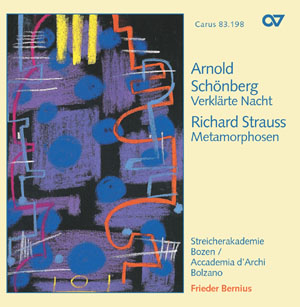
Arnold Schönberg: Verklärte Nacht. Richard Strauss: Metamorphosen
Carus poursuit sa collaboration avec Frieder Bernius autour de la musique instrumentale, avec le psychogramme post-romantique d’Arnold Schönberg Verklärte Nacht (La nuit transfigurée) op. 4 (1899, dans la version pour orchestre de 1943) et les Metarmophosen (Métamorphoses) pour 23 instruments à cordes solo (1945) de Richard Strauss.
Même si les deux œuvres laissent entrevoir d’évidents parallélismes dans leur disposition formelle, leur geste musical et leur genre, elles divergent beaucoup par leur programme. Schönberg essaya, dans son poème musical, qui s’oriente nettement vers les poèmes symphoniques de jeunesse de Strauss, de « dessiner la nature et d’exprimer les sentiments humains ». Le fondement littéraire de l’œuvre est un poème de Richard Dehmel, considéré comme le plus célèbre poète lyrique allemand avant la Première Guerre mondiale. Quant au contenu programmatique des Metamorphosen de Strauss, il s’agit bien plutôt d’un « programme intérieur » qui se voue au sentiment du deuil – à la fin de la Seconde Guerre mondiale, Strauss assista, avec un profond abattement, à la disparition par les flammes des lieux qui le virent triompher.
Frieder Bernius, qui fut récompensé ces derniers mois par trois Diapasons d’Or, interprète ces œuvres avec l’académie de cordes de Bolzano.
 Ecouter
(2)
Ecouter
(2)
- Transfigured Night
- Metamorphoses
Sommaire
-
Compositeur
Arnold Schönberg
| 1874-1951Arnold Schönberg était un compositeur, théoricien de la musique et peintre autrichien considéré comme l'un des compositeurs les plus influents du XXe siècle.
Schönberg a grandi à Vienne et a pris des cours de violon dès l'âge de neuf ans. Très tôt, il s'est essayé à la composition en autodidacte. Il a d'abord travaillé comme employé de banque, mais a décidé au tournant du siècle de se lancer dans une carrière de compositeur. Friede auf Erden op. 13, l'une des rares œuvres chorales de la Seconde École de Vienne, est considérée comme la dernière composition tonale d'Arnold Schönberg avant qu'il ne développe l'atonalité entre 1906 et 1909. Vers 1920, il a formulé la technique dodécaphonique, qui a eu une influence déterminante sur la musique du XXe siècle. Figure centrale de la Seconde École de Vienne, professeur de compositeurs importants tels qu'Alban Berg et Anton Webern, les innovations de Schönberg ont influencé le développement de la musique sérielle et électronique. En 1933, Schönberg émigra aux États-Unis et obtint la nationalité américaine en 1941. Il mourut le 13 juillet 1951 à Los Angeles.
Plus d'information sur la personne
-
Compositeur
Richard Strauss
| 1864-1949Le fils du musicien Franz Joseph Strauss et de sa femme Joséphine commence à composer dès l'âge de six ans. À son 18e anniversaire, il a déjà écrit environ 140 pièces, dont près de 60 lieder et plus de 40 œuvres pour piano. En 1881, il entame une carrière fulgurante avec son opus 1, la Marche de fête pour grand orchestre. En 1886, Strauss prend un poste de troisième chef d'orchestre à l'opéra de la cour de Munich, sa ville natale. Là, il a le temps d'approfondir son répertoire. Au cours des quatre années suivantes, il compose entre autres de nombreux lieder, comme le Ständchen op. 17,2, qui paraît aux éditions Carus en même temps que Von dunklem Schleier umsponnen op. 17,4 et Nicht im Schlafe hab ich das geträumt op. 48,1. En 1905 et après de nombreuses compositions de lieder, Richard Strauss, déjà célébré, écrit également une histoire à succès avec un opéra. L'adaptation lyrique de Salomé d'Oscar Wild, dont Strauss a lui-même traduit le texte en allemand, est considérée par ses adeptes comme l'incarnation de la musique d'opéra moderne. Plus d'information sur la personne
-
L'auteur de l'avant-propos
Mirjam Schlemmer
-
Ensemble
Streicherakademie Bozen
La Streicherakademie Bozen sous la direction de Georg Egger a été fondée en 1987 par la Société de Musique du Tirol du sud. Elle est essentiellement composée de musiciens originaires de cette région possédant une grande expérience dans d’importantes formations orchestrales et de musique de chambre aussi bien en Italie qu'à l'étranger et pouvant transmettre leur savoir à de jeunes musiciens dans le cadre d’un travail effectué en commun. L’Académie joue la plupart du temps sans chef. Pour de plus grands projets, un partenariat artistique existe depuis plusieurs années entre l'ensemble et Frieder Bernius qui connaît certains membres par leur collaboration régulière avec la Philharmonie classique de Stuttgart. À côté de leur propres séries de concerts annuelles, les musiciens apparaissent régulièrement dans les importants festivals, tels que les Mozartwochen de Salzbourg, les Semaines Gustav Mahler de Toblach ou les Festwochen d'Engadine. Sergio Azzolini, Juliane Banse, Eduard Brunner, Giuliano Carmignola, Mirijam Contzen, Ingeborg Danz, Christian Gerhaher, Dietrich Henschel, Heinz Holliger, Diethelm Jonas, Louis Lortie, Antonio Meneses, Johannes Moser, Sabine et Wolfgang Meyer, Birgit Remmert, Sibylla Rubens, Andràs Schiff, Thomas Quasthoff, Wen-Sinn Yang et Ruth Ziesak sont, entre autres, leurs partenaires solistes. Leur large répertoire va de Bach, Haendel, Zelenka à Britten, Bartòk, Stravinsky, Schönberg, Schnebel et Stuppner en passant par La Jeune Fille et la Mort de Schubert/Mahler et Mendelssohn. Jusqu'à maintenant, ils ont enregistré plusieurs disques compacts avec des œuvres par C. Ph. E. Bach, Boccherini, Mozart, Rossini, Schönberg, Strauss et Stuppner. Plus d'information sur la personne
-
Chef d'orchestre
Frieder Bernius
| 1947Le travail de Frieder Bernius jouit d’une grande reconnaissance à l’échelle mondiale. Il est très sollicité à l’international, tant comme chef d’orchestre que comme professeur. Ses partenaires artistiques sont principalement le Chœur de chambre de Stuttgart, l’Orchestre baroque de Stuttgart, la Hofkapelle de Stuttgart et la Philharmonie classique de Stuttgart. C’est en 1968, avec la création du Chœur de chambre de Stuttgart, qu’il a posé les bases de sa carrière exceptionnelle, qu’il a rapidement fait de cet ensemble l’un des plus éminents de son genre. Qu’il s’agisse d’œuvres vocales de Monteverdi, Bach, Haendel, Mozart, Beethoven, Fauré et Ligeti, de musiques de théâtre de Mendelssohn ou de symphonies de Haydn, Burgmüller et Schubert, le travail de Frieder Bernius vise toujours un son à la fois fidèle à l’idéal sonore original et d’une personnalité incomparable. Il se consacre aussi bien à la redécouverte d’opéras du XVIIIe siècle qu’aux créations de compositions contemporaines. Il porte un intérêt particulier à l’histoire de la musique du sud-ouest de l’Allemagne. Le travail de Frieder Bernius est largement documenté sur disques et CD sous le label Carus. De nombreux enregistrements ont été récompensés par des prix internationaux. Dans le cadre du Festival choral allemand de Stuttgart, Frieder Bernius s’est vu décerner un CD d’or par les éditions Carus pour son intégrale de la musique vocale sacrée de Felix Mendelssohn Bartholdy. Plus d'information sur la personne
Critiques
Schönberg, A
Schönberg, A.: Verklärte Nacht; Strauss, R.: Metamorphosen
Ohne Zweifel gehören die beiden Werke zu den Höhepunkten der Literatur für Streichorchester. Fällt Schönbergs „Verklärte Nacht” von 1897 in eine Zeit, in der durch die Erweiterung und später sogar Auflösung der traditionellen Harmonik alles möglich schien, so sind die „Metamorphosen für 23 Solostreicher” ein Dokument tiefer Trauer und Resignation, die Strauss angesichts der Zerstörungen des Zweiten Weltkriegs empfand: „Mein Lebenswerk ist zerstört. Meine Werke werde ich auf dieser Welt nicht mehr sehen und hören - ich wollte, Mozart und Schubert hätten mich nach dem 80. zu sich ins Elysium genommen.” Doch gibt es auch Gemeinsames: Auch Schönbergs „Verklärte Nacht” ist in der eingespielten Fassung von 1943 letztendlich eine Verarbeitung der Weltkriegsereignisse, eine Flucht ins Jahr 1897.
Quelle: ohne Angabe
Schönberg, A.: Verklärte Nacht; Strauss, R.: Metamorphosen
It is said that really good orchestras can conduct themselves, and this is certainly true for the Streicherakademie who usually play without a conductor. Both Verklärte Nacht and Metamorphosen are large-scale chamber works – the former an orchestral amplification of an original string sextet and the latter a chamber work for 23 solo strings. The execution on this recording is immaculate except for one regrettably flagrant intonation mishap towards the end of the Metamorphosen [22:19]. But all credit to the conductor, Frieder Bernius, who is obviously a tasteful musician. He resists the temptation to wallow in self-indulgent late-Romantic excess and instead treats us to a meaningful sensuousness and constantly shifting drama that is deeply moving.
Considering Verklärte Nacht and Metamorphosen were written so far apart, the similarity between the two works is striking, and there is little doubt that Schoenberg’s early work is directly inspired by Strauss’s mature composition. Both pieces resemble each other particularly in structure, style and gesture. They are highly chromatic Romantic conceptions designed as single movement symphonic poems – where Schoenberg condenses five sections into one, Strauss adheres to the thematically tri-partite sonata-form structure. The inspiration for each is drawn from extra-musical sources and it is therefore important to consider these for a proper understanding. Richard Dehmel’s poem about a guilty pregnant girl, consoled by her new lover who insists that her unborn baby will transform into their very own love-child, lends its title and content to Verklärte Nacht. The poetry’s translucent quality is convincingly translated into a musical tongue. The conceptual force behind Strauss’s Metamorphosen is the sadness of the last years of WW2: an „inner”, psychological programme that bears no direct relation to events – as does Schoenberg’s oeuvre – but expresses a particular emotional quality.
As I said earlier, but for an unfortunately obvious moment of poor intonation, this is a really well polished recording. The Streicherakademie deliver a true chamber music performance, producing throughout a very intimate, homogeneous sound. The effects are lush but contained, and the instrumental interplays are seamless. The acoustics are, however, unforgiving – as though one were sitting through a live concert, every little detail can be heard: no ‚soft-focusing’ here. With a lesser performance this would be a disaster, but in my opinion, the vulnerable acoustic actually works in its favour. The wispy disturbances give a mark of authenticity.
My single subjective criticism is that the Streicherakademie fail to highlight the solo events within the works. But this has to do with their aesthetic approach – a consistent chamber music democracy over a hierarchical sound structure. Something in between perhaps? I would have liked to hear the solos sound out a little more, and especially in Metamorphosen where the violin, viola and cello are particularly independent and tuneful. For those who share my preference, let me recommend the 1974 Karajan/Berlin Philharmonic recording of Verklärte Nacht. All in all, an exciting recording. Not least for the powerful climaxes and wonderful palette of dynamics that are anchored in a rich and wholesome chamber music sonority. The depth and power of sound is impressive.
Aline Nassif
Quelle: musicweb.uk.net
Les évaluations sur notre site web ne peuvent être effectuées que par des clients disposant d'un compte d'utilisateur enregistré. Il n'est pas vérifié si les produits évalués ont été effectivement achetés.
Questions fréquentes sur l'œuvre
 Il n'y a pas encore de questions et réponses concernant cette œuvre ou vous n'avez pas trouvé la réponse à votre question sur l'œuvre ? Cliquez ici et envoyez votre question spécifique à notre service clients.