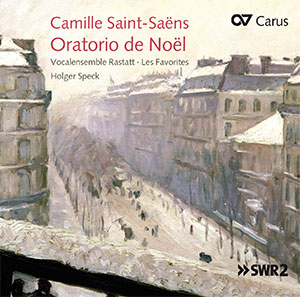
Oratorio de Noël
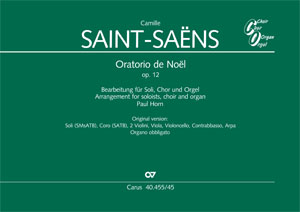
L’assimilation du genre de l’« oratorio de Noël » à l’oeuvre de J. S. Bach dissimule la variété du genre. L’Oratorio de Noël de Camille Saint-Saëns est ainsi un élément important et enrichissant du répertoire. Cette oeuvre en dix mouvements progresse dans une formation inhabituelle : aux voix, quintette à cordes et orgue est ajoutée dans trois mouvements, en vue d’un effet sonore spécial, une harpe, ce qui crée une atmosphère lyrique particulière. Celle-ci – à laquelle contribuent aussi l’harmonie, les chorals simples, et l’écriture presque chambriste de l’orchestre – n’est que rarement rompue par des éléments dramatiques. La tension qui en résulte donne à l’oeuvre un attrait expressif, qui explique le succès mondial de cet oratorio. L’Ensemble vocal de Rastatt, Les Favorites, et l’organiste Romano Giefer sous la direction de Holger Speck, montrent, par leur interprétation différenciée, que le genre de l’« oratorio de Noël » possède bien plus de facettes qu’on ne le pense souvent.
Découvrir


 Ecouter
(16)
Ecouter
(16)
- Prélude
- Et pastores erant / Gloria in altissimus Deo
- Expectans exspectavi Dominum
- Domine, ego credidi
- Benedictus
- Quare fremuerunt gentes
- Tecum principium
- Alleluia
- Consurge, Filia Sion
- Tollite hostias
- Bénédiction nuptiale
- Ave verum corpus
- Sub tuum praesidium
- O salutaris hostia
- Ave Maria
- Tantum ergo
 S`exercer
-
Aides à l'apprentissage
-
Aides à l'apprentissage voix soprano
- Et pastores erant / Gloria in altissimus Deo (Choir Coach)
- Domine, ego credidi (Choir Coach, soprano 1)
- Domine, ego credidi (Choir Coach, soprano 2)
- Quare fremuerunt gentes (Choir Coach)
- Consurge, Filia Sion (Choir Coach)
- Tollite hostias (Choir Coach)
- Et pastores erant / Gloria in altissimus Deo (Choir Coach, Slow mode)
- Domine, ego credidi (Choir Coach, Slow mode, soprano 1)
- Domine, ego credidi (Choir Coach, Slow mode, soprano 2)
- Quare fremuerunt gentes (Choir Coach, Slow mode)
- Consurge, Filia Sion (Choir Coach, Slow mode)
- Tollite hostias (Choir Coach, Slow mode)
-
Aides à l'apprentissage voix alto
- Et pastores erant / Gloria in altissimus Deo (Choir Coach)
- Domine, ego credidi (Choir Coach, Alto 1)
- Domine, ego credidi (Choir Coach, Alto 2)
- Quare fremuerunt gentes (Choir Coach)
- Consurge, Filia Sion (Choir Coach)
- Tollite hostias (Choir Coach)
- Domine, ego credidi (Choir Coach, Slow mode, Alto 1)
- Domine, ego credidi (Choir Coach, Slow mode, Alto 2)
- Quare fremuerunt gentes (Choir Coach, Slow mode)
- Consurge, Filia Sion (Choir Coach, Slow mode)
- Tollite hostias (Choir Coach, Slow mode)
-
Aides à l'apprentissage voix tenore
- Et pastores erant / Gloria in altissimus Deo (Choir Coach)
- Quare fremuerunt gentes (Choir Coach)
- Consurge, Filia Sion (Choir Coach)
- Tollite hostias (Choir Coach)
- Et pastores erant / Gloria in altissimus Deo (Choir Coach, Slow mode)
- Quare fremuerunt gentes (Choir Coach, Slow mode)
- Consurge, Filia Sion (Choir Coach, Slow mode)
- Tollite hostias (Choir Coach, Slow mode)
-
Aides à l'apprentissage voix basse
- Et pastores erant / Gloria in altissimus Deo (Choir Coach)
- Quare fremuerunt gentes (Choir Coach)
- Consurge, Filia Sion (Choir Coach)
- Tollite hostias (Choir Coach)
- Et pastores erant / Gloria in altissimus Deo (Choir Coach, Slow mode)
- Quare fremuerunt gentes (Choir Coach, Slow mode)
- Consurge, Filia Sion (Choir Coach, Slow mode)
- Tollite hostias (Choir Coach, Slow mode)
-
Acheter
Informations complémentaires sur l'œuvre
Sommaire


-
Compositeur
Camille Saint-Saëns
| 1835-1921Camille Saint-Saëns était un véritable multitalent. Pianiste, chef d'orchestre, organiste, musicologue, pédagogue musical et compositeur, il s'est surtout fait connaître par le Carnaval des animaux et l'opéra Samson et Dalila.
Il composa sa symphonie en la majeur à l'âge de 15 ans et fut admis à l'université de Paris dès l'âge de 16 ans. Saint-Saëns étudia le piano, l'orgue et la composition au Conservatoire de Paris et devint organiste de Saint-Séverin à Paris en 1852. La même année, il fit la connaissance de Franz Liszt, qui exerça par la suite une influence sur la composition de Saint-Saëns. Un an plus tard, il fait ses débuts musicaux en tant que compositeur. L'opéra Samson et Dalila, créé à Weimar en 1877, lui valut un succès qui ne s'est jamais démenti à l'opéra. Son Oratorio de Noël, disponible aux éditions Carus, est sans doute la plus connue de ses œuvres religieuses. Plus d'information sur la personne
-
L'auteur de l'avant-propos
Herbert Lölkes
-
Chœur
Vocalensemble Rastatt
Alongside its dedication to a core repertoire of composers such as Monteverdi, Schütz, Bach, Mozart, Haydn, Schumann, and Brahms, the Vocalensemble Rastatt & Les Favorites frequently explore new terrain with premiere performances. On the heels of its successes in national and international choir competitions, the ensemble has taken part in numerous internationally acclaimed CD recordings as well as radio, and television productions for SWR, Radio France, Deutschlandradio Kultur, and Deutschlandfunk. The Vocalensemble Rastatt & Les Favorites have performed in the Festspielhaus Baden-Baden, the Musikfest Bremen, the Kölner Philharmonie, the SWR RheinVokal Festival, the Europäisches Musikfest Stuttgart, the Schwetzinger Festspiele, the Deutschlandradio Kultur Wartburgkonzerte, the Internationale Musiktage im Dom zu Speyer, the Philharmonie in Mulhouse, and the Centre de Musique “Les Dominicains” in Guebwiller, France, among other venues. The flexible choir does not shy away from excursions into the world of opera, having performed Donizetti’s Lucia di Lammermoor and Bellini’s Norma with Edita Gruberova, and Mozart’s Don Giovanni and Così fan tutte with Rolando Villazón. Together with Klaus Maria Brandauer and the Chamber Orchestra of Europe, the choir also performed Mendelssohn’s Sommernachtstraum at the Musikfest Bremen. The ensemble is sponsored by the German state of Baden-Württemberg in co-operation with its “Kunst 2020” program, as well as by its home city of Rastatt. Plus d'information sur la personne
-
Ensemble
Les Favorites
Alongside its dedication to a core repertoire of composers such as Monteverdi, Schütz, Bach, Mozart, Haydn, Schumann, and Brahms, the Vocalensemble Rastatt & Les Favorites frequently explore new terrain with premiere performances. On the heels of its successes in national and international choir competitions, the ensemble has taken part in numerous internationally acclaimed CD recordings as well as radio, and television productions for SWR, Radio France, Deutschlandradio Kultur, and Deutschlandfunk. The Vocalensemble Rastatt & Les Favorites have performed in the Festspielhaus Baden-Baden, the Musikfest Bremen, the Kölner Philharmonie, the SWR RheinVokal Festival, the Europäisches Musikfest Stuttgart, the Schwetzinger Festspiele, the Deutschlandradio Kultur Wartburgkonzerte, the Internationale Musiktage im Dom zu Speyer, the Philharmonie in Mulhouse, and the Centre de Musique “Les Dominicains” in Guebwiller, France, among other venues. The flexible choir does not shy away from excursions into the world of opera, having performed Donizetti’s Lucia di Lammermoor and Bellini’s Norma with Edita Gruberova, and Mozart’s Don Giovanni and Così fan tutte with Rolando Villazón. Together with Klaus Maria Brandauer and the Chamber Orchestra of Europe, the choir also performed Mendelssohn’s Sommernachtstraum at the Musikfest Bremen. The ensemble is sponsored by the German state of Baden-Württemberg in co-operation with its “Kunst 2020” program, as well as by its home city of Rastatt. Plus d'information sur la personne
-
Chef d'orchestre
Holger Speck
Holger Speck enjoys an international reputation as a charismatic conductor who succeeds both in realizing stylistic characteristics in an innovative manner and in conveying emotional content. Fanfare magazine from the USA attests to his “undeniable authority.” With his distinctive sense of sound and compelling, lively and authentic interpretations, he shapes the image of his own ensembles as well as the choirs and orchestras with which he works as a guest conductor. The president of the German Bundestag Dr. Wolfgang Schäuble engaged him and his Vocalensemble Rastatt for a concert during the G20 summit. Speck established the Grammy-nominated Vocalensemble Rastatt and the Baroque orchestra Les Favorites internationally with exciting concert programs and outstanding CD recordings on the Carus label containing music by Buxtehude, Telemann, Handel and Brahms, among others. For Deutsche Grammophon productions, he was responsible for the choral sections of the Mozart operas “Die Entführung aus dem Serail,” “Le nozze di Figaro,” “Così fan tutte,” and “Don Giovanni.” Holger Speck teaches at the University of Music in Karlsruhe; in addition to being the artistic director of Vocalensemble Rastatt & Les Favorites, he works as a guest conductor with the NDR Vokalensemble, the Freiburg Baroque Orchestra, the Akademie für Alte Musik Berlin, and the choir and orchestra of the Slovenian Philharmonic Orchestra in Ljubljana, among others. The ballet director John Neumeier engaged Speck to conduct his last major creation “Dona nobis pacem” with Bach’s Mass in B minor at the Hamburg State Opera and the Festspielhaus Baden-Baden. . Plus d'information sur la personne
-
Solist - soprano
Antonia Bourvé
Antonia Bourvé studied opera and lieder singing with Stephan Kohlenberg and Felicitas Strack at the Hochschule für Musik in Karlsruhe. Her studies continued with master classes with Brigitte Fassbaender and Anna Reynolds, and lieder classes with Mitsuko Shirai and Hartmut Höll. She was awarded a scholarship by the Richard Wagner Association and won first prize in the Kulturfonds Baden opera competition. A much sought-after soprano, Antonia Bourvé’s guest appearances include the title role in Mozart’s Zaide at the Staatstheater Nuremberg. She has also sung on CD recordings of Mozart’s Schauspieldirektor and Beethoven’s Scottish Songs. A further recording, which has been praised as a benchmark recording by the press, is Saint-Saëns’ Oratorio de Noël, conducted by Holger Speck on the Carus label (Carus 83.352) Plus d'information sur la personne
-
Solist - alto
Sabine Czinczel
-
Solist - mezzo-soprano
Gundula Schneider
Gundula Schneider, geboren in Dresden, ist Preisträgerin mehrerer internationaler Wettbewerbe, darunter Brahms-Wettbewerb Hamburg, Dvorak-Wettbewerb Karlsbad, 1. Preis bei Pro Musicis in Paris und New York. Die Mezzosopranistin war festes Mitglied am Theater Dortmund und gastierte an den Opernhäusern von Strasbourg, Stuttgart, Düsseldorf, an der Komischen Oper Berling, in Innsbruck und Neapel. Als Lied- und Konzertsängerin war Gundula Schneider in Deutschland, dem europäischen Ausland, den USA sowie China und Japan, u.a. an der Pariser Opéra Comique und der Carnegie Hall in New York zu hören. Zudem wirkte sie bei zahlreichen Rundfunkaufnahmen und CD-Einspielungen mit. Plus d'information sur la personne
-
Solist - ténor
Marcus Ullmann
-
solist - baryton
Jens Hamann
Jens Hamann a été enfant de chœur du « Stuttgarter Hymnus-Chorknaben », a fait partie du Kammerchor Suttgart et de la Maîtrise de Gächingen. Après ses études de chant auprès de Rudolf Piernay à Mannheim, le baryton a remporté en 2006 le « prix spécial de musique ancienne » de la Radio de la Sarre. Le premier enregistrement mondial du Requiem de Michael Haydn (Carus 83.353) auquel il a participé s’est vu décerner le MIDEM Classical Award 2007. Dans le domaine de l’oratorio, il travaille avec Helmuth Rilling, Georg Grün et Ralf Otto et a répondu à des invitations du Festival de musique européen de Stuttgart et du Festival d’opéra du château de Hallwyl. Plus d'information sur la personne
-
Solist - orgue
Romano Giefer
Critiques
… das Album überzeugte mit einer Aufnahmequalität, welche die Opulenz wie auch die intimeren Aspekte dieses sträflich vernachlässigten Werks von Camille Saint-Saens offenbaren.
Image hifi, Nov/Dez 2024
... Ein hochromantisches, wunderschönes Werk, das durch die Ausführenden eine klanglich nuancenreiche Wiedergabe erfährt! Aber auch den anderen kleineren kirchenmusikalischen Werken wird durch die Ausführenden die notwendige Aufmerksamkeit entgegengebracht, so dass insgesamt eine rundum gelungene Einspielung vorliegt!
Singende Kirche, 4/2006
Es zählt zu den Paradebeispielen für die genuin französische kleine Oratorienform, Camille Saint-Saëns Weihnachtsoratorium. ... Holger Speck und seine Mitstreiter, das Vocalensemble Rastatt und sein Kammerorchester Les Favorites, setzten in ihrer jüngsten Einspielung, was die Interpretation anbelangt, höchste Maßstäbe. ... Bei allem tonangebend ist ein Interpretationsanspruch, der dem Werk jenseits süßlicher Melodienseligkeit eine ungeahnte Dramatik verleiht. Überaus sensibel lotet Holger Speck Tempi, Dynamik und Phrasierungen aus, scheut er auch nicht die Grenze hin zur Überdehnung, um das Ensemble dann weniger fulminant aufwirbelnd als inhaltlich nur logisch steigernd in Richtung gegensätzlicher Extreme zu führen. Auf diese Weise bescheinigt Speck der inhaltlichen Botschaft und musikalischen Sprache eines Saint Saëns in seinem frühen Werk Tiefe und Intensität.
Christiane Franke, Neue Chorzeit, 12/2006
Les évaluations sur notre site web ne peuvent être effectuées que par des clients disposant d'un compte d'utilisateur enregistré. Il n'est pas vérifié si les produits évalués ont été effectivement achetés.
Aucune évaluation disponible pour ce produit.
Questions fréquentes sur l'œuvre
 Il n'y a pas encore de questions et réponses concernant cette œuvre ou vous n'avez pas trouvé la réponse à votre question sur l'œuvre ? Cliquez ici et envoyez votre question spécifique à notre service clients.