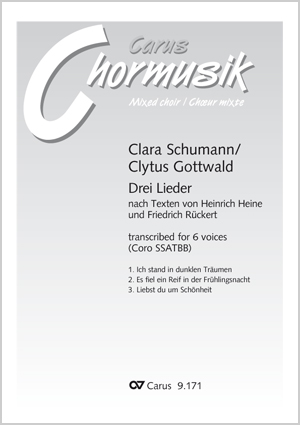
Drei Lieder nach Texten von Heinrich Heine und Friedrich Rückert
Transcriptions vocales de Clytus Gottwald 1840/2018
The three songs were written in the first years of her marriage to Robert. In 1840 she composed the two Heine settings, Ihr Bildnis and Volkslied. The Rückert setting Liebst du um Schönheit was written in 1841.
 Consulter
 Ecouter
(2)
Ecouter
(2)
- Es fiel ein Reif in der Frühlingsnacht
- Liebst du um Schönheit
 Compléments
- Acheter des compléments au format téléchargement.
-
 Texte numérique (sans notes), licence d'impression incluse, fichier html, paroles, originalfichier html, paroles, original (Extrait)Unbenanntes Dokument Ich stand in dunkeln Träumen
Ich stand in dunklen Träumen
und starrt ihr Bildnis an,
und das geliebte Antlitz
heimlich zu leben begann.Um ihre Lippen zog sich
ein Lächeln wunderbar,
und wie von Wehmutstränen
erglänzte ihr Augenpaar.Auch meine Tränen flossen
mir von den Wangen herab,
und ach, ich kann’s nicht glauben,
dass ich dich verloren hab!...
-
Texte numérique (sans notes), licence d'impression incluse, fichier html, paroles, traduction en anglaisfichier html, paroles, traduction en anglais (Extrait)Unbenanntes Dokument I stood in darkness dreaming
I stood in darkness dreaming
and stared upon her portrait,
and that beloved face
secretly came to life.About her lips there played
a smile so wondrous,
and as in wistful tears
her pair of eyes, they gleamed.And my tears did also flow
down upon my cheeks,
and alas, I cannot believe,
that I have lost you....
Sommaire

-
Compositeur
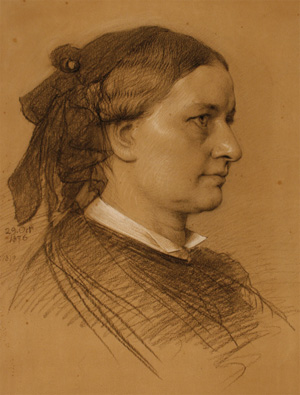
Clara Schumann
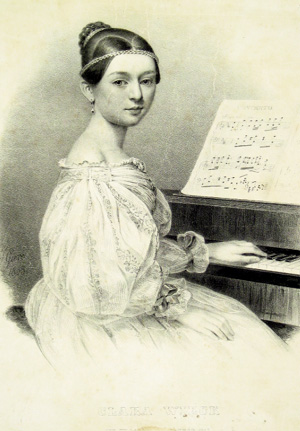
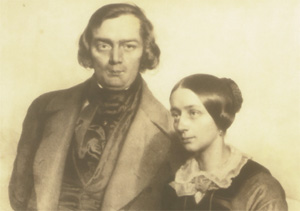
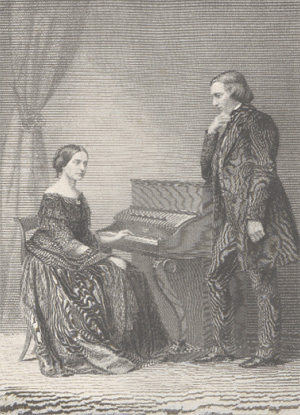
| 1819-1896The most famous female pianist of the 19th century, Clara Schumann, née Wieck, grew up in a musical family. She was strongly encouraged by her father – perhaps a little too strongly, considering that, without any further ado, he penned his daughter’s first diary entries himself. Even as the mother of eight children and wife of Robert Schumann, she continued her impressive career as a concert pianist. Clara Schumann composed numerous piano works, songs, works for chamber ensembles and a piano concerto.
Plus d'information sur la personne
-
Parolier/Librettiste
Friedrich Rückert
| 1788-1866Friedrich Rückert, né en 1788 à Schweinfurt, mort en 1866 près de Cobourg. Poète et traducteur. Professeur de philologie orientale à Erlangen. Plus d'information sur la personne
-
Parolier/Librettiste
Heinrich Heine
| 1797-1856Heinrich Heine (1797-1856) compte parmi les plus grands poètes allemands du XIXe siècle. Né à Düsseldorf, il est surtout connu pour ses poèmes lyriques, qui allient le romantisme à une critique sociale acerbe. Bon nombre de ses œuvres traitent de l’amour, de la nature et de la liberté. En raison de ses opinions politiques, Heine a vécu de nombreuses années en exil à Paris.
Il occupe également une place prépondérante dans l’histoire de la musique. Ses textes lyriques ont été mis en musique par de nombreux compositeurs et ont notamment marqué de leur empreinte le lied romantique. Robert Schumann, Franz Schubert, Felix Mendelssohn Bartholdy et Hugo Wolf, en particulier, ont créé, à partir des poèmes de Heine, des œuvres musicales d’une importance durable. L’alliance poétique entre simplicité linguistique, profondeur émotionnelle et ambiguïté souvent ironique a offert aux compositeurs de multiples possibilités d’interprétation musicale. C’est ainsi que la poésie de Heine est devenue un élément central du répertoire romantique de la chanson et continue d’influencer la musique vocale jusqu’à aujourd’hui.
Plus d'information sur la personne
-
Arrangeur
Clytus Gottwald
| 1925-2023Le chef de chœur, compositeur et musicologue Clytus Gottwald (1925 - 2023) a apporté des contributions essentielles à la musique chorale contemporaine. En tant que rédacteur de musique contemporaine à la radio Südfunk de Stuttgart et fondateur et directeur de la Schola Cantorum Stuttgart, il a eu des échanges productifs avec ses contemporains fondateurs de la musique contemporaine, Pierre Boulez, Mauricio Kagel, György Ligeti, Luigi Nono, Karlheinz Stockhausen et bien d'autres. Avec sa Schola Cantorum, un ensemble vocal de chambre à 16 voix, Gottwald a marqué de manière décisive la culture chorale a cappella, devenue aujourd'hui une évidence, au plus haut niveau technique. Ses transcriptions de lieder ou de pièces instrumentales pour chœur à plusieurs voix a cappella, dont l’écriture inspirée de Ligeti est musicalement très exigeante, sont appréciées par les chœurs du monde entier. Clytus Gottwald a été récompensé à plusieurs reprises pour ses mérites, notamment par le Kulturpreis Baden-Württemberg en 2009, le Preis der Europäischen Kirchenmusik 2012 et la Verdienstkreuz der Bundesrepublik Deutschland 2014. Son importance pour le développement de la musique chorale contemporaine ne peut être surestimée. Plus d'information sur la personne
Les évaluations sur notre site web ne peuvent être effectuées que par des clients disposant d'un compte d'utilisateur enregistré. Il n'est pas vérifié si les produits évalués ont été effectivement achetés.
Questions fréquentes sur l'œuvre
 Il n'y a pas encore de questions et réponses concernant cette œuvre ou vous n'avez pas trouvé la réponse à votre question sur l'œuvre ? Cliquez ici et envoyez votre question spécifique à notre service clients.