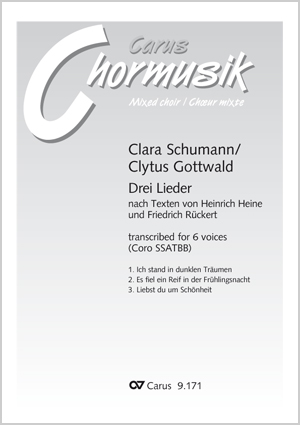
Drei Lieder nach Texten von Heinrich Heine und Friedrich Rückert
Vocal transcriptions by Clytus Gottwald 1840/2018
The three songs were written in the first years of her marriage to Robert. In 1840 she composed the two Heine settings, Ihr Bildnis and Volkslied. The Rückert setting Liebst du um Schönheit was written in 1841.
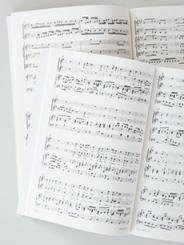
 View
View
 Listen
(2)
Listen
(2)
- Es fiel ein Reif in der Frühlingsnacht
- Liebst du um Schönheit
 Additional material
- Purchase additional material as a download product.
-
 Digital text (without sheet music) incl. printing licence, html file, singing text, originalhtml file, singing text, original (Sample)Unbenanntes Dokument Ich stand in dunkeln Träumen
Ich stand in dunklen Träumen
und starrt ihr Bildnis an,
und das geliebte Antlitz
heimlich zu leben begann.Um ihre Lippen zog sich
ein Lächeln wunderbar,
und wie von Wehmutstränen
erglänzte ihr Augenpaar.Auch meine Tränen flossen
mir von den Wangen herab,
und ach, ich kann’s nicht glauben,
dass ich dich verloren hab!...
-
Digital text (without sheet music) incl. printing licence, html file, singing text, english translationhtml file, singing text, english translation (Sample)Unbenanntes Dokument I stood in darkness dreaming
I stood in darkness dreaming
and stared upon her portrait,
and that beloved face
secretly came to life.About her lips there played
a smile so wondrous,
and as in wistful tears
her pair of eyes, they gleamed.And my tears did also flow
down upon my cheeks,
and alas, I cannot believe,
that I have lost you....
Contents

-
Composer
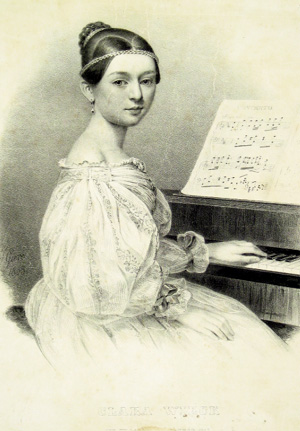
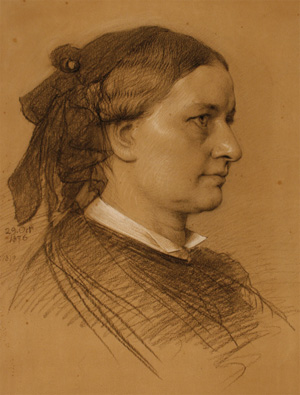
Clara Schumann
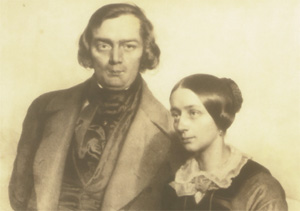
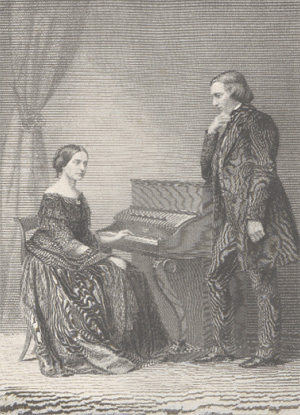
| 1819-1896The most famous female pianist of the 19th century, Clara Schumann, née Wieck, grew up in a musical family. She was strongly encouraged by her father – perhaps a little too strongly, considering that, without any further ado, he penned his daughter’s first diary entries himself. Even as the mother of eight children and wife of Robert Schumann, she continued her impressive career as a concert pianist. Clara Schumann composed numerous piano works, songs, works for chamber ensembles and a piano concerto.
Personal details
-
Songwriter / Librettist
Friedrich Rückert
| 1788-1866Friedrich Rückert, born 1788 in Schweinfurt, died 1866 near Coburg. Poet and translator. Professor of oriental philology in Erlangen. Personal details
-
Songwriter / Librettist
Heinrich Heine
| 1797-1856
-
Arranger
Clytus Gottwald
| 1925-2023The choral conductor, composer and musicologist Clytus Gottwald (1925 - 2023) made significant contributions to contemporary choral music. As editor for New Music at Südfunk Stuttgart and founder and director of the Schola Cantorum Stuttgart, he was in productive exchange with his contemporaries, Pierre Boulez, Mauricio Kagel, György Ligeti, Luigi Nono, Karlheinz Stockhausen and many others. With his Schola Cantorum, a 16-voice chamber vocal ensemble, Gottwald decisively shaped the a cappella choral culture of the highest technical level that is taken for granted today. Clytus Gottwald's transcriptions of piano songs and instrumental pieces for unaccompanied choir are appreciated by choirs all over the world. Modelled on the style of Ligeti, his works set the highest of musical standards. Clytus Gottwald has received several awards for his services, including the Cultural Prize of Baden-Württemberg in 2009, the European Church Music Prize in 2012, and the Cross of Merit of the Federal Republic of Germany in 2014. His importance for the development of contemporary choral music cannot be overestimated. Personal details
Reviews on our website can only be submitted by customers with a registered user account. A check whether the rated products were actually purchased does not take place.
Frequent questions about this work
 There are no questions and answers available so far or you were unable to find an answer to your specific question about this work? Then click here and send your specific questions to our Customer Services!