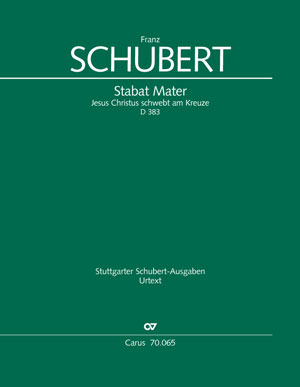
Stabat Mater
Jesus Christus schwebt am Kreuze D 383
In spring 1816 Franz Schubert, just nineteen years old, completed his second setting of the Stabat Mater in the midst of a highly productive period. In contrast with his first setting written the previous year, just five minutes in length, this time Schubert used the German translation by Klopstock as the basis for his composition. Stefan Schuck’s edition is the first one of this work to be based on a critical evaluation of the primary sources, with complete performance material. The work, in a dark F minor, with its text by Klopstock, places Jesus Christ, rather than Mary, at the center of the contemplation. With his fugues, but particularly in the eight-part lamenting chorus "Wer wird Zähren sanften Mitleids", Schubert shows himself at the height of his creative output. He composed his 4th Symphony, the "Tragic", at almost the same time.
The Stabat Mater is a rewarding work for choral societies and choirs to perform, because the choir has the largest portion to sing, and the choral parts are not too demanding. The composition is also a beautiful introduction to the choral-symphonic music of Schubert for less experienced choirs.


-
Compositeur
Franz Schubert
| 1797-1828La musique d'église a occupé Franz Schubert toute sa vie : une partie a été composée comme œuvre de commande, entre autres pour le chœur de l'église de sa paroisse d'origine, et se révèle fortement orientée vers la pratique. Schubert ne composait donc plus seulement pour des musiciens professionnels, mais aussi pour les membres de la paroisse. Ses œuvres sont destinées à de multiples occasions liturgiques et présentent un degré de difficulté et une ampleur variables ; elles répondent ainsi de manière idéale aux besoins actuels de la musique d'église. Des mouvements simples et sobres côtoient des parties de chœur plus exigeantes et des pièces de concert solistes et virtuoses. Les éditions Carus visent l'exhaustivité dans le domaine de la musique sacrée de Schubert : Il s'agit de découvrir une œuvre riche en tensions ; dans ses éléments de lied, harmoniquement profonds, elle reflète un monde d'expression typiquement schubertien : des œuvres d'une grande force de conviction et d'une beauté musicale exceptionnelle. Plus d'information sur la personne
-
Éditeur
Stefan Schuck
| 1963
Critiques
... Die ganze Schönheit des Werkes erfährt man, so der Herausgeber, erst durch präzises Befolgen der zahlreichen dynamischen und artikulatorischen Besonderheiten, eine gute Schule also für größer besetzte Kammerchö re und differenziert musizierende Instrumentalistinnen.
Ulrich Barthel, Chorzeit, 01/2019
... Die vorliegende Ausgabe ist die erste quellensichere Ausgabe dieses Werkes mit komplettem Aufführungsmaterial. ... Die Komposition ist also auch für weniger leistungsstarke Chöre ein schöner Einstieg in die chorsymphonische Musik Schuberts.
Kirchenmusikalische Mitteilungen der Diözese Rottenburg-Stuttgart, Juli/Aug. 2019
... Das erstklassige Werk eignet sich in besonderer Weise für Passionskonzerte, wobei der beträchtliche Choranteil eine überaus dankbare Aufgabe darstellt. (mk)
Kirchenmusikalische Mitteilungen der Erzdiözese Freiburg, Mai 2019
... Die Neuausgabe von Carus ist die erste quellenkritische und bietet mit qualitativ hochwertigem Druck und gut lesbarem Notenbild eine optimale Arbeitsgrundlage zur Einstudierung des Werkes. (js)
Kirchenmusik im Bistum Limburg, 1/ 2019
Les évaluations sur notre site web ne peuvent être effectuées que par des clients disposant d'un compte d'utilisateur enregistré. Il n'est pas vérifié si les produits évalués ont été effectivement achetés.
Questions fréquentes sur l'œuvre
 Il n'y a pas encore de questions et réponses concernant cette œuvre ou vous n'avez pas trouvé la réponse à votre question sur l'œuvre ? Cliquez ici et envoyez votre question spécifique à notre service clients.