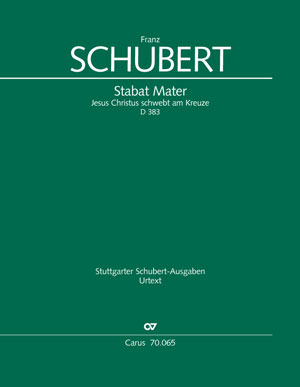
Stabat Mater
Jesus Christus schwebt am Kreuze D 383
In spring 1816 Franz Schubert, just nineteen years old, completed his second setting of the Stabat Mater in the midst of a highly productive period. In contrast with his first setting written the previous year, just five minutes in length, this time Schubert used the German translation by Klopstock as the basis for his composition. Stefan Schuck’s edition is the first one of this work to be based on a critical evaluation of the primary sources, with complete performance material. The work, in a dark F minor, with its text by Klopstock, places Jesus Christ, rather than Mary, at the center of the contemplation. With his fugues, but particularly in the eight-part lamenting chorus "Wer wird Zähren sanften Mitleids", Schubert shows himself at the height of his creative output. He composed his 4th Symphony, the "Tragic", at almost the same time.
The Stabat Mater is a rewarding work for choral societies and choirs to perform, because the choir has the largest portion to sing, and the choral parts are not too demanding. The composition is also a beautiful introduction to the choral-symphonic music of Schubert for less experienced choirs.


-
Composer
Franz Schubert
| 1797-1828Throughout most of his life Franz Schubert was concerned with church music. When he was eleven he was chosen as treble soloist at his local church in the Vienna suburb of Lichtenthal and soon afterwards he was admitted to the choir of the Imperial Court Chapel, directed by Antonio Salieri. Soon he also began to compose; his earliest surviving sacred pieces date from 1812. During his lifetime his church music achieved a comparatively wide degree of acceptance but after his death, most notably, his smaller works were unjustly forgotten. The Carus programme encompasses Schubert’s complete sacred compositions and it is intended to emphasize the wide range of his works in this area. Many of the smaller liturgical compositions are published here for the first time in separate editions. What is to be discovered is a fascinating œuvre, rooted in the ‘stile antico’ of Antonio Salieri and in the compositions of the Viennese classical masters, but whose exquisite lyricism and harmonic subtlety reveal a typically Schubertian world of expression: works with great power of conviction and exceptional musical beauty. Personal details
-
Editor
Stefan Schuck
| 1963
Reviews
... Die ganze Schönheit des Werkes erfährt man, so der Herausgeber, erst durch präzises Befolgen der zahlreichen dynamischen und artikulatorischen Besonderheiten, eine gute Schule also für größer besetzte Kammerchö re und differenziert musizierende Instrumentalistinnen.
Ulrich Barthel, Chorzeit, 01/2019
... Die vorliegende Ausgabe ist die erste quellensichere Ausgabe dieses Werkes mit komplettem Aufführungsmaterial. ... Die Komposition ist also auch für weniger leistungsstarke Chöre ein schöner Einstieg in die chorsymphonische Musik Schuberts.
Kirchenmusikalische Mitteilungen der Diözese Rottenburg-Stuttgart, Juli/Aug. 2019
... Das erstklassige Werk eignet sich in besonderer Weise für Passionskonzerte, wobei der beträchtliche Choranteil eine überaus dankbare Aufgabe darstellt. (mk)
Kirchenmusikalische Mitteilungen der Erzdiözese Freiburg, Mai 2019
... Die Neuausgabe von Carus ist die erste quellenkritische und bietet mit qualitativ hochwertigem Druck und gut lesbarem Notenbild eine optimale Arbeitsgrundlage zur Einstudierung des Werkes. (js)
Kirchenmusik im Bistum Limburg, 1/ 2019
Reviews on our website can only be submitted by customers with a registered user account. A check whether the rated products were actually purchased does not take place.
Frequent questions about this work
 There are no questions and answers available so far or you were unable to find an answer to your specific question about this work? Then click here and send your specific questions to our Customer Services!