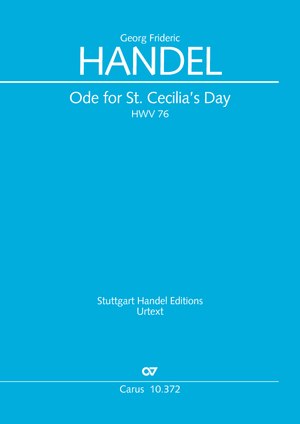
À la fin du XVIIe siècle, les compositeurs anglais fêtaient le 22 novembre sainte Cécile, patronne des musiciens, par des offices religieux et des concerts spéciaux. Händel fit revivre la tradition de cette fête le jour de la sainte Cécile 1732 par son « Ode for St. Cecilia’s Day » (HWV 76). Cette pièce appelée « Petite Ode de la sainte Cécile » est une louange joyeusement musicale au pouvoir de la musique : deux chœurs solennels encadrent cinq airs séduisants présentant chacun un instrument en soliste et correspondant chacun selon les règles de l’art baroque à une émotion particulière. Ce faisant, Händel laisse aux solistes, et particulièrement à l’orgue, son instrument préféré, une grande liberté d’improvisation et de grandes possibilités de démontrer leur talent.
Découvrir
 Consulter

 Ecouter
(12)
Ecouter
(12)
- Ouverture – Menuet
- Recitative (Tenore): From harmony, from heav’nly harmony; Accompagnato (Tenore): When nature, underneath a heap
- Chorus: From harmony, from heav’nly harmony
- Air (Soprano): What passion cannot Music raise
- Air (Tenore) and Chorus: The Trumpets loud clangor
- La Marche
- Air (Soprano): The soft complaining Flute
- Air (Tenore): Sharp Violins proclaim
- Air (Soprano): But oh! what art can teach
- Air (Soprano): Orpheus could lead could lead the savage race
- Accompagnato (Soprano): But bright Cecilia rais’d the wonder high’r
- Chorus: As from the pow’r of sacred lays
 Compléments
- Acheter des compléments au format téléchargement.
-
 Texte numérique (sans notes), licence d'impression incluse, fichier html, paroles, traduction allemandefichier html, paroles, traduction allemande (Extrait)
Ouvertüre – Menuett
1. Rezitativ (Tenore) Aus Harmonie, aus heil’ger Harmonie
erwuchs dies Weltall, endlos weit.2. Accompagnato (Tenore) Als formlos die Natur noch war
und ganz verworren lag,
sich selbst noch kaum bewußt,
klang wie Musik des Schöpfers Wort:
„Erstarrte Welt, wach’ auf!“
Da ordneten sich Kalt und Heiss,
und Feucht und Trocken schieden sich,
gehorchend der Musik.3. Chor Aus Harmonie, aus heil’ger Harmonie
erwuchs dies Weltall, endlos weit:
Von Harmonie zu Harmonie
durchlief die Schöpfung aller Töne Klang
zur letzten Stufe, die da war der Mensch.4. Arie (Soprano)
...
-
Texte numérique (sans notes), licence d'impression incluse, fichier html, paroles, originalfichier html, paroles, original (Extrait)
Ouverture – Menuet
1. Recitative (Tenore) From harmony, from heav’nly harmony This universal frame began.
2. Accompagnato (Tenore) When nature underneath a heap
of jarring atoms lay,
and could not heave her head,
the tuneful voice was heard from high,
arise ye more than dead.
Then cold, and hot, and moist, and dry,
in order to their stations leap,
and Music’s pow’r obey.3. Chorus From harmony, from heav’nly harmony
this universal frame began:
from harmony to harmony
through all the compasss of the notes it ran,
the diapason closing full in man.4. Air (Soprano)
...
-
Texte numérique (sans notes), licence d'impression incluse, fichier html, Texte introductif, françaisfichier html, Texte introductif, français (Extrait)Avant-propos de l’édition Carus 10.372
Markus Schwering>
Traduction : Sylvie CoquillatDepuis le 15ème siècle, sainte Cécile, martyr romaine dès débuts du christianisme, fait l’objet d’un culte, les protestants en faisant même plus tard la protectrice de la musique d’église. D’un point de vue historique, la synthèse religieuse et musicale qu’elle incarne et qui est glorifiée dans la légende n’a aucune substance. Ce qui n’affecte en rien le culte cécilien – depuis des siècles, le 22 novembre fut et est célébré comme jour de sa commémoration par une fête de sainte Cécile accompagnée de prestations musicales. C’est aussi le cas à l’époque de Haendel à Londres. Depuis 1683, une Musical Society organise les festivités correspondantes, qui comprennent chaque fois la représentation d’une œuvre nouvelle avec référence thématique adéquate. Lorsque Haendel compose Alexander’s Feast et l’Ode for St. Cecilia’s Day, il s’inscrit donc dans une
...
Acheter
Informations complémentaires sur l'œuvre
Sommaire

-
Compositeur
Georg Friedrich Händel
| 1685-1759Georg Friedrich Händel a démontré très tôt ses capacités de composition universelle exceptionnelles. Après s'être installé à Londres en 1712, il y créa - nommé Composer of Musick for His Majesty's Chapel Royal en 1723 - de nombreux chefs-d'œuvre pour la cour royale ainsi que ses grandes séries d'opéras : pendant des années, il connut des succès triomphants avec des opéras chantés par des interprètes d'exception ou avec des sérénades, plus tard aussi avec des oratorios comme "Saul" ou "Israel in Egypt". Au fil des années, la renommée de Haendel s'est étendue bien au-delà de son lieu de travail ; certaines de ses œuvres chorales, notamment le "Messiah", disposent d'une tradition d'exécution qui ne s'est jamais démentie et sont chantées par des chœurs du monde entier. Plus d'information sur la personne
-
Éditeur
Christine Martin
-
Parolier/Librettiste
John Dryden
-
auteur de la réduction pour piano
Paul Horn
| 1922-2016Paul Horn war ein deutscher Kirchenmusiker, Organist, Komponist und Musikwissenschaftler. Er studierte Kirchenmusik und Orgel an der Evangelischen Kirchenmusikschule Esslingen am Neckar bei Hans-Arnold Metzger und Musikwissenschaft, Theologie und Geschichte an der Universität Tübingen. Seine berufliche Laufbahn begann als Kantor an der Evangelischen Michaelskirche in Stuttgart-Degerloch. 1954 wurde er Kantor an der Evangelischen Stadtkirche Ravensburg, eine Position, die er bis zu seiner Pensionierung innehatte. Als Musikwissenschaftler arbeitete Horn bis ins hohe Alter eng mit Carus zusammen. So stammen zahlreiche Carus-Klavierauszüge aus seiner Feder. Plus d'information sur la personne
Critiques
Georg Friedrich Händel: Ode for St
Georg Friedrich Händel: Ode for St. Cecilia’s Day (HWV 76)
Im Rahmen seiner Stuttgarter Händel-Ausgaben legt der Carus-Verlag nun die Cäcilienode des Jahres 1739 auf einen Text von John Dryden (engl.) vor. Neben den für Händel bezeichnenden festlichen Chören besticht das dreizehnteilige Werk durch ungewöhnlich phantasievolle Instrumentierung der Soloarien. Das Werk ist sicherlich einmal eine Alternative zum ewigen Dauerbrenner Messias, nur leider wohl nicht abendfüllend.
Wilfried Rombach
Quelle: Kirchenmusikalische Mitteilungen 10/2004
I can still remember the impression made on me when, I suppose about 45 years ago, I bought a World Record Club disc of this and was bowled over by the alternating soprano solo and choral chorale that begins the final chorus ? luckily I don‚t still have the disc, since I suspect that I‚d now find that Teresa Stich-Randall‚s voice lacked the precision of the trumpet fanfare that arose under her final top A. I don‚t remember ever hearing a live performance, their rarity perhaps being because of the lack of decent orchestral material (though the Kalmus set isn‚t as bad as usual). We were thinking of doing a set ourselves during the next few months, but that has been made unnecessary by this fine new edition from Carus. As well as the full score, the vocal score is already available (10.372/03; ?14.00, about £9.5o) and parts are promised in a couple of months. There are two obvious editorial decisions to be made. One is the title. As with Purcell‚s Hail, bright Cecilia, the term Ode refers to the form of the poem, while the musical term is Song. Handel‚s autograph is headed Ouverture to the Song for St Cecilia‚s Day by Mr Dryden 1687, and the first two editions of the work have the usual title for selected solos, Songs from/in continued with the word Ode referring to the poem: in the Ode wrote by Mr Dryden for St. Cecilia‚s Day Set by Mr Handel. In the first full score (1771) the title is more ambiguous: The Complete Score of the Ode... Set to Music by Mr Handel. HWV uses the opening line ‚From Harmony, from heav‚nly Harmony‚ as the main title, but undermines it by having Ode for St. Cecilia‚s Day as the running heading for the relevant pages. Modern usage should probably be either the first line or Dryden‚s Ode...
The other problem is what to do with the minuets that end the Ouverture. The autograph has one in D minor followed by another in D major, with the D-minor one crossed out. The Ouverture is missing from the conducting score. I haven‚t had a chance to check the early sources, but it is curious that the three pre-Chrysander editions I have (Arnold c.1792, The Handel Society, 1844-5, and Vincent Novello‚s vocal score from the 1850s) all have the related Minuet in D major that Handel used to end op. 6/5 (whose first two movements are taken from the Overture to the St Cecilia‚s Day Song). I would guess this to have been normal 18th-century manner of performance. The Carus edition ignores Handel‚s deletion, reverses the MS order, and prints them as Minuet and Trio, not Handel‚s normal treatment when minuets end overtures. I‚d be happier if the suggestion were footnoted, not buried in the commentary. The editor misses that in the D major Minuet, the middle line is allocated to violin 3 as well as viola: at least, that‚s how it reads to me, both on the facsimile in the edition and on my microfilm.
Were this a thorough critical edition, I would expect a slightly more precise commentary. I can‚t see on my film, for instance, the words Liuto and Org. at bar 39 of No. 7, although as suggestions they are sensible enough. But I have no hesitation in recommending this to customers. It is good value (about £22), clearly readable, with no cluttering German translation underlaid; instead, the poem is printed the introduction with a German version alongside.
Quelle: Early Music Review, 4/04, S.3
Les évaluations sur notre site web ne peuvent être effectuées que par des clients disposant d'un compte d'utilisateur enregistré. Il n'est pas vérifié si les produits évalués ont été effectivement achetés.
Aucune évaluation disponible pour ce produit.
Questions fréquentes sur l'œuvre
 Il n'y a pas encore de questions et réponses concernant cette œuvre ou vous n'avez pas trouvé la réponse à votre question sur l'œuvre ? Cliquez ici et envoyez votre question spécifique à notre service clients.