St. Mark Passion
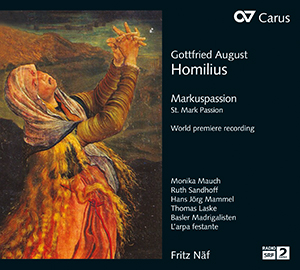
Die Geschichte des Leidens und Sterbens unseres Heilandes Jesu Christi nach der Beschreibung des Evanglisten Marcus HoWV I.10

The world premiere recording of Gottfried August Homilius’s St. Mark Passion is part of a widely acclaimed series featuring music for Passion (e.g. St. John Passion and Passion Cantatas) by this Bach pupil and Dresden Kreuzkantor. He was among the last composers of the 18th century who, in addition to composing Passion oratorios based on entire poetic texts also continued to write Passions using biblical texts. With emotional arias, unusual orchestral sounds and expressive turba choruses Homilius translated the Passion to his time. Fritz Näf, the Basler Madrigalisten and L’arpa festante have devoted their talents and energies to this Passion of the sensitive style.
Découvrir
 Ecouter
(75)
Ecouter
(75)
- 1. Choral "So gehst du nun, mein Jesu"
- 2a. Recitativo "Und nach zween Tagen"
- 2b. Coro "Ja nicht auf das Fest"
- 2c. Recitativo "Und da er zu Bethanien"
- 2d. Coro "Was soll doch dieser Unrat"
- 2e. Recitativo "Und murreten über sie"
- 3. Aria "Mensch, empfinde doch Erbarmen"
- 4a. Recitativo "Und Judas Ischarioth"
- 4b. Coro "Wo willt du"
- 4c. Recitativo "Und er sandte"
- 5. Choral "Wo soll ich, der du alles weißt"
- 6. Recitativo "Und sie wurdne traurig"
- 7. Choral "O weh demselben"
- 8. Recitativo "Und indem sie aßen"
- 9a. Aria "Wenn euch eure Sünden drücken"
- 9b. Coro "Dir Heiland, dir weihn wir"
- 10. Recitativo "Und da sie den Lobgesang"
- 11. Choral "Hilf, dass ich stets"
- 12. Recitativo "Desselbengleichen"
- 13. Choral "Wache, dass dich Satans List"
- 14. Recitativo "Und ging ein wenig"
- 15. Aria "Ich geh, von Leiden ganz"
- 16. Recitativo "Und alsbald"
- 17. Choral "Sei getreu in deinem Herzen"
- 18. Recitativo "Die aber legten"
- 19. Choral "Mir nach, spricht Christus"
- 20a. Recitativo "Und er war da"
- 20b. Arioso "Wir haben gehöret"
- 20c. Recitativo "Aber ihr Zeugnis"
- 21. Choral "O Jesu, hilf zur selben Zeit"
- 22. Recitativo "Da zuriss der Hohepriester"
- 23. Aria "Verdammt ihn nur"
- 24a. Recitativo "Da fingen an etliche"
- 24b. Coro "Weissage uns"
- 24c. Recitativo "Und die Knechte"
- 24d. Coro "Wahrlich, du bist der einer"
- 24e. Recitativo "Und er fing an"
- 25. Aria "Verkennt ihn nicht"
- 26. Recitativo "Und der Hahn krähete"
- 27. Choral "O Vater der Barmherzigkeit"
- 28. Choral "Weint, izt wird"
- 29. Recitativo "Und bald am Morgen"
- 30. Aria "Mit Preis und Ruhm gekrönt"
- 31a. Recitativo "Und die Hohenpriester"
- 31b. Coro "Kreuzige ihn"
- 31c. Recitativo "Pilatus aber sprach"
- 31d. Coro "Kreuzige ihn"
- 32. Choral "Herzliebster Jesu"
- 33a. Recitativo "Pilatus aber gedachte"
- 33b. Coro "Gegrüßet seist du"
- 33c. Recitativo "Und schlugen ihm"
- "34a. Accompagnato "Jerusalem"
- 34b. Aria "Er hat dich erretten wollen"
- 34c. Accompagnato "Nein, du hast nicht"
- 34d. Aria "Er will leiden"
- 33. Recitativo "Und sie brachtem ihn"
- 36. Choral "Dein Durst und Gallentrank"
- 37a. Recitativo "Und da sie ihn"
- 37b. Coro "Pfui dich"
- 37c. Recitativo "Desselbigengleichen"
- 37d. Coro "Er hat andern geholfen"
- 37e. Recitativo "Und die mit ihm"
- 38. Choral "Ich werde dir zu Ehren"
- 39. Recitativo "Und nach der sechsten"
- 40. Aria "Verstummet, ihr Himmel!"
- 41a. Recitativo "Und etliche"
- 41b. Coro "Siehe, er rufet"
- 41c. Recitativo "Da lief einer"
- 42. Aria "Ihr Tränen fließt!"
- 43. Recitativo "Und der Vorhang"
- 44. Choral "Ihr Gräber brecht"
- 45. Recitativo "Der Hauptmann aber"
- 46. Choral "Der Hirt ist tot"
- 47. Recitativo "Und er kaufte"
- "Gott ist versöhnt"
 Compléments
- Acheter des compléments au format téléchargement.
-
 Texte numérique (sans notes), licence d'impression incluse, fichier html, paroles, traduction en anglaisfichier html, paroles, traduction en anglais (Extrait)Part 1 1. Choral
And so thou goest, Lord Jesus, hence
2a. Recitativo Evangelist
to suffer death for me,
sinner that I am,
who hath clouded thy joy.
Go on thy way, then, noble treasure!
Weeping and wailing,
my eyes shall yield a flood of tears
to besprinkle thy sorrow.
Caspar Friedrich Nachtenhofer (1624–1685): „So gehst du nun, mein Jesu, hin“, Verse 1
Translations (chorals & arias): Hector Ian SogaAfter two days was the feast of the passover, and of unleavened bread: and the chief priests and the scribes sought how they might take him by craft, and put him to death. But they said:
2b. CoroNot on the feast day, lest there be an uproar of the people.
2c. Recitativo EvangelistAnd being in Bethany in the house of Simon the leper,
...
-
Texte numérique (sans notes), licence d'impression incluse, fichier html, paroles, originalfichier html, paroles, original (Extrait)Teil 1 1. Choral
So gehst du nun, mein Jesu, hin,
2a. Recitativo Evangelist
den Tod für mich zu leiden,
für mich, der ich ein Sünder bin,
der dich betrübt in Freuden.
Wohlan, fahr fort, du edler Hort,
mein Augen sollen fließen,
ein Tränensee mit Ach und Weh
dein Leiden zu begießen.
Caspar Friedrich Nachtenhofer (1624–1685): „So gehst du nun, mein Jesu, hin“, Strophe 1Und nach zween Tagen war Ostern und die Tage der süßen Brot. Und die Hohenpriester und Schriftgelehrten suchten, wie sie ihn mit Listen griffen und töten. Sie sprachen aber:
2b. CoroJa nicht auf das Fest, dass nicht ein Aufruhr im Volk werde.
2c. Recitativo EvangelistUnd da er zu Bethanien war, in Simonis, des Aussätzigen, Hause, und saß zu Tische, da kam ein Weib,
...
-
Texte numérique (sans notes), licence d'impression incluse, fichier html, Texte introductif, en anglaisfichier html, Texte introductif, en anglais (Extrait)Text from the CD 83.260
Uwe Wolf
Translation (abridged): Elizabeth RobinsonPRINCESS may the work of the devout Muse please YOU, | who dedicates it to YOU shyly and reverently, | YOUR great acclaim shall encourage him to greater songs, | if he deserves these, he will sing happily. | YOUR ROYAL HIGHNESS’S | most humble servant | Gottfried August Homilius.
With these affected words, typical of the time, Gottfried August Homilius, Kreuzkantor in Dresden, dedicated a copy of his St. Mark Passion to the Prussian princess Anna Amalia, the music lover and composing sister of Frederick the Great.
This dedication by the Dresden Kantor to the Prussian princess was most probably in connection with a Berlin performance of the St. Mark Passion, the precise date of which is not known, which had taken place a few years prior to 1765. Both that performance as well as the dedication are notable in several respects.
In the 1760s, the immensely successful Passion oratorio Der Tod Jesu, composed in 1755 by Carl Heinrich Graun (who was associated with the circle centered around Anna Amalia), was already enjoying its triumphal progress throughout Germany. With the success of Der Tod Jesu Passion oratorios without
...
-
Texte numérique (sans notes), licence d'impression incluse, fichier html, Texte introductif, en allemandfichier html, Texte introductif, en allemand (Extrait)Booklet-Text der CD Carus 83.260
Uwe Wolf
PRINZESSIN laß DIR das Werk der frommen Muse gefallen, | das sie DIR schüchtern und erfurchtsvoll weyht, | DEIN hoher Beyfall soll sie zu höhern Liedern ermuntern, | Verdient sie diesen, so sing sie beglückt. | EUER KOENIGLICHEN HOHEIT | unterthänigster Knecht | Gottfried August Homilius.
Mit diesen zeittypisch gestelzten Worten widmete der Dresdner Kreuzkantor Gottfried August Homilius eine Abschrift seiner Markuspassion der preußischen Prinzessin Anna Amalia, der musikliebenden und komponierenden Schwester Friedrichs des Großen. Diese Widmung des Dresdner Kantors an die preußische Prinzessin steht höchstwahrscheinlich im Zusammenhang mit einer nicht genau zu datierenden Berliner Aufführung jener Markuspassion, die wenige Jahre vor 1765 stattgefunden hatte (eine Berliner Aufführung einer nicht näher genannten Passion 1758 von Homilius ist bezeugt). Sowohl jene Aufführung als auch die Widmung sind in mehrfacher Hinsicht bemerkenswert.
In den 1760er Jahren hatte das immens erfolgreiche Passionsoratorium Der Tod Jesu von Carl Heinrich Graun (1755, entstanden im Umkreis Anna Amalias) seinen deutschlandweiten Siegeszug bereits begonnen. Mit dem Erfolg des Tod
...
Acheter
Informations complémentaires sur l'œuvre
Sommaire

-
Compositeur
Gottfried August Homilius
| 1714-1785Gottfried August Homilius, the son of a pastor, was born in Rosenthal (Saxony) on 2 February 1714. In May 1735 he enrolled as a law student at Leipzig University. Likewise, it was probably at this time that Homilius was a pupil of Johann Sebastian Bach; the latter fact had been attested to by Johann Adam Hiller. Apart from Bach, Homilius also had contact with Johann Schneider, a Bach pupil and organist at the Nicolaikirche, for whom he also substituted. After unsuccesfully applying for a post as organist in Bautzen, Homilius was appointed organist at the Dresden Frauenkirche in 1742. In 1755 Homilius succeeded Theodor Christlieb Reinhold as Kreuzkantor and music director of the three main churches in Dresden, a position that he occupied until his death on 2 June 1785. Plus d'information sur la personne
-
L'auteur de l'avant-propos
Uwe Wolf
| 1961Uwe Wolf est un musicologue spécialisé dans les 17e et 18e siècles. Ses domaines de travail s'étendent de l'époque de Monteverdi et de Schütz au classicisme viennois en passant par Bach et la génération des fils et élèves de Bach. Depuis octobre 2011, il dirige le lectorat de la maison d'édition Carus. Auparavant, il a travaillé pendant plus de 20 ans dans la recherche sur Bach. Plus d'information sur la personne
-
Ensemble
L'arpa festante Barockorchester
-
Ensemble
Basler Madrigalisten
Les Basler Madrigalisten (Madrigalistes de Bâle) créés par Fritz Näf chantent dans les distributions les plus diverses, en solistes ou en petit ensemble vocal. Leur vaste répertoire s’étend des débuts de la Renaissance à nos jours. Les centres de gravité de leur travail sont l’étude et la représentation (initiale) d’œuvres contemporaines, ainsi que la reprise d’œuvres du 15ème au 18ème siècle. Les Madrigalistes de Bâle se sont produits lors des festivals musicaux les plus importants au monde. Des tournées de concert les ont conduits dans presque tous les pays d’Europe, en Russie, aux Etats-Unis, au Liban et en Extrême-Orient. Les enregistrements des Madrigalistes de Bâle ont été récompensés de diverses distinctions. Ils ont obtenu plusieurs fois le Prix d’encouragement de la Fondation musicale Ernst von Siemens et ont reçu en 1998 le Prix d’encouragement de l’Économie Européenne. Les Madrigalistes de Bâle sont soutenus par les deux cantons Pays Bâlois et Ville de Bâle, par la Fondation Artephila et d’autres fondations. Plus d'information sur la personne
-
Chef d'orchestre
Fritz Näf
| 1943Fritz Näf a étudié le chant soliste aux Conservatoires de musique de Zurich et Fribourg/Brisgau et a fréquenté les masterclasses entre autres de Jenny Tourel et Ernst Haefliger. En qualité de ténor, il donne des concerts dans la plupart des pays d’Europe et a acquis en plus une formation de chef de chœur et d’orchestre. De 1976 à 1986, il a enseigné le chant soliste et l’ensemble vocal à la Schola Cantorum Basiliensis, où il a créé en 1978 les Madrigalistes de Bâle. De 1986 à 2000, il a été tout d’abord directeur de l’école de musique et du conservatoire de Winterthur, puis recteur de la nouvelle Faculté de musique et de théâtre de Zurich. Depuis décembre 2000, Fritz Näf est directeur artistique à temps complet du Chœur de chambre suisse créé en 1997, ainsi que des Madrigalistes de Bâle ; il est par ailleurs chef invité auprès de différents chœurs et orchestres. Plus d'information sur la personne
-
Solist - soprano
Monika Mauch
La soprano Monika Mauch a étudié le chant tout d’abord auprès de Richard Wistreich à l’Institut de musique ancienne du Conservatoire de musique de Trossingen puis a approfondi sa formation au cours d’une année d’étude à Paris avec Jill Feldman. Depuis le début de sa carrière vocale, des projets de musique ancienne sont au cœur de son intérêt musical. Elle travaille avec des ensembles de renom tels que le Ricercar Ensemble, le Taverner Consort, avec Red Byrd, le Hilliard Ensemble, L’arpa festante (Munich), l’ensemble Daedalus (Genève), le CordArte Ensemble (Cologne) et le Montreal Baroque. Nombre d’enregistrements pour la radio et le CD documentent le travail vocal de Monika Mauch. Les enregistrements du « Altbachisches Archiv » et de la Messe en si mineur avec Cantus Coelln et le CD « Morimur » avec le Hilliard Ensemble ont été particulièrement remarqués. En tant qu’interprète de concert, Monika Mauch travaille régulièrement avec des chefs d’orchestre tels que Roland Wilson, Manfred Cordes, René Jacobs et Philippe Herreweghe. Plus d'information sur la personne
-
Solist - alto
Ruth Sandhoff
The repertoire of mezzo-soprano Ruth Sandhoff ranges from early Baroque works to contemporary compositions. Lied singing is her especial passion, also in collaboration with the choreographer Sasha Waltz. Ruth Sandhoff has given concert tours in the USA, in Australia and in Europe. She has participated in numerous CD productions both in Germany and abroad. The recording of J. C. Bach’s “Missa da Requiem” with the RIAS Chamber Choir was awarded the German Record Critics’ Award. Plus d'information sur la personne
-
Solist - ténor
Hans Jörg Mammel
-
Solist - basse
Thomas Laske
Thomas Laske was born in Stuttgart. He won the Richard Strauss singing competition in Munich in 1997. As a concert singer the baritone has appeared with leading conductors and ensembles such as Riccardo Chailly, Mariss Jansons, Ton Koopman, Helmuth Rilling, the Bavarian Radio Symphony Orchestra, Leipzig Gewandhaus Orchestra, Saint Petersburg Philharmonic Orchestra, Amsterdam Baroque Orchestra & Choir, Dresdner Kreuzchor, and Thomanerchor Leipzig and has participated in numerous CD productions. On the operatic stage (a.?o. Deutsche Oper Berlin, Deutsche Oper am Rhein and the Bavarian State Opera in Munich) he has sung roles including Barbier, Don Giovanni, Figaro, Graf Almaviva, Escamillo, Eugen Onegin, Sharpless, and Marcello. Thomas Laske has been teaching singing at the Robert Schumann Hochschule in Düsseldorf since 2010. Plus d'information sur la personne
Critiques
Homilius erweist sich hier als ein grosser Komponist, und die Interpreten lassen seine Qualitäten zur vollen Blüte kommen.
Toccata, Nr. 2 (März/April) 2014
Die Aufnahme kann in allen Belangen als mustergültig bezeichnet werden.
Neue Zürcher Zeitung, 18. Oktober 2013
[…] a compelling Passion with music of great beauty and incisive expression. The performance does full justice to its character and quality. […] A worthy addition to the repertoire for Passiontide.
Johan van Veen, musicweb-international.com, Juli 2013
Fritz Näf und seine Ensembles verstehen es wunderbar, die Worte in Musik zu kleiden und den Text glaubwürdig, authentisch zu interpretieren.
Pizzicato, Juni 2013
This new recording of the St. Mark Passion HoWV I.10 by Gottfried August Homilius (1714-1785) is an important release that should not slip by any collector unnoticed; it has been released by Carus and is the world premiere recording. Regarding the performance, there really isn't much more to ask for from tenor-turned-conductor Fritz Näf, the Basler Madrigalisten, L'arpa Festante and his fine assembly of vocal soloists.
Paul Ballyk, expeditionaudio.com, 24. April 2013
Fritz Näf und seine Ensembles überzeugen auf der ganzen Linie mit ihrem frischen, direkten, durchaus dramatisch orientierten Ansatz, der auch das Elegante, Schlichte schön zur Entfaltung kommen lässt. Eine feine Bereicherung des Repertoires.
Dr. Matthias Lange, klassik.com, 23. April 2013
Und da Gottfried August Homilius in Fritz Näf und seinen Ensembles „L’arpa festante“ und Basler Madrigalisten, ergänzt um gehaltvolle Solisten, überaus beredte Anwälte findet, erklingt hier eine Passionsmusik, die keine Wünsche offen lässt, daneben aber auch in Sachen spiritueller Expressivität hohe Maßstäbe setzt.
Norbert Meyers, Kirchenzeitung/Bistumspresse, Ausgabe 2013.12 - 24. März 2013
A grandly expressive take on the St Matthew Passion […] elegant performances […]
John Terauds, Musical Toronto, 16. März 2013
Fritz Näf gelingt mit den Basler Madrigalisten und dem Ensemble L'arpa festante eine tief empfundene, den klassischen Duktus betonende Interpretation. […] Musikalisches Neuland, das den Entdecker reich belohnt.
Glaube + Heimat, 17. März 2013
Es muss nicht immer Bach in der vorösterlichen Zeit sein! Hier muss sogleich angemerkt werden, dass alle Homilius-Einspielungen des Carus-CD-Labels interpretatorisch auf allerhöchstem Niveau angesiedelt sind, was in besonders hohem Maße für die vorliegende gilt. Die hochprofessionellen Solisten, der Chor und das Instrumentalensemble setzen hier ihre langjährige Erfahrung mit der Musik des 17. und 18. Jahrhunderts höchst eindrücklich um. Vor allem gelingt Fritz Näf vorzüglich, den besonderen Ausdruckswert der Komposition zu entfalten.
Bernhard Morbach, kulturradio rbb, 7. März 2013
[…] insightfully performed […]
New Classics, März 2013
Die Stärke dieser historisch informierten Aufnahme ist die Kultur, mit der hier gesungen und musiziert wird. [...] eine große Entdeckung, die einen ins Herz trifft.
Mannheimer Morgen, 21. Februar 2013
... The performances of this truly shining St. Mark are absolutely first rate all around, from chorus to soloists, to the exceptionally gorgeous-sounding orchestra, all under the knowing and caring hand of director Fritz Näf. The sound, from the Reformierte Kirche Arlsheim, couldn’t be bettered.
Classics today, 2021
Les évaluations sur notre site web ne peuvent être effectuées que par des clients disposant d'un compte d'utilisateur enregistré. Il n'est pas vérifié si les produits évalués ont été effectivement achetés.
Aucune évaluation disponible pour ce produit.
Questions fréquentes sur l'œuvre
 Il n'y a pas encore de questions et réponses concernant cette œuvre ou vous n'avez pas trouvé la réponse à votre question sur l'œuvre ? Cliquez ici et envoyez votre question spécifique à notre service clients.