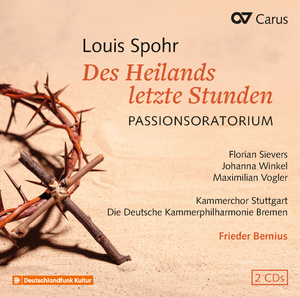
C’est une découverte : l’oratorio de la Passion Des Heilands letzte Stunden de Louis Spohr est quasiment inconnu aujourd’hui. Suite à une représentation de la Passion selon saint Matthieu de Bach, Spohr écrit sa Passion en 1834, relatant les événements sous une perspective inhabituelle : l’apotre Jean assume la fonction du narrateur directement partie prenante de la scène. Avec Marie, la mère de Jésus, il raconte la Passion. On remarquera particulièrement les scènes devant le grand prêtre Caiphe et devant la croix avec le séisme figuré dans la musique.
Ce grand oratorio de la Passion est un joyau de musique chorale sacrée du début du XIXe siècle, auquel nous avons de nouveau accès grâce à Frieder Bernius, son Kammerchor Stuttgart et la Deutsche Kammerphilharmonie de Brême. Les sept solistes sont excellent : Johanna Winkel, Maximilian Vogler, Florian Sievers, Arttu Kataja, Thomas E. Bauer, Felix Rathgeber et Magnus Piontek.
Découvrir
 Consulter

 Ecouter
(37)
Ecouter
(37)
- Ouvertüre
- Chor der Freunde und Freundinnen Jesu: Senke dich, stille Nacht
- Rezit. (Johannes): So find ich endlich Freunde meines Herrn
- Rezit. (Judas): Wohin? Wohin? Was scheut mein Blick?
- Arie (Judas): Weh! Judas, weh über dich!
- Rezit. (Maria): Wer bleibet sein, wenn ihm die Treue brechen
- Arie (Maria) und Chor: Und wenn sie alle weichen, ich hange fest an dir
- Rezit. (Johannes): Wer naht sich dort? Seht, welche düstre Schar
- Rezit. (Johannes): Folgt mir! Wir treten dem Palaste näher
- Arie (Petrus): Ewig fließet, meine Zähren
- Rezit. (Maria): Auch, Petrus, du? – Du Fels, auf den er baute
- Chor und Maria: Der du mit Allgewalt über dem Erdkreis thronst
- Rezit. (Johannes): Die Pforten des Palastes tun sich auf
- Chor der Priester, Philo und Zeugen: Lasst mit heiligem Erbeben
- Rezit. (Johannes) und Solo-Quartett: Wir schwören! Wir schwören!
- Rezit. (Nicodemus): Treu bin ich dem Gesetz, ihr wisst’s!
- Rezit. (Joseph von Arimathia): Auch mir erschien er ein Prophet des Herrn
- Chor der Priester und des Volks: Schmach! Schmach! Schmach!
- Solo (Kaiphas) und Chor: Tief hinab zum Staube beugt mich der Frevel
- Rezit. (Kaiphas und Jesus): Ich, der auf Moses heil’gem Stuhle thront
- Rezit. (Nicodemus): Und keinem regt sich in der Brust ein Herz?
- Chor der Priester und des Volks: Über uns komme sein Blut und über unsre Kinder!
- Chor und Soli: Blicke, du strahlende Sonne, nicht so freundlich
- Rezit. (Johannes): Wir stehn am Altar, wo das Lamm soll bluten
- Chor der Priester und des Volks: Arzt, der allen half, hilf dir nun selber!
- Rezit. (Johannes): Maria, hör auf ihn, nicht auf die Frevler!
- Rezit. (Maria): Er denkt an mich! Er hat auf mich geblickt
- Arie (Maria): Rufe aus der Welt voll Mängel
- Solo-Terzett (Freundinnen Jesu): Jesus, himmlische Liebe!
- Rezit. (Johannes): Blick hin: die letzte Stunde naht!
- Chor: In seiner Todesnot dich zu ihm wende
- Rezit. (Johannes), Solo-Quartett und Chor: Seht! Gott verlässt den nicht, der ihm vertraut
- Chor der Priester und des Volks: Welch drohend Ungewitter
- Rezit. (Joseph): Entflöht ihr auch dem Rächer in den Wolken
- Joseph und Chor: Er war der Christ, der Sohn des Hochgelobten
- Rezit. (Joseph): Den heil’gen Leichnam, nicht vom Tod entstellt
- Chor der Freunde und Freundinnen Jesu: Wir drücken dir die Augen zu
Acheter
Informations complémentaires sur l'œuvre
Sommaire


-
Compositeur
Louis Spohr
| 1784-1859Louis Spohr, né en 1784 à Braunschweig, mort en 1859 à Kassel. Considéré comme l'un des meilleurs violonistes, chefs d'orchestre et compositeurs de son époque. Il a suivi des cours de violon dès l'âge de cinq ans. Déjà violoniste à la chapelle de la cour de Brunswick en 1799, puis premier violon à Gotha ; 1812 - 1815 maître de chapelle à Vienne ; à partir de 1822 maître de chapelle de la cour de Kassel, recommandé par C. M. v. Weber. De longues tournées de concerts l'ont amené à rencontrer, entre autres, N. Paganini. Il a laissé plus de 200 œuvres, dont de nombreux chœurs a cappella. Son oratorio « Die letzten Dinge » (1826) a été très apprécié au 19e siècle. Plus d'information sur la personne
-
Parolier/Librettiste
Johann Friedrich Rochlitz
| 1769-1842Johann Friedrich Rochlitz était un compositeur, dramaturge et écrivain musical originaire de Leipzig. En 1798, il fonda l'Allgemeine Musikalische Zeitung (Journal musical général) et y publia de nombreux articles. Rochlitz fit la connaissance de nombreuses personnalités importantes de l'époque, notamment Goethe, Schiller, E. T. A. Hoffmann, Wieland, Beethoven et Schubert, qui mit également trois poèmes de Rochlitz en musique. Plus d'information sur la personne
-
Chœur
Kammerchor Stuttgart
The Kammerchor Stuttgart is regarded as one of the best ensembles of its kind. Over its fifty-year existence, Frieder Bernius has developed the choir into an exceptional ensemble acclaimed by audiences and press alike. This has led to invitations for the choir to perform at all the important European festivals. In Germany the chamber choir performs at festivals and in concert halls in repertoire ranging from the 17th to the 21st century. Frieder Bernius and his ensemble have received numerous accolades for their contribution to new music. The Kammerchor Stuttgart has made over 80 CDs and LPs, numerous of which have been awarded international recording prizes (including the Edison award, Diapason d’or, Gramophone Choice, Classical Internet Award, International Classical Music Award, and German Record Critics’ Award prizes). The International Federation for Choral Music has invited the ensemble to sing at the 1st, 4th and 10th World Symposia on Choral Music in Vienna, Sydney and Seoul. Regular tours of North America and Asia since 1988 and a South America tour reflect the Kammerchor Stuttgart’s international reputation. Since 1984 the top ensemble has also been invited to Israel biennially. Plus d'information sur la personne
-
Orchestre
Die Deutsche Kammerphilharmonie Bremen
The Deutsche Kammerphilharmonie Bremen is one of the world's leading orchestras, captivating audiences everywhere with its unique style of music-making. The Estonian conductor Paavo Järvi has been the orchestra's Artistic Director since 2004.
One of the many highlights of the collaboration with Paavo Järvi has been their Beethoven Project, on which conductor and orchestra concentrated for six years. Their Beethoven interpretations have been acclaimed worldwide by audiences and critics alike as benchmark performances. Following the Beethoven Project The Deutsche Kammerphilharmonie Bremen and Paavo Järvi focused on Robert Schumann's symphonic works with equal success.
The latest project of the orchestra and its conductor is the German composer Johannes Brahms. The first CD (Sony/RCA) of the project – Symphony No. 2, Tragic Ouverture and the Academic Festi-val Ouverture – was released in autumn 2017 and received the Opus Klassik in October 2018. The second CD, including Symphony No. 1 and the Haydn-Variations, followed in autumn 2018. With the third and fourth Symphony, released in March 2019, the symphony cycle has come to completion.
Highlight of the project was the internationally acclaimed performance of ›A German Requiem‹ on the 10th of April 2018 at Bremen Cathedral, 150 years after the first performance. The recording has now been released on DVD and Blu-ray by C-Major. In October 2019, ›The Brahms Code‹ – an excit-ing TV/DVD documentary about the Brahms Project produced by Deutsche Welle/Unitel – was re-leased and is the current German Record Critics' Award winner in the category music film (listed 1/20).
The Deutsche Kammerphilharmonie Bremen has been honoured with countless prizes such as Echo, Opus and Diapason d'Or for its recordings and the unique education project with the Gesamtschule Bremen-Ost in Osterholz-Tenever, the Zukunftslabor. For years, the orchestra has cultivated close musical friendships with international soloists such as Christian Tetzlaff, Maria João Pires, Janine Jansen, Igor Levit, Hilary Hahn and Martin Grubinger.
The Deutsche Kammerphilharmonie Bremen is permanent guest orchestra at the Elbphilharmonie Hamburg and Festival Orchestra of Kissinger Sommer. Plus d'information sur la personne
-
Chef d'orchestre
Frieder Bernius
| 1947Le travail de Frieder Bernius jouit d’une grande reconnaissance à l’échelle mondiale. Il est très sollicité à l’international, tant comme chef d’orchestre que comme professeur. Ses partenaires artistiques sont principalement le Chœur de chambre de Stuttgart, l’Orchestre baroque de Stuttgart, la Hofkapelle de Stuttgart et la Philharmonie classique de Stuttgart. C’est en 1968, avec la création du Chœur de chambre de Stuttgart, qu’il a posé les bases de sa carrière exceptionnelle, qu’il a rapidement fait de cet ensemble l’un des plus éminents de son genre. Qu’il s’agisse d’œuvres vocales de Monteverdi, Bach, Haendel, Mozart, Beethoven, Fauré et Ligeti, de musiques de théâtre de Mendelssohn ou de symphonies de Haydn, Burgmüller et Schubert, le travail de Frieder Bernius vise toujours un son à la fois fidèle à l’idéal sonore original et d’une personnalité incomparable. Il se consacre aussi bien à la redécouverte d’opéras du XVIIIe siècle qu’aux créations de compositions contemporaines. Il porte un intérêt particulier à l’histoire de la musique du sud-ouest de l’Allemagne. Le travail de Frieder Bernius est largement documenté sur disques et CD sous le label Carus. De nombreux enregistrements ont été récompensés par des prix internationaux. Dans le cadre du Festival choral allemand de Stuttgart, Frieder Bernius s’est vu décerner un CD d’or par les éditions Carus pour son intégrale de la musique vocale sacrée de Felix Mendelssohn Bartholdy. Plus d'information sur la personne
-
Solist - soprano
Franziska Bobe
Franziska Bobe studied singing in Würzburg. As a concert singer, she has developed a wideranging repertoire that extends from the historically informed performance practice of Baroque music (St. Matthew Passion in the Thomaskirche Leipzig, Christmas Oratorio in the Alte Oper in Frankfurt and St. Paul at the European Festival for Church Music in Schwäbisch Gmünd) to contemporary music (e.g., the world premiere of lieder by Uwe Strübing). Her collaboration with renowned conductors is documented on CDs and numerous radio recordings. Franziska Bobe has worked with Frieder Bernius and the Kammerchor Stuttgart for many years. Plus d'information sur la personne
-
Solist - soprano
Maria Bernius
-
Solist - alto
Leonie Volle
-
Solist - alto
Sigrun Bornträger
-
Solist - ténor
Raoul Bumiller
-
Solist - ténor
Valentin Bauer
-
Solist - ténor
Christian Georg
Critiques
Mit perfekter Balance, … und luzid wie immer konturiert der Kammerchor Stuttgart Dramatisches, lässt Ätherisches schweben … die Deutsche Kammerphilharmonie ... mit differenzierten Farbnuancen…
Stuttgarter Zeitung, 21.03.2025
Die Doppel-CD wird für lange Zeit eine Referenzaufnahme bleiben… Bernius holt das Maximum aus dem … Werk heraus.
Johannes Mundry, Hessische/ Niedersächsische Allgemeine, 02/2025
Bernius ... leitet das Werk mit großer musikalischer Intelligenz. Die Tempi sind genau, der Chor präzise und ausdrucksvoll, die Solisten stimmlich stark und textverständlich.
Hagai Goren, HaAretz, 07/2025
Die Deutsche Kammerphilharmonie Bremen unter Frieder Bernius hat mit dem präzisen, voluminösen Kammerchor Stuttgart eine Referenzaufnahme geschaffen.
Andreas Berger, Kultur und Leben, 06/2025
Die Aufnahme ist einmal mehr ein Verdienst des unermüdlichen Frieder Bernius mit seinem Kammerchor Stuttgart sowie der Deutschen Kammerphilharmonie Bremen, die uns hier mit ihren bekannten hohen Qualitäten einen bedeutenden Beitrag zur Passionsgeschichte zugänglich machen.
Gustav Danzinger, CHOR aktuell, 05/2025
Jürgen Gahre, Opernglas, 04/2025
Thorsten Stegemann, Kulturabdruck, 04/2025
Les évaluations sur notre site web ne peuvent être effectuées que par des clients disposant d'un compte d'utilisateur enregistré. Il n'est pas vérifié si les produits évalués ont été effectivement achetés.
Aucune évaluation disponible pour ce produit.
Questions fréquentes sur l'œuvre
 Il n'y a pas encore de questions et réponses concernant cette œuvre ou vous n'avez pas trouvé la réponse à votre question sur l'œuvre ? Cliquez ici et envoyez votre question spécifique à notre service clients.