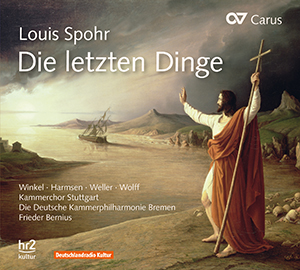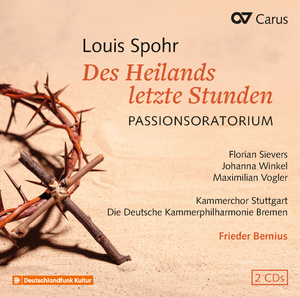
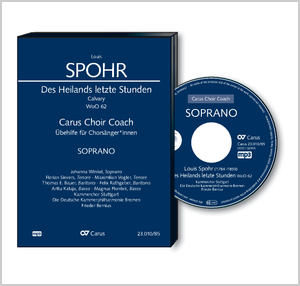
This is a real discovery: Louis Spohr’s Passion oratorio Des Heilands letzte Stunden is today practically unknown. Inspired by a performance of Bach’s St. Matthew Passion, Spohr wrote his Passion in 1834. It reports the well-known story from an unusual perspective: John the Apostle assumes the role of the narrator, who is also a direct participant in the proceedings. Together with Mary, mother of Jesus, he relates the terrible events of the Passion. The scenes at the Sanhedrin Trial and at the foot of the Cross, with its musical depiction of an earthquake, are particularly striking.
This great Passion oratorio is a jewel of early 19th-century sacred choral music, which Frieder Bernius and his Kammerchor Stuttgart, together with the Deutsche Kammerphilharmonie Bremen, have made accessible to us once again. The recording features seven outstanding soloists: Johanna Winkel, Maximilian Vogler, Florian Sievers, Arttu Kataja, Thomas E. Bauer as well as Felix Rathgeber and Magnus Piontek.
Explore
 View
View

 Listen
(37)
Listen
(37)
- Ouvertüre
- Chor der Freunde und Freundinnen Jesu: Senke dich, stille Nacht
- Rezit. (Johannes): So find ich endlich Freunde meines Herrn
- Rezit. (Judas): Wohin? Wohin? Was scheut mein Blick?
- Arie (Judas): Weh! Judas, weh über dich!
- Rezit. (Maria): Wer bleibet sein, wenn ihm die Treue brechen
- Arie (Maria) und Chor: Und wenn sie alle weichen, ich hange fest an dir
- Rezit. (Johannes): Wer naht sich dort? Seht, welche düstre Schar
- Rezit. (Johannes): Folgt mir! Wir treten dem Palaste näher
- Arie (Petrus): Ewig fließet, meine Zähren
- Rezit. (Maria): Auch, Petrus, du? – Du Fels, auf den er baute
- Chor und Maria: Der du mit Allgewalt über dem Erdkreis thronst
- Rezit. (Johannes): Die Pforten des Palastes tun sich auf
- Chor der Priester, Philo und Zeugen: Lasst mit heiligem Erbeben
- Rezit. (Johannes) und Solo-Quartett: Wir schwören! Wir schwören!
- Rezit. (Nicodemus): Treu bin ich dem Gesetz, ihr wisst’s!
- Rezit. (Joseph von Arimathia): Auch mir erschien er ein Prophet des Herrn
- Chor der Priester und des Volks: Schmach! Schmach! Schmach!
- Solo (Kaiphas) und Chor: Tief hinab zum Staube beugt mich der Frevel
- Rezit. (Kaiphas und Jesus): Ich, der auf Moses heil’gem Stuhle thront
- Rezit. (Nicodemus): Und keinem regt sich in der Brust ein Herz?
- Chor der Priester und des Volks: Über uns komme sein Blut und über unsre Kinder!
- Chor und Soli: Blicke, du strahlende Sonne, nicht so freundlich
- Rezit. (Johannes): Wir stehn am Altar, wo das Lamm soll bluten
- Chor der Priester und des Volks: Arzt, der allen half, hilf dir nun selber!
- Rezit. (Johannes): Maria, hör auf ihn, nicht auf die Frevler!
- Rezit. (Maria): Er denkt an mich! Er hat auf mich geblickt
- Arie (Maria): Rufe aus der Welt voll Mängel
- Solo-Terzett (Freundinnen Jesu): Jesus, himmlische Liebe!
- Rezit. (Johannes): Blick hin: die letzte Stunde naht!
- Chor: In seiner Todesnot dich zu ihm wende
- Rezit. (Johannes), Solo-Quartett und Chor: Seht! Gott verlässt den nicht, der ihm vertraut
- Chor der Priester und des Volks: Welch drohend Ungewitter
- Rezit. (Joseph): Entflöht ihr auch dem Rächer in den Wolken
- Joseph und Chor: Er war der Christ, der Sohn des Hochgelobten
- Rezit. (Joseph): Den heil’gen Leichnam, nicht vom Tod entstellt
- Chor der Freunde und Freundinnen Jesu: Wir drücken dir die Augen zu
Purchase
Additional product information
Contents


-
Composer
Louis Spohr
| 1784-1859Louis Spohr, born 1784 in Braunschweig, died 1859 in Kassel. Considered one of the best violinists, conductors and composers of his time. He received violin lessons from the age of five. As early as 1799 violinist in the Brunswick court orchestra, then concertmaster in Gotha; 1812 - 1815 Kapellmeister in Vienna; from 1822 court Kapellmeister in Kassel, recommended by C. M. v. Weber. Extensive concert tours brought him together with N. Paganini, among others. He left behind over 200 works, including many a cappella choirs. His oratorio ‘Die letzten Dinge’ (1826) was highly regarded in the 19th century. Personal details
-
Songwriter / Librettist
Johann Friedrich Rochlitz
| 1769-1842Johann Friedrich Rochlitz was a composer, dramatist and music writer from Leipzig. In 1798, he founded the Allgemeine Musikalische Zeitung (General Music Newspaper) and wrote numerous articles for it. Rochlitz became acquainted with many important figures of the time, including Goethe, Schiller, E. T. A. Hoffmann, Wieland, Beethoven and Schubert, who also set three of Rochlitz's poems to music. Personal details
-
Choir
Kammerchor Stuttgart
The Kammerchor Stuttgart is regarded as one of the best ensembles of its kind. Over its fifty-year existence, Frieder Bernius has developed the choir into an exceptional ensemble acclaimed by audiences and press alike. This has led to invitations for the choir to perform at all the important European festivals. In Germany the chamber choir performs at festivals and in concert halls in repertoire ranging from the 17th to the 21st century. Frieder Bernius and his ensemble have received numerous accolades for their contribution to new music. The Kammerchor Stuttgart has made over 80 CDs and LPs, numerous of which have been awarded international recording prizes (including the Edison award, Diapason d’or, Gramophone Choice, Classical Internet Award, International Classical Music Award, and German Record Critics’ Award prizes). The International Federation for Choral Music has invited the ensemble to sing at the 1st, 4th and 10th World Symposia on Choral Music in Vienna, Sydney and Seoul. Regular tours of North America and Asia since 1988 and a South America tour reflect the Kammerchor Stuttgart’s international reputation. Since 1984 the top ensemble has also been invited to Israel biennially. Personal details
-
Orchestra
Die Deutsche Kammerphilharmonie Bremen
The Deutsche Kammerphilharmonie Bremen is one of the world's leading orchestras, captivating audiences everywhere with its unique style of music-making. The Estonian conductor Paavo Järvi has been the orchestra's Artistic Director since 2004.
One of the many highlights of the collaboration with Paavo Järvi has been their Beethoven Project, on which conductor and orchestra concentrated for six years. Their Beethoven interpretations have been acclaimed worldwide by audiences and critics alike as benchmark performances. Following the Beethoven Project The Deutsche Kammerphilharmonie Bremen and Paavo Järvi focused on Robert Schumann's symphonic works with equal success.
The latest project of the orchestra and its conductor is the German composer Johannes Brahms. The first CD (Sony/RCA) of the project – Symphony No. 2, Tragic Ouverture and the Academic Festi-val Ouverture – was released in autumn 2017 and received the Opus Klassik in October 2018. The second CD, including Symphony No. 1 and the Haydn-Variations, followed in autumn 2018. With the third and fourth Symphony, released in March 2019, the symphony cycle has come to completion.
Highlight of the project was the internationally acclaimed performance of ›A German Requiem‹ on the 10th of April 2018 at Bremen Cathedral, 150 years after the first performance. The recording has now been released on DVD and Blu-ray by C-Major. In October 2019, ›The Brahms Code‹ – an excit-ing TV/DVD documentary about the Brahms Project produced by Deutsche Welle/Unitel – was re-leased and is the current German Record Critics' Award winner in the category music film (listed 1/20).
The Deutsche Kammerphilharmonie Bremen has been honoured with countless prizes such as Echo, Opus and Diapason d'Or for its recordings and the unique education project with the Gesamtschule Bremen-Ost in Osterholz-Tenever, the Zukunftslabor. For years, the orchestra has cultivated close musical friendships with international soloists such as Christian Tetzlaff, Maria João Pires, Janine Jansen, Igor Levit, Hilary Hahn and Martin Grubinger.
The Deutsche Kammerphilharmonie Bremen is permanent guest orchestra at the Elbphilharmonie Hamburg and Festival Orchestra of Kissinger Sommer. Personal details
-
Conductor
Frieder Bernius
| 1947Frieder Bernius’s work has earned great worldwide recognition. He is in demand internationally as a conductor and as a teacher. His principal artistic collaborators are the ensembles he founded himself, the Kammerchor Stuttgart, the Barockorchester Stuttgart, the Hofkapelle Stuttgart and the Klassische Philharmonie Stuttgart. As a guest conductor, he has collaborated repeatedly with, for example, the SWR Vokalensemble Stuttgart, the Deutsche Kammerphilharmonie Bremen, the Stuttgarter Kammerorchester and the Streicherakademie Bozen. Great stylistic versatility is Frieder Bernius’s hallmark. Whether he conducts vocal works by Monteverdi, Bach, Händel, Mozart, Beethoven, Fauré and Ligeti, stage music by Mendelssohn or symphonies by Haydn, Burgmüller and Schubert, his work always aims for a sound that is at once unmistakably personal and at the same time oriented towards the original period sound ideal. He devotes himself equally to the rediscovery of 18th century operas and to first performances of contemporary compositions. He is particularly interested in the musical history of southwestern Germany. Carus-Verlag has awarded Frieder Bernius a Golden CD for his complete recording of the sacred music of Felix Mendelssohn Bartholdy. The award was presented to him during the German Choir Festival in Stuttgart 2016. The sale of over 250,000 recordings, which has been acclaimed with a number of awards, has made a not insignificant contribution to what today is the obvious presence of Mendelssohn's complete œuvre in the concert repertoire. Personal details
-
Soloist - soprano
Franziska Bobe
Franziska Bobe studied singing in Würzburg. As a concert singer, she has developed a wideranging repertoire that extends from the historically informed performance practice of Baroque music (St. Matthew Passion in the Thomaskirche Leipzig, Christmas Oratorio in the Alte Oper in Frankfurt and St. Paul at the European Festival for Church Music in Schwäbisch Gmünd) to contemporary music (e.g., the world premiere of lieder by Uwe Strübing). Her collaboration with renowned conductors is documented on CDs and numerous radio recordings. Franziska Bobe has worked with Frieder Bernius and the Kammerchor Stuttgart for many years. Personal details
-
Soloist - soprano
Maria Bernius
-
Soloist - alto
Leonie Volle
-
Soloist - alto
Sigrun Bornträger
-
Soloist - tenor
Raoul Bumiller
-
Soloist - tenor
Valentin Bauer
-
Soloist - tenor
Christian Georg
Reviews
Mit perfekter Balance, … und luzid wie immer konturiert der Kammerchor Stuttgart Dramatisches, lässt Ätherisches schweben … die Deutsche Kammerphilharmonie ... mit differenzierten Farbnuancen…
Stuttgarter Zeitung, 21.03.2025
Die Doppel-CD wird für lange Zeit eine Referenzaufnahme bleiben… Bernius holt das Maximum aus dem … Werk heraus.
Johannes Mundry, Hessische/ Niedersächsische Allgemeine, 02/2025
Bernius ... leitet das Werk mit großer musikalischer Intelligenz. Die Tempi sind genau, der Chor präzise und ausdrucksvoll, die Solisten stimmlich stark und textverständlich.
Hagai Goren, HaAretz, 07/2025
Die Deutsche Kammerphilharmonie Bremen unter Frieder Bernius hat mit dem präzisen, voluminösen Kammerchor Stuttgart eine Referenzaufnahme geschaffen.
Andreas Berger, Kultur und Leben, 06/2025
Die Aufnahme ist einmal mehr ein Verdienst des unermüdlichen Frieder Bernius mit seinem Kammerchor Stuttgart sowie der Deutschen Kammerphilharmonie Bremen, die uns hier mit ihren bekannten hohen Qualitäten einen bedeutenden Beitrag zur Passionsgeschichte zugänglich machen.
Gustav Danzinger, CHOR aktuell, 05/2025
Jürgen Gahre, Opernglas, 04/2025
Thorsten Stegemann, Kulturabdruck, 04/2025
Reviews on our website can only be submitted by customers with a registered user account. A check whether the rated products were actually purchased does not take place.
No feedback available for this product.
Frequent questions about this work
 There are no questions and answers available so far or you were unable to find an answer to your specific question about this work? Then click here and send your specific questions to our Customer Services!