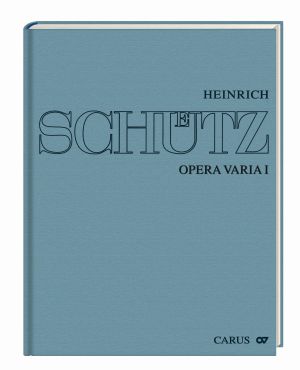
Histoire de la Résurrection du Christ
Auferstehungshistorie für sechs bis acht Stimmen mit Generalbass SWV 50, 1623
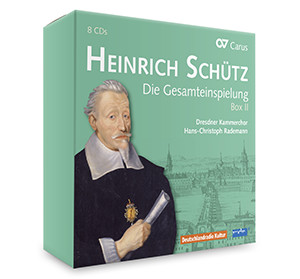
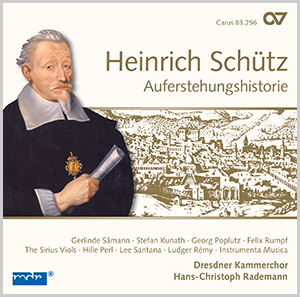
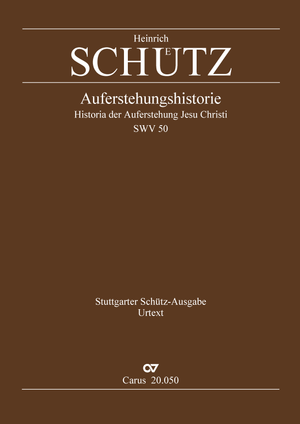
Opus 3, pour six à huit voix avec basse continue
Découvrir
 Consulter

 Ecouter
(10)
Ecouter
(10)
- Auferstehungshistorie - Introitus
- Der Ostermorgen
- Jesus erscheint der Maria Magdalena
- Der Jüngling im Grabe
- Jesus erscheint den Frauen
- Rat der Hohenpriester
- Jesus erscheint den Emmausjüngern
- Jesus erscheint den elf Jüngern
- Der Sendungsbefehl
- Conclusio/Beschluss
Acheter
Informations complémentaires sur l'œuvre
Sommaire

-
Compositeur
Heinrich Schütz
| 1585-1672Heinrich Schütz is regarded as the first German musician of European stature. As a choirboy from 1599 at the court of Landgrave Moritz of Hessen-Kassel, he received a thorough education. In 1608 he began a law degree in Marburg, but broke this off in 1609 in order, with the support of the Landgrave, to study composition with Giovanni Gabrieli, organist at St Mark’s in Venice. In 1613 Schütz returned to Kassel, but two years later was enticed away by Elector Johann Georg I of Saxony to the Dresden court as “Organist und Director der Musica”, where he held the position of Hofkapellmeister (court Kapellmeister) from 1617 until his death. Schütz’s great cycles of vocal works marked the high point of his reputation in Germany and northern Europe. But these represent only part of Schütz’s output; individual works are represented in printed collections with works by other composers, others only survive in manuscript, and much has been lost. The Stuttgart Schütz Edition makes available Schütz’s complete oeuvre, and all works are also published in practical Urtext editions. Plus d'information sur la personne
-
Éditeur
Günter Graulich
| 1926L'éditeur, cantor et pédagogue Günter Graulich est l'un des éditeurs importants de l'après-guerre en Allemagne. En 1972, il fonda avec son épouse Waltraud les Editions Carus-Verlag, qu'il fit évoluer d'un bureau de 2 personnes à une entreprise de près de 60 employés. Lui-même cantor pendant de longues années à l'église St Matthieu de Stuttgart, il dirigea pendant plus de 50 ans le Motettenchor Stuttgart. Il réalisa avec ce chœur plusieurs enregistrements sur disques vinyls et CD, et de nombreuses tournées à travers l'Europe et l'Amérique. Plus d'information sur la personne
-
Basse continue réalisée
Paul Horn
| 1922-2016Paul Horn war ein deutscher Kirchenmusiker, Organist, Komponist und Musikwissenschaftler. Er studierte Kirchenmusik und Orgel an der Evangelischen Kirchenmusikschule Esslingen am Neckar bei Hans-Arnold Metzger und Musikwissenschaft, Theologie und Geschichte an der Universität Tübingen. Seine berufliche Laufbahn begann als Kantor an der Evangelischen Michaelskirche in Stuttgart-Degerloch. 1954 wurde er Kantor an der Evangelischen Stadtkirche Ravensburg, eine Position, die er bis zu seiner Pensionierung innehatte. Als Musikwissenschaftler arbeitete Horn bis ins hohe Alter eng mit Carus zusammen. So stammen zahlreiche Carus-Klavierauszüge aus seiner Feder. Plus d'information sur la personne
-
Traducteur
Derek McCulloch
Les évaluations sur notre site web ne peuvent être effectuées que par des clients disposant d'un compte d'utilisateur enregistré. Il n'est pas vérifié si les produits évalués ont été effectivement achetés.
Aucune évaluation disponible pour ce produit.
Questions fréquentes sur l'œuvre
 Il n'y a pas encore de questions et réponses concernant cette œuvre ou vous n'avez pas trouvé la réponse à votre question sur l'œuvre ? Cliquez ici et envoyez votre question spécifique à notre service clients.