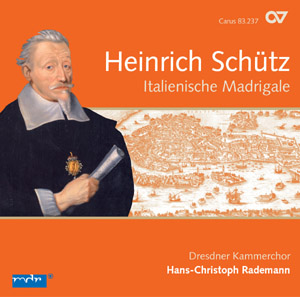
Stuttgarter Schütz-Ausgabe: Italienische Madrigale (Gesamtausgabe, Bd. 1)
Stuttgart Schütz Edition
Il Primo Libro de Madrigali op. 1 (1611), SWV 1-19. 18 madrigaux, principalement SSATB ou SATTB.
Œuvres également disponibles en édition séparée (CV 20.001/00 - CV 20.019/00)
Grâce à une bourse de son protecteur, le landgrave Maurice de Hesse-Kassel, Schütz commence trois années d’études à Venise chez Giovanni Gabrieli, qui se terminent par la publication d’un recueil de madrigaux en 1611, Il Primo Libro de Madrigali, comprenant dix-huit madrigaux à cinq voix, et dont la qualité musicale surpasse de nombreuses œuvres encore créées dans le style de la composition traditionnelle au début du xviie siècle.
 Consulter

 Ecouter
(19)
Ecouter
(19)
- O primavera (O beau printemps, saison de la jeunesse de l'année)
- O most bitter sweetnesses of love
- Happy woods
- Sorrowful soul, what are you doing?
- So, must I die?
- Of the dreadful rock of the Alps
- Le printemps rit
- Flee, Flee, o my heart!
- Wound each other, strike out
- An enmeshing flame and trap are you
- As a doe am I
- She greets me
- Io moro, ecco ch’io moro (Je meurs, je meurs ici)
- Sigh, which from the lovely breast
- So farewell, beloved woods
- Come back, o dear kisses
- You are of marble
- It is almost night, my Lydia
- Vast sea
 Compléments
- Acheter des compléments au format téléchargement.
-
 Texte numérique (sans notes), licence d'impression incluse, fichier html, paroles, traduction en anglaisfichier html, paroles, traduction en anglais (Extrait)
O primavera SWV 1 O Spring, youth of the year,
beautiful mother of flowers,
of new grass and of new loves,
you are returning, but with you
do not come the peaceful
and happy days of my joy;
you are returning, you return,
but you are accompanied by nothing more
than the sad and grievous memory
of my dear, lost treasure.
You are the one, you the one
who once were so lovely and beautiful;
but I am no longer who I was before
so dear in the eyes of others.
Battista Guarini (1538–1612), Il Pastor fido III, 1, first partO dolcezze amarissime d’amore SWV 2 O most bitter sweetnesses of love,
how much harder it is to lose you than never
to have tasted nor possessed!
What happiness love would be
...
-
Texte numérique (sans notes), licence d'impression incluse, fichier html, paroles, traduction allemandefichier html, paroles, traduction allemande (Extrait)
O primavera SWV 1 O schöner Frühling, Jugendzeit des Jahres,
heiterer Spender von Blumen,
Blättern, Gräsern und neuen Liebschaften,
du kehrst zurück, doch mit dir
mitnichten jene Tage
der Freude und des Glücks erlebter Wonnen;
du kehrst zurück, du kehrest,
doch nichts anderes bringst du
als vom geliebten, verlorenen Schatz
nur die Erinnerung elendsvoller Schmerzen.
Du bist es noch, du bist es,
die du so hübsch einst warst für alle Augen;
ich aber bin nicht mehr, der ich gewesen,
so teuer den Augen anderer.
Battista Guarini (1538–1612), Il Pastor fido III, 1, erster TeilO dolcezze amarissime d’amore SWV 2 O bitterste Süßigkeiten der Liebe,
wieviel härter ist es, euch zu verlieren, als euch nie
gekannt noch genossen zu haben!
...
-
Texte numérique (sans notes), licence d'impression incluse, fichier html, paroles, originalfichier html, paroles, original (Extrait)
O primavera, gioventù de l‘anno,
bella madre di fiori,
d‘erbe novelle e di novelli amori,
tu torni ben, ma teco
non tornano i sereni
e fortunati dì delle mie gioie;
tu torni ben, tu torni,
ma teco altro non torna
che del perduto mio caro tesoro
la rimembranza misera e dolente.
Tu quella se’, tu quella
ch‘eri pur dianzi si vezzosa e bella;
ma non son io già quel ch’un tempo fui
si caro agli occhi altrui.
Battista Guarini (1538–1612), Il Pastor fido III, 1, prima parteO dolcezze amarissime d’amore,
quanto è più duro perdervi, che mai
non v’aver o provate o possedute!
Come sarìa l’amar felice stato,
se’l già goduto ben non si perdesse;
o, quando egli si perde,
...
-
Texte numérique (sans notes), licence d'impression incluse, fichier html, Texte introductif, françaisfichier html, Texte introductif, français (Extrait)Texte du livret du CD Carus 83.237
Oliver Geisler
Traduction (abrégée) : Sylvie CoquillatHenrico Sagittario Allemanno
ou : quelqu’un qui s’en alla apprendre la composition Celui qui voit sa formation ou ses études soutenues par une bourse avec séjour à l’étranger à l’appui doit avoir des dons et de la chance. De nos jours comme il y a 400 ans. Heinrich Schütz avait les deux lorsque le landgrave Moritz von Hessen lui offre la possibilité de se rendre à Venise afin d’étudier à partir de 1609 auprès d’une ‹ star › de son époque – le musicien et compositeur Giovanni Gabrieli.Moritz von Hessen joue dans la vie de Heinrich Schütz un rôle décisif : c’est lui qui découvre le garçon lorsqu’il l’entend chanter à l’auberge « Zum Goldenen Ring » de Weissenfels et qui le fait venir à Kassel afin qu’il y reçoive une solide formation scolaire au Collegium Mauritianum. Et maintenant Venise !
...
-
Texte numérique (sans notes), licence d'impression incluse, fichier html, Texte introductif, en anglaisfichier html, Texte introductif, en anglais (Extrait)Text from the CD Carus 83.237
Oliver Geisler
Translation (abridged): Liz RobinsonHenrico Sagittario Allemanno
or: The tale of one who went forth to learn how to compose Anyone who receives support for training or study through a stipend, including a stay abroad, needs talent and luck. The same applies today just as it did 400 years ago. Heinrich Schütz doubtless had both when he was given the opportunity, through Landgrave Moritz of Hesse, of travelling to Venice in 1609 in order to study with one of the ‘stars’ of his day – the musician and composer Giovanni Gabrieli.Moritz of Hesse played a crucial role in the life of Heinrich Schütz: he discovered the boy when he heard him singing in the inn “Zum Goldenen Ring” in Weißenfels and brought him to Kassel, where the boy received a thorough education at the Collegium Mauritianum. And now to Venice!
...
-
Texte numérique (sans notes), licence d'impression incluse, fichier html, Texte introductif, en allemandfichier html, Texte introductif, en allemand (Extrait)Booklet-Text der CD Carus 83.237
Oliver Geisler
Henrico Sagittario Allemanno
oder: Von einem, der auszog, das Komponieren zu lernen Wer seine Ausbildung oder sein Studium mit einem Stipendium inklusive Auslandsaufenthalt gefördert bekommt, braucht Begabung und Glück. Das ist heute genauso wie vor 400 Jahren. Heinrich Schütz hatte wohl beides, als sich ihm durch den Landgrafen Moritz von Hessen die Möglichkeit eröffnete, nach Venedig zu reisen, um ab 1609 bei einem ‚Star‘ seiner Zeit – dem Musiker und Komponisten Giovanni Gabrieli – zu studieren. Ihm wurden hierfür vom Landgrafen 200 Taler jährlich „anpraesentiert“.Moritz von Hessen spielte im Leben von Heinrich Schütz eine entscheidende Rolle: Er entdeckte den Knaben, als er ihn auf der Durchreise von Dresden nach Kassel im Gasthof „Zum Goldenen Ring“ in Weißenfels singen hörte. Nach beharrlichem Briefwechsel
...
Sommaire


-
Compositeur
Heinrich Schütz
| 1585-1672Heinrich Schütz is regarded as the first German musician of European stature. As a choirboy from 1599 at the court of Landgrave Moritz of Hessen-Kassel, he received a thorough education. In 1608 he began a law degree in Marburg, but broke this off in 1609 in order, with the support of the Landgrave, to study composition with Giovanni Gabrieli, organist at St Mark’s in Venice. In 1613 Schütz returned to Kassel, but two years later was enticed away by Elector Johann Georg I of Saxony to the Dresden court as “Organist und Director der Musica”, where he held the position of Hofkapellmeister (court Kapellmeister) from 1617 until his death. Schütz’s great cycles of vocal works marked the high point of his reputation in Germany and northern Europe. But these represent only part of Schütz’s output; individual works are represented in printed collections with works by other composers, others only survive in manuscript, and much has been lost. The Stuttgart Schütz Edition makes available Schütz’s complete oeuvre, and all works are also published in practical Urtext editions. Plus d'information sur la personne
-
Éditeur
Siegfried Schmalzriedt
| 1941-2008
Les évaluations sur notre site web ne peuvent être effectuées que par des clients disposant d'un compte d'utilisateur enregistré. Il n'est pas vérifié si les produits évalués ont été effectivement achetés.
Questions fréquentes sur l'œuvre
 Il n'y a pas encore de questions et réponses concernant cette œuvre ou vous n'avez pas trouvé la réponse à votre question sur l'œuvre ? Cliquez ici et envoyez votre question spécifique à notre service clients.