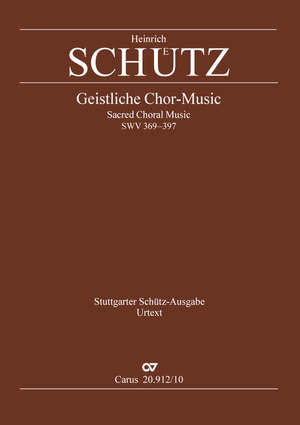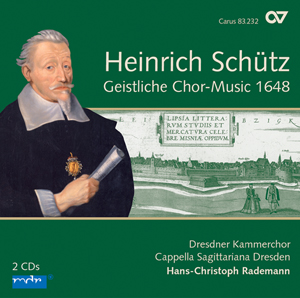
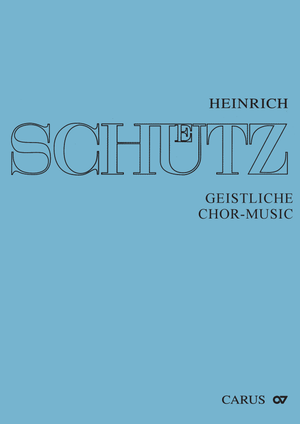
Geistliche Chor-Music 1648 (Complete Edition, vol. 12)
Stuttgart Schütz Edition SWV 369–397 (Op. 11)
Quand il s’agit de saluer le travail de composition de Heinrich Schütz, son talent pour travailler le texte et la langue est cité en premier. Recueil de 29 motets pour chœur de cinq à sept voix et une des œuvres essentielles de Schütz, la Geistliche Chor-Music 1648 est aussi une transposition musicale soigneusement étudiée des textes. Dans son avant-propos détaillé du recueil, le compositeur présente celui-ci comme modèle de la composition sans basse continue, convaincu que tout jeune compositeur devrait acquérir « les bases solides d’un bon contrepoint ». Malgré le contrepoint rigoureux, un pas en arrière du point de vue stylistique, le « Musicus poeticus » parvient à donner à ses œuvres un caractère très expressif. Les différents motets ont une structure différente et se distinguent – selon leur contenu — dans leur longueur et caractère. Des pièces courtes, plutôt sobres, en côtoient d’autres très élaborées et d’une grande intensité expressive, œuvres joyeuses et optimistes succèdent aux compositions plaintives. Tous les motets sont disponibles en édition séparée.
Découvrir
 Consulter


 Ecouter
(29)
Ecouter
(29)
- The haevens are telling the Father's glory
- Lord, in thee I shall trust
- Das ist je gewisslich wahr
- The royal staff of the ruler
- He shall tread out his cloak in wine
- Now there appeareth the grace of the Lord
- O Lord, now grant us thy peace in grace
- Grant to our people
- None among us lives for his own sake
- Many shall go there from eastward and from westward
- Go, pull up all the weeds first
- Who in sorrow plant seed
- Now I go forth
- For God so loved this sinful world
- O thou most gracious Lord, waken us now
- O my people, take heart
- See, I am the voice of one crying
- A child is born unto us
- The word was man
- Tender love have I for thee, Lord
- I am the only true vine
- We are citizens of heaven
- Blest are the departed
- What my god wills, let that be done
- I know that my redeemer lives
- Look upon the sprouting
- The angel said, said to the shepherds
- Auf dem Gebirge
- False servant
Acheter
Informations complémentaires sur l'œuvre
Sommaire


-
Compositeur
Heinrich Schütz
| 1585-1672Heinrich Schütz is regarded as the first German musician of European stature. As a choirboy from 1599 at the court of Landgrave Moritz of Hessen-Kassel, he received a thorough education. In 1608 he began a law degree in Marburg, but broke this off in 1609 in order, with the support of the Landgrave, to study composition with Giovanni Gabrieli, organist at St Mark’s in Venice. In 1613 Schütz returned to Kassel, but two years later was enticed away by Elector Johann Georg I of Saxony to the Dresden court as “Organist und Director der Musica”, where he held the position of Hofkapellmeister (court Kapellmeister) from 1617 until his death. Schütz’s great cycles of vocal works marked the high point of his reputation in Germany and northern Europe. But these represent only part of Schütz’s output; individual works are represented in printed collections with works by other composers, others only survive in manuscript, and much has been lost. The Stuttgart Schütz Edition makes available Schütz’s complete oeuvre, and all works are also published in practical Urtext editions. Plus d'information sur la personne
-
Éditeur
Michael Heinemann
| 1959
Critiques
Was die Praxistauglichkeit betrifft, so punktet der Carus-Verlag zweifellos mit dem Angebot von zweisprachigen Einzelausgaben (dt./engl.) und Aufführungsmaterial zu allen Stücken.
Musik und Kirche, 2/2022
Die Motetten für 5 bis 7 Stimmen sind abwechslungsreich in ihrer Besetzung und Thematik, eine Fundgrube für alle die den Schützschen Umgang mit Text und Sprache lieben.
Singende Kirche, 3/2016
Les évaluations sur notre site web ne peuvent être effectuées que par des clients disposant d'un compte d'utilisateur enregistré. Il n'est pas vérifié si les produits évalués ont été effectivement achetés.
Aucune évaluation disponible pour ce produit.
Questions fréquentes sur l'œuvre
 Il n'y a pas encore de questions et réponses concernant cette œuvre ou vous n'avez pas trouvé la réponse à votre question sur l'œuvre ? Cliquez ici et envoyez votre question spécifique à notre service clients.