

L'Histoire de Noël
Historia der freuden- und gnadenreichen Geburt Gottes und Marien Sohnes Jesu Christi SWV 435, 1664
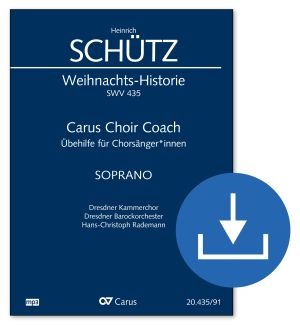
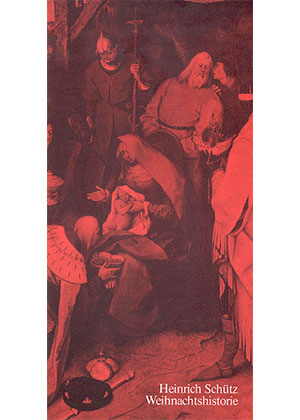
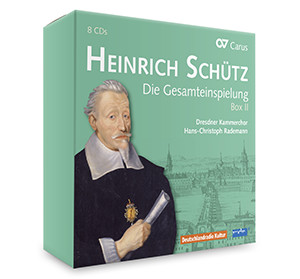
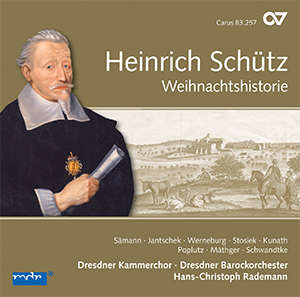
Weihnachts-Historie de Schütz pour solistes et chœur à six voix (SSATTB) est une interprétation très vivante et concrète de l’histoire de la Nativité. La représentation expressive de la parole trouve son apogée dans le rôle central de l’évangéliste, qui reprend comme aucun autre le ton de lecture, mais le chœur est aussi utilisé de manière ciblée pour une mise en musique émotionnelle du texte : alors que les bergers sont reproduits de manière populaire avec une sobriété touchante des moyens musicaux, les louanges et la joie enthousiasmantes caractérisent le chœur des anges. Toutes les parties de la Weihnachtshistorie ont en commun leur légèreté qui, aussi concrète et directe la musique soit-elle, constitue un défi pour tout choriste.
L’enregistrement original a été réalisé avec un accordage d’époque. Il sonne environ un demi-ton plus haut que l’accordage moderne de notre piano.Il suffit de s’exercer. Partout. A tout moment.
Que ce soit à la maison sur votre tablette ou votre PC ou en déplacement sur votre smartphone : avec carus music, the Choir Coach, vous avez toujours vos œuvres chorales avec vous pour vous entraîner ! Avec l’application chorale de carus music, vous pouvez écouter votre partition ainsi qu’un enregistrement de première qualité sur n’importe quel appareil et vous entraîner facilement à votre propre partie de chœur avec un coach. Avec carus music, la préparation de vos concerts est facile, efficace et amusante à maîtriser !
Interprètes: Gerlinde Sämann (soprano), Marie Luise Werneburg (soprano), Isabel Jantschek (soprano), Stefan Kunath (alto), Maria Stosiek (alto), Tobias Mäthger (tenore), Georg Poplutz (tenore), Felix Schwandtke (basso) – Dresdner Kammerchor, Dresdner Barockorchester – Hans-Christoph Rademann
Découvrir
 Ecouter
(16)
Ecouter
(16)
- Introduktion
- Die Geburt Jesu
- Der Engel zu den Hirten auf dem Felde (aus Vol. 10: Weihnachtshistorie)
- Die Menge der Engel
- Die Hirten auf dem Felde
- Die Anbetung der Hirten
- Die Weisen aus dem Morgenlande
- Die Hohenpriester und Schriftgelehrten
- Herodes
- Die Anbetung der Weisen aus dem Morgenlande
- Die Flucht nach Ägypten
- Die Flucht nach Ägypten II
- Kindermord des Herodes
- Rückkehr aus Ägypten (aus Vol. 10: Weihnachtshistorie)
- Rückkehr aus Ägypten II
- Conclusio
 S`exercer
-
 carus music, the Choir Coach
Üben mit carus music
carus music, the Choir Coach
Üben mit carus music
-
Aides à l'apprentissage
-
Aides à l'apprentissage voix soprano
- Introduktion (Choir Coach)
- Introduktion (Choir Coach, Slow mode)
- Introduktion (Choir Coach, soprano 1)
- Introduktion (Choir Coach, Slow mode, soprano 1)
- Introduktion (Choir Coach, soprano 2)
- Introduktion (Choir Coach, Slow mode, soprano 2)
- Conclusio (Choir Coach)
- Conclusio (Choir Coach, Slow mode)
-
Aides à l'apprentissage voix alto
- Introduktion (Choir Coach)
- Introduktion (Choir Coach, Slow mode)
- Die Menge der Engel (Choir Coach)
- Die Menge der Engel (Choir Coach, Slow mode)
- Die Hirten auf dem Felde (Choir Coach, Alto 1)
- Die Hirten auf dem Felde (Choir Coach, Slow mode, Alto 1)
- Die Hirten auf dem Felde (Choir Coach, Alto 2)
- Die Hirten auf dem Felde (Choir Coach, Slow mode, Alto 2)
- Die Hirten auf dem Felde (Choir Coach)
- Die Hirten auf dem Felde (Choir Coach, Slow mode)
- Conclusio (Choir Coach)
- Conclusio (Choir Coach, Slow mode)
-
Aides à l'apprentissage voix tenore
- Introduktion (Choir Coach)
- Introduktion (Choir Coach, Slow mode)
- Die Menge der Engel (Choir Coach, Tenore 1)
- Die Menge der Engel (Choir Coach, Slow mode, Tenore 1)
- Die Menge der Engel (Choir Coach, Tenore 2)
- Die Menge der Engel (Choir Coach, Slow mode, Tenore 2)
- Die Hirten auf dem Felde (Choir Coach)
- Die Hirten auf dem Felde (Choir Coach, Slow mode)
- Die Weisen aus dem Morgenlande (Choir Coach, Tenore 1)
- Die Weisen aus dem Morgenlande (Choir Coach, Slow mode, Tenore 1)
- Die Weisen aus dem Morgenlande (Choir Coach, Tenore 2)
- Die Weisen aus dem Morgenlande (Choir Coach, Slow mode, Tenore 2)
- Die Weisen aus dem Morgenlande (Choir Coach)
- Die Weisen aus dem Morgenlande (Choir Coach, Slow mode)
- Conclusio (Choir Coach)
- Conclusio (Choir Coach, Slow mode)
-
Aides à l'apprentissage voix basse
- Introduktion (Choir Coach)
- Introduktion (Choir Coach, Slow mode)
- Die Menge der Engel (Choir Coach)
- Die Menge der Engel (Choir Coach, Slow mode)
- Die Hohenpriester und Schriftgelehrten (Choir Coach, Basse 1)
- Die Hohenpriester und Schriftgelehrten (Choir Coach, Slow mode, Basse 1)
- Die Hohenpriester und Schriftgelehrten (Choir Coach, Basse 2)
- Die Hohenpriester und Schriftgelehrten (Choir Coach, Slow mode, Basse 2)
- Die Hohenpriester und Schriftgelehrten (Choir Coach)
- Die Hohenpriester und Schriftgelehrten (Choir Coach, Slow mode)
- Die Hohenpriester und Schriftgelehrten (Choir Coach)
- Die Hohenpriester und Schriftgelehrten (Choir Coach, Slow mode)
- Conclusio (Choir Coach)
- Conclusio (Choir Coach, Slow mode)
-
 Compléments
- Acheter des compléments au format téléchargement.
-
 Texte numérique (sans notes), licence d'impression incluse, fichier html, paroles, traduction en anglaisfichier html, paroles, traduction en anglais (Extrait)Introduction (Coro)
The glad birth, of our Lord and Savior Jesus Christ, in the words of the holy Evangelists’ description, who wrote it down..
The birth of Jesus
Evangelist (Tenore)And behold, it came to pass in those days, that there went out a decree from Caesar Augustus, that all the world enroll for taxing. (And this taxing was the first; being made at the time when Cyrenius was governor of Syria.) And ev’ryone went that he might be taxed, unto the city of his birth. Among them there went up Joseph being of Galilee, and went from Nazareth, to Judaea, to the city of David, which is called Bethlehem; (because he was of the lineage and house of David:) that he might enroll for taxing, and with him Mary, his own espoused wife, being great with child. And, while they yet tarried there, it was time that she should be delivered. And she brought forth her first-born son, and wrapped him round in swaddling, and laid him in a lowly manger, for they could not find a room for them in the inn. And, in the same country where shepherds abiding in the fields, and keeping watch over their flock by night. And lo, the Lord’s own angel came upon them, and the glory of the Lord shone round about them: and they were sore afraid.
...
-
Texte numérique (sans notes), licence d'impression incluse, fichier html, paroles, originalfichier html, paroles, original (Extrait)Introduction (Coro)
Die Geburt unseres Herrn Jesu Christi, wie uns die von den heiligen Evangelisten beschrieben wird.
Jesu Geburt
Evangelist (Tenore)Es begab sich aber zu der selbigen Zeit, dass ein Gebot von dem Kaiser Augusto ausging, dass alle Welt geschätzet würde, und diese Schätzung war die erste und geschah zu der Zeit, da Cyrenius Landpfleger in Syrien war, und jedermann ging, dass er sich schätzen ließe, ein jeglicher in seine Stadt. Da machte sich auch auf Joseph aus Galiläa, aus der Stadt Nazareth, in das jüdische Land zu der Stadt Davids, die da heißet Bethlehem, darum dass er von dem Hause und Geschlechte Davids war, auf dass er sich schätzen ließe mit Maria, seinem vertrauten Weibe, die war schwanger. Und als sie daselbst waren, kam die Zeit, dass sie gebären sollte, und sie gebar ihren ersten Sohn und wickelt’ ihn in Windeln und legte ihn in eine Krippe, denn sie hatten sonst keinen Raum in der Herberge. Und es waren Hirten in derselbigen Gegend auf dem Felde, die hüteten des Nachts ihre Herde, und siehe, des Herren Engel trat zu ihnen, und die Klarheit des Herren leuchtet’ um sie und sie furchten sich sehr, und der Engel sprach zu
...
Acheter
Informations complémentaires sur l'œuvre
Sommaire


-
Compositeur
Heinrich Schütz
| 1585-1672Heinrich Schütz is regarded as the first German musician of European stature. As a choirboy from 1599 at the court of Landgrave Moritz of Hessen-Kassel, he received a thorough education. In 1608 he began a law degree in Marburg, but broke this off in 1609 in order, with the support of the Landgrave, to study composition with Giovanni Gabrieli, organist at St Mark’s in Venice. In 1613 Schütz returned to Kassel, but two years later was enticed away by Elector Johann Georg I of Saxony to the Dresden court as “Organist und Director der Musica”, where he held the position of Hofkapellmeister (court Kapellmeister) from 1617 until his death. Schütz’s great cycles of vocal works marked the high point of his reputation in Germany and northern Europe. But these represent only part of Schütz’s output; individual works are represented in printed collections with works by other composers, others only survive in manuscript, and much has been lost. The Stuttgart Schütz Edition makes available Schütz’s complete oeuvre, and all works are also published in practical Urtext editions. Plus d'information sur la personne
-
Basse continue réalisée
Paul Horn
| 1922-2016Paul Horn war ein deutscher Kirchenmusiker, Organist, Komponist und Musikwissenschaftler. Er studierte Kirchenmusik und Orgel an der Evangelischen Kirchenmusikschule Esslingen am Neckar bei Hans-Arnold Metzger und Musikwissenschaft, Theologie und Geschichte an der Universität Tübingen. Seine berufliche Laufbahn begann als Kantor an der Evangelischen Michaelskirche in Stuttgart-Degerloch. 1954 wurde er Kantor an der Evangelischen Stadtkirche Ravensburg, eine Position, die er bis zu seiner Pensionierung innehatte. Als Musikwissenschaftler arbeitete Horn bis ins hohe Alter eng mit Carus zusammen. So stammen zahlreiche Carus-Klavierauszüge aus seiner Feder. Plus d'information sur la personne
-
Traducteur
Derek McCulloch
-
Traducteur
David Johnston
-
Chœur
Dresdner Kammerchor
Le Dresdner Kammerchor (Chœur de chambre de Dresde) – l’un des meilleurs chœurs d’Allemagne – est bien connu pour sa sonorité unique, faite d’une grande intensité et clarté. Rayonnement dynamique, homogénéité et transparence sonores souvent cités en exemple sont les points forts de cet ensemble demandé au niveau international. Le chœur a été créé en 1985 par Hans-Christoph Rademann et des étudiants du Conservatoire de musique « Carl Maria von Weber » de Dresde. De nombreuses tournées de concerts ont établi la notoriété de l’ensemble également hors d’Europe. En ont résulté des invitations régulières à d’importants festivals internationaux. Le répertoire du chœur va de la musique de la Renaissance à des compositions du 21ème siècle. Des interprétations de la musique chorale romantique et contemporaine ont été récompensées de prix spéciaux lors de concours internationaux, ainsi que du prix d’encouragement de la fondation Ernst von Siemens. En dehors de la pratique a cappella, le chœur de chambre se consacre intensément à la coopération avec le Dresdner Barockorchester et l’ensemble « Alte Musik Dresden », donnant des impulsions importantes à la pratique de la musique ancienne en Saxe. Une foule d’enregistrements pour la radio et pour le CD, ainsi que la coopération avec des orchestres allemands et étrangers viennent renforcer la renommée du Chœur de chambre de Dresde. Le CD paru aux Editions Carus de Stuttgart, avec le premier enregistrement mondial du Requiem en mi bémol majeur de Johann Adolf Hasse s’est vu décerner le prix de la Critique allemand du disque. Plus d'information sur la personne
-
Orchestre
Dresdner Barockorchester
Le Dresdner Barockorchester [Orchestre baroque de Dresde] a été créé en 1991 par des diplômés du Conservatoire de musique de Dresde. Au cours des années, les musiciens saxons ont révélé tout ce qu’il avaient de particulier à apporter à la scène de la musique ancienne : force émotionnelle et expressive, alliée à une musicalité éloquente, une interprétation sous un angle neuf, vivant. Les compositions de maîtres de chapelle et instrumentistes de la Chapelle de la cour de Dresde des 17ème et 18ème siècles comme Hasse, Heinichen, Zelenka, Quantz, Pisendel e. a. constituent un aspect important du répertoire du Dresdner Barockorchester. Le centre de gravité et le défi véritable pour l’ensemble est le vécu direct du concert. Plusieurs enregistrements pour le CD documentent autant l’art des interprètes que la pratique musicale éprise de magnificence de la cour baroque de Dresde. Des tournées ont conduit le Dresdner Barockorchester non seulement dans de nombreux centres musicaux d’Allemagne, mais aussi en Hollande, en Espagne, en Autriche et au Japon. Plus d'information sur la personne
-
Chef d'orchestre
Hans-Christoph Rademann
| 1965Conductor Hans-Christoph Rademann is an immensely versatile artist with a broad repertoire who devotes himself with equal passion and expertise both to the performance and rediscovery of early music and to the first performances and cultivation of Contemporary Music. Born in Dresden and raised in the Erzgebirge mountains, he was influenced at an early age by the great Central German kantorial and musical tradition. He was a student at the traditional Kreuzgymnasium, a member of the famous Kreuzchor, and studied choral and orchestral conducting at the Carl Maria von Weber University of Music in Dresden. During his studies, he founded the Dresdner Kammerchor and formed it into a top international choir which is still under his direction today. Since 2013, Hans-Christoph Rademann has been the academy director of the International Bach Academy Stuttgart. He regularly collaborates with leading choirs and ensembles of the international music scene. From 1999 to 2004 he was chief conductor of the NDR Choir and from 2007 to 2015 chief conductor of the RIAS Chamber Choir. Guest conducting engagements have led and continue to lead him to the Nederlandse Bachvereniging, the Collegium Vocale Gent, the Akademie für Alte Musik, the Freiburger Barockorchester, the Deutsche Radiophilharmonie Saarbrücken Kaiserslautern, the Sinfonieorchester Basel, the Orchestre Philharmonique de Luxembourg, among others. Hans-Christoph Rademann has been awarded prizes and honors for his artistic work, including the Johann Walter Plaque of the Saxon Music Council (2014), the Saxon Constitutional Medal (2008), the Sponsorship Prize as well as the Art Prize of the state capital Dresden (1994 and 2014 respectively). He received the Preis der Deutschen Schallplattenkritik several times for his numerous CD recordings (most recently in 2016), as well as the Grand Prix du Disque (2002), the Diapason d’Or (2006 & 2011), the CHOC de l’année 2011 and the Best Baroque Vocal Award 2014. In 2016 he was awarded the European Church Music Prize of the city of Schwäbisch Gmünd. His exemplary interpretation and recording of the complete works of Heinrich Schütz with the Dresdner Kammerchor in the Stuttgart Carus-Verlag, which was completed in 2019, was awarded the newly endowed Heinrich Schütz Prize as well as the OPUS KLASSIK 2020 in the same year. Hans-Christoph Rademann is professor of choral conducting at the Carl Maria von Weber University of Music in Dresden. He is also artistic director of the Musikfest Erzgebirge, ambassador of the Erzgebirge and patron of the Christian Hospice Service Dresden. Plus d'information sur la personne
-
Solist - soprano
Marie Luise Werneburg
Marie Luise Werneburg loves Renaissance and Baroque music. She grew up in a musical rectory in Dresden, and then developed her musical inclination and talent by firstly studying church music in Dresden and then later studying singing in Bremen. She is a sought-after soloist who pursues her passion for early music by singing concerts worldwide with, among others, the Ensemble Weser-Renaissance Bremen, the Lautten Compagney Berlin, the Rheinische Kantorei and Bell’Arte Salzburg. She is especially passionate about J.?S.?Bach’s cantatas and oratorios and H.?Schütz’s oeuvre. But she has also been enchanted by other musical treasures by less well-known composers such as Rosenmüller and Biber. Additionally, Werneburg’s other favorite musical projects include collaborating with the harpsichordist Elina Albach and her ensemble CONTINUUI IM, as well as with Hille Perl and the Sirius Viols. Plus d'information sur la personne
-
Solist - soprano
Isabel Schicketanz
-
Solist - soprano
Gerlinde Sämann
The blind soprano Gerlinde Sämann studied piano and singing at the Richard Strauss Conservatoire in Munich, working with teachers including Karl- Heinz Jarius, Henriette Meyer-Ravenstein and Selma Aykan. Her repertoire ranges from historic works, via lieder and oratorio, to avant-garde and contemporary music theatre works. Since 1991 Gerlinde Samann has performed as a soloist with a wide range of ensembles, mainly specializing in early music, at leading festivals. These include the Dresdner Kreuzchor, Accentus Chamber Choir, Arsys Bourgogne, Akademie fur Alte Musik Berlin, and La Petite Bande. She also enjoys a busy career in opera and contemporary music theatre, working with directors such as Arila Siegert, Gil Mehmert, Sabine Hasz, Thomas Hoft, Crescentia Dunser, and Otto Kukla. She has made numerous radio recordings and CDs in Germany and abroad. Gerlinde Samann is passionately committed to devising programs of unusual songs and duos, performing these with musicians such as the renowned fortepianist Ronald Brautigam. Plus d'information sur la personne
-
Solist - alto
Stefan Kunath
-
Solist - alto
Maria Stosiek
The mezzo-soprano Maria Stosiek was born in Gorlitz in 1988. In Dresden she studied voice under Christiane Junghanns and violin with Annette Under and was a stipendiary of the Dresden Talentschmiede. Master classes under, among others, Charlotte Lehmann and Dorothee Mields brought her important musical impulses. Today she sings in the MDR choir (Middle German Radio Choir) as well as in the Dresdner Kammerchor, where she regularly sings solo parts. Moreover, she works as a soloist together with both the Singakademie Dresden and the Vokalensemble Kassel. Concert tours have taken her to other European countries, to Israel and Palestine, as well as to Taiwan and China. In addtion to ensemble singing and concert singing Maria Stosiek has devoted herself increasingly to contemporary music. Plus d'information sur la personne
-
Solist - ténor
Georg Poplutz
-
Solist - ténor
Tobias Mäthger
Tenor Tobias Mäthger studied singing, conducting and school music in Dresden and works as a freelance singer, conductor, teacher and church musician. He has already achieved considerable success with a varied concert career both nationally and internationally. He is a member and soloist with the Dresdner Kammerchor, as well as a member of the soloists’ ensemble of the Musik Podium Stuttgart under Frieder Bernius. In addition, he regularly works with leading artists and ensembles including Marc Minkowski, Rafael Frubeck de Burgos, Dresden Staatskapelle, the Dresden Philharmonic Orchestra, Bremer Kammerphilharmonie, Dresdner Kreuzchor, Rheinische Kantorei and many others, as a soloist or as a conductor’s assistant. Plus d'information sur la personne
-
Solist - basse
Felix Schwandtke
Ratio, Emotio, Physis – reason, emotion and physics – to be able to bring these three human aspects together in singing, that is the great challenge and the profound joy in Felix Schwandtke’s life. Being the son of a mathematician and an engineer, he has been shaped by analytical thinking; music provided a way for him to relate this to emotion, and to explore, with joy, the developing interaction. In the process, early music became an important catalyst, and his creative work lead him to renowned ensembles all across Europe, bringing with it many new musical encounters. Among these, the ones who have made the most impact are Hans-Christph Rademann, Ludger Rémy and Lars Ulrik Mortensen, as well as the director and Baroque dancer Milo Pablo Momm. Plus d'information sur la personne
Les évaluations sur notre site web ne peuvent être effectuées que par des clients disposant d'un compte d'utilisateur enregistré. Il n'est pas vérifié si les produits évalués ont été effectivement achetés.
Aucune évaluation disponible pour ce produit.
Questions fréquentes sur l'œuvre
 Il n'y a pas encore de questions et réponses concernant cette œuvre ou vous n'avez pas trouvé la réponse à votre question sur l'œuvre ? Cliquez ici et envoyez votre question spécifique à notre service clients.