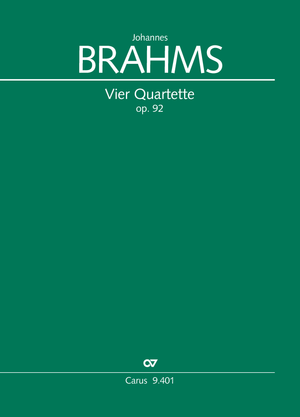
Vier Quartette
op. 92, 1877
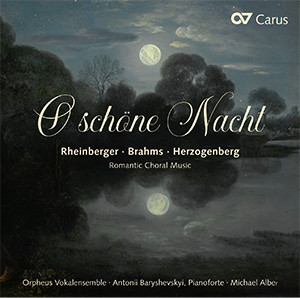
Brahms always had a fine feeling for lyrical quality. His cycle Vier Quartette (Four Quartets) Op. 92 for voices and piano, setting four poems by Goethe, Daumer, Allmers, and Hebbel, demonstrates his musical skills in a particularly moving way. The cycle is about the romantic night atmosphere, about melancholy reflections on autumn, and secret noctural amorous adventures.
The Urtext edition from Carus comprises a conductor’s score in large format and a choral score, both underlaid with singing text in German and English, and the piano accompaniment. The cycle can be performed by solo voices and piano, or by four-part mixed choir and piano.
All songs are also available as separate editions (printed and digitally).


 Ecouter
(3)
Ecouter
(3)
- O charming night!
- Late autumn
- Evening song
Sommaire


-
Compositeur
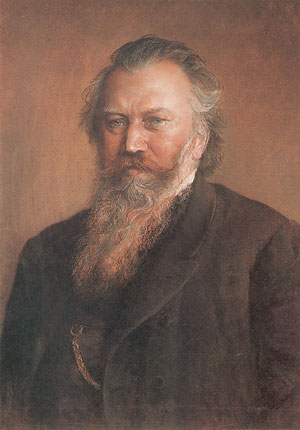
Johannes Brahms
| 1833-1897Johannes Brahms' study of musical tradition was of crucial importance to his output: he combined church modes, canonic technique, Baroque style and diction, Bach's counterpoint and Beethoven's thematic-motivic work with the harmonic and expressive achievements of Romanticism to form his own distinctive style. In this respect his choral songs and vocal quartets (e.g. the “Liebeslieder Waltzes” and “New Liebeslieder Waltzes”), often to folk song texts, in which a musical microcosm unfolds, are examplary. His “Deutsches Requiem”, available from Carus in several different versions, constitutes one of the most fascinating confessions of faith in the history of music. Plus d'information sur la personne
-
Éditeur
Uwe Wolf
| 1961Uwe Wolf est un musicologue spécialisé dans les 17e et 18e siècles. Ses domaines de travail s'étendent de l'époque de Monteverdi et de Schütz au classicisme viennois en passant par Bach et la génération des fils et élèves de Bach. Depuis octobre 2011, il dirige le lectorat de la maison d'édition Carus. Auparavant, il a travaillé pendant plus de 20 ans dans la recherche sur Bach. Plus d'information sur la personne
Les évaluations sur notre site web ne peuvent être effectuées que par des clients disposant d'un compte d'utilisateur enregistré. Il n'est pas vérifié si les produits évalués ont été effectivement achetés.
Questions fréquentes sur l'œuvre
 Il n'y a pas encore de questions et réponses concernant cette œuvre ou vous n'avez pas trouvé la réponse à votre question sur l'œuvre ? Cliquez ici et envoyez votre question spécifique à notre service clients.