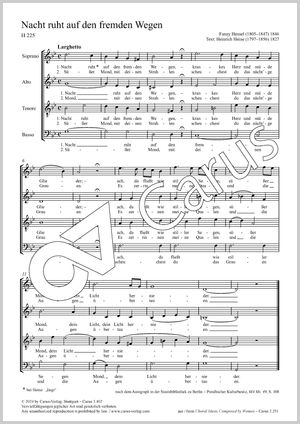
Audio sample: “Nacht ruht auf den fremden Wegen” (performed by Vokalensemble “et hepera”, dir. Franziska de Gilde)
Explore
 View
View


 Listen
(1)
Listen
(1)
- Nacht ruht auf den fremden Wegen
Purchase
Additional product information
-
Composer
Fanny Hensel
| 1805-1847Fanny Hensel (1805-1847), born Mendelssohn, was one of the most talented female composers of the Romantic period and an important representative of 19th century German musical life. As the sister of Felix Mendelssohn-Bartholdy, she grew up in an artistic environment that encouraged her musical development from an early age, but also confronted her with social restrictions due to her gender. In the 1830s and 1840s in particular, Fanny Hensel composed a large number of songs, piano and choral works and - despite the reservations of her father and brother - ultimately decided to gradually publish her music. In her family home in Berlin, a centre for musicians and intellectuals, she performed many of these works, which combine romantic emotionality with tonal sophistication, as part of the so-called Sunday music. On 14 May 1847, she suffered a stroke during rehearsals for one of her popular Sunday concerts and died just a few hours later. Her impressive œuvre, which comprises more than 460 compositions, is today regarded as a significant contribution to Romantic musical culture and is attracting increasing attention in concerts and academic studies.
Personal details
-
Songwriter / Librettist
Heinrich Heine
| 1797-1856Heinrich Heine (1797–1856) is regarded as one of the most important German poets of the 19th century. He was born in Düsseldorf and is best known for his lyric poetry, which combines Romanticism with sharp social criticism. Many of his works deal with love, nature and freedom. Because of his political views, Heine lived in exile in Paris for many years.
He also occupies a prominent place in the history of music. His lyrical texts were set to music by numerous composers and had a particularly profound influence on the Romantic art song. Robert Schumann, Franz Schubert, Felix Mendelssohn Bartholdy and Hugo Wolf, in particular, created musical works of enduring significance based on Heine’s poems. The poetic combination of linguistic simplicity, emotional depth and often ironic ambiguity offered composers a wide range of possibilities for musical interpretation. As a result, Heine’s poetry became a central part of the Romantic art-song repertoire and continues to influence vocal music to this day.
Personal details
Reviews on our website can only be submitted by customers with a registered user account. A check whether the rated products were actually purchased does not take place.
No feedback available for this product.
Frequent questions about this work
 There are no questions and answers available so far or you were unable to find an answer to your specific question about this work? Then click here and send your specific questions to our Customer Services!