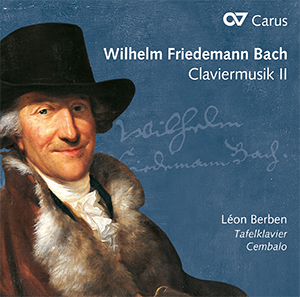
Claviermusik II
 Ecouter
(20)
Ecouter
(20)
- Allegro
- Grave
- Vivace
- Allegro
- Andante
- Presto
- Allegretto
- Suave
- Vivace
- Allegro
- Andante
- Vivace
- Fantasia in c
- Allegro ma non tanto
- Siciliano
- Vivace
- Allegro ma non molto
- Larghetto
- Presto
- Fantasia in e
Sommaire

-
Compositeur
Wilhelm Friedemann Bach
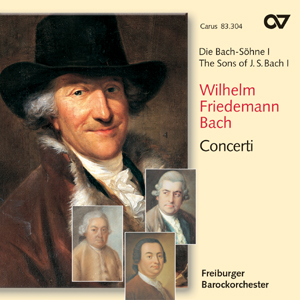
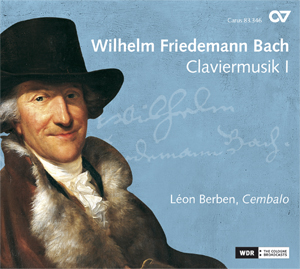
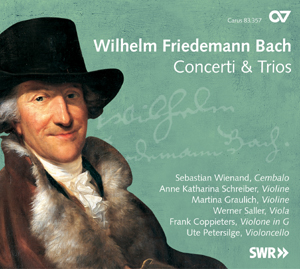
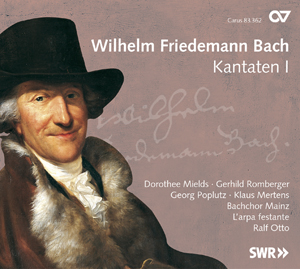
| 1710-1784Wilhelm Friedemann Bach, l'aîné des fils de Johann Sebastian, était connu comme l'un des meilleurs compositeurs de sa génération, mais aussi comme l'un des plus indépendants. Son œuvre témoigne de son ambition de poursuivre l'héritage de son père tout en faisant évoluer le goût musical de ses contemporains. Ses exigences artistiques de haut niveau sont présentes pratiquement dans toutes ses œuvres – des premières pièces pour clavier jusqu'aux sonates et fantaisies tardives, en passant par les cantates de la maturité. Wilhelm Friedemann Bach est l'auteur de pièces pour clavier, de musique de chambre, de concertos et de cantates sacrées. Il entreprit, avec un haut niveau de technique de composition, une synthèse attrayante entre le style complexe du haut-baroque et le style galant expressif. Alors qu'il composa principalement ses œuvres instrumentales à Dresde (1733–1746) et Berlin (1774–1784) , où il était contraint à un style de cour somptueux, ses œuvres vocales appartiennent à la période de Hallens, où il était organiste et directeur de la musique à l'église Saint Marc (1746–1764), et se distinguent par leurs audaces expressives et leur virtuosité. Plus d'information sur la personne
-
Éditeur
Dr. Thorsten Preuß
Executive producer BR Plus d'information sur la personne
-
L'auteur de l'avant-propos
Peter Wollny
| 1961
-
Solist
Leon Berben
Whether as an organist or harpsichordist, Léon Berben can be considered a master in his field. His extensive knowledge of music history and historical performance practice make him one of the leading figures of his generation in the field of early music. His repertoire embraces keyboard music from 1550 to 1790. He is the co-author of various articles in Die Musik in Geschichte und Gegenwart. His interpretations are given special weight by intensive study of the sources and constant research work, and his solo recordings on historic instruments have received great critical acclaim, winning several awards including the Diapason d’Or, the Choc du Monde de la Musique, as well as the Quarterly German Record Critics’ Award. Léon Berben was born in 1970 in Heerlen, The Netherlands, and lives in Cologne. He gained his solo diploma in organ and harpsichord in Amsterdam and at The Hague, studying with Gustav Leonhardt (whose last student he was), Rienk Jiskoot, Ton Koopman and Tini Mathot. He was the harpsichordist for Musica Antiqua Köln (Reinhard Goebel) from 2000, with whom he performed throughout Europe, Asia and North and South America, and recorded many CDs. Since the dissolution of the ensemble in 2006, he has pursued a solo career, appearing regularly at the most prestigious international festivals such as Klavier-Festival Ruhr, Internationaal Orgelfestival Haarlem, Schleswig-Holstein Musik Festival, Bodenseefestival, Festival Oude Muziek Utrecht, Rheingau Musikfestival, Festival de Saintes, Lucerne Festival, and the Festival de Música Antiga de Barcelona. He performs regulary with Concerto Melante, a chamber music ensemble of the Berliner Philharmoniker. Plus d'information sur la personne
Critiques
Wie die erste Folge ist auch diese zweite wieder sehr interessant und musikalisch überzeugend. Berbens Spiel ist technisch souverän; seine Interpretationen sind immer spanned und fesselnd.
Johann van Veen, Toccata 96/2018
...musically Berben delivers outstanding performances.
Johann van Veen, musica-dei-donum.org, Herbst 2016
Und was Berben dabei an den Instrumenten vorführt, ist purer Sturm und Drang [...]. Zweifellos eine fantastische Einspielung [...].
Hagen Kunze, bach magazin, Herbst/Winter 2015/16
Leon Berben spielt die Sonaten und Phantasien mit hörbarem Verve und pianistischer Überlegenheit, arbeitet die Strukturen mit variierter Agogik heraus.
Rainer Goede, orgel-information.de, März/August 2015
… a superb album of W. F. Bach's keyboard music.
Lynn René Bayley, fanfaremag.com, 2. Juni 2015
There's a good chance that whatever your expectations of the music on this excellent CD by Dutch harpsichordist Léon Berben they will be modified, if not overturned. This is music which exudes excitement, originality, energy and color from first note to last. Berben responds admirably to these qualities. He is obviously enjoying the experience of presenting us with a couple of première recordings too: the other Fantasia here, in C minor [tr.13], and the F Major sonata [tr.s 17-19].
Mark Sealey, classical.net, 17.April 2015
Les évaluations sur notre site web ne peuvent être effectuées que par des clients disposant d'un compte d'utilisateur enregistré. Il n'est pas vérifié si les produits évalués ont été effectivement achetés.
Questions fréquentes sur l'œuvre
 Il n'y a pas encore de questions et réponses concernant cette œuvre ou vous n'avez pas trouvé la réponse à votre question sur l'œuvre ? Cliquez ici et envoyez votre question spécifique à notre service clients.