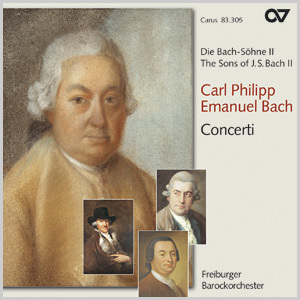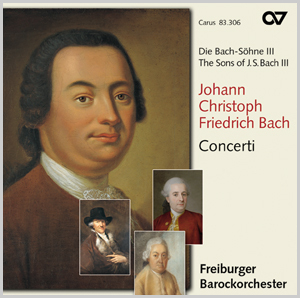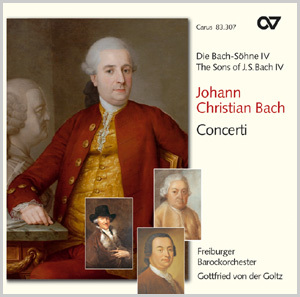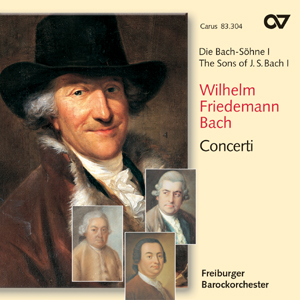
Concerti (FBO)
 Ecouter
(11)
Ecouter
(11)
- Un poco Allegro
- Largo
- Vivace
- Adagio
- Allegro e forte (Fuga)
- Allegretto
- Adagio
- Allegro assai
- Un poco Allegro
- Cantabile
- Vivace
Sommaire


-
Compositeur
Wilhelm Friedemann Bach
| 1710-1784Wilhelm Friedemann Bach, l'aîné des fils de Johann Sebastian, était connu comme l'un des meilleurs compositeurs de sa génération, mais aussi comme l'un des plus indépendants. Son œuvre témoigne de son ambition de poursuivre l'héritage de son père tout en faisant évoluer le goût musical de ses contemporains. Ses exigences artistiques de haut niveau sont présentes pratiquement dans toutes ses œuvres – des premières pièces pour clavier jusqu'aux sonates et fantaisies tardives, en passant par les cantates de la maturité. Wilhelm Friedemann Bach est l'auteur de pièces pour clavier, de musique de chambre, de concertos et de cantates sacrées. Il entreprit, avec un haut niveau de technique de composition, une synthèse attrayante entre le style complexe du haut-baroque et le style galant expressif. Alors qu'il composa principalement ses œuvres instrumentales à Dresde (1733–1746) et Berlin (1774–1784) , où il était contraint à un style de cour somptueux, ses œuvres vocales appartiennent à la période de Hallens, où il était organiste et directeur de la musique à l'église Saint Marc (1746–1764), et se distinguent par leurs audaces expressives et leur virtuosité. Plus d'information sur la personne
-
L'auteur de l'avant-propos
Peter Wollny
| 1961
-
Ensemble
Freiburger Barockorchester
Orchestre de l'année 2007 (Opernwelt) Plus d'information sur la personne
-
Chef d'orchestre
Gottfried von der Goltz
Gottfried von der Goltz has made a respected international name for himself as a Baroque violinist and Artistic Director of the Freiburger Barockorchester. As was common during the 18th century, he leads the FBO from the platform of the concertmaster. He also occasionally swaps the violin for the baton as, for example, in the Freiburger Barockorchester’s Beethoven Series which stretched over a period of many years. Gottfried von der Goltz made the specialist world sit up and take notice with successful CD recordings of the regrettably long-forgotten music of the Dresden Baroque and Bach’s sons. Nevertheless, he does not want to restrict himself to being a specialist in a particular repertoire. His diverse discography, ranging from the 17th century to the modern, shows instead that he is a tremendously versatile and flexible musician. In addition to his multi-layered chamber music engagements, Gottfried von der Goltz is Artistic Director of the Norsk Barokkorkesters. As a Professor, he is also a sought after teacher of Baroque and modern violin at the Hochschule für Musik in Freiburg. Plus d'information sur la personne
-
Solist - clavecin
Robert Hill
Robert Hill, professor for historical keyboard instruments and performance practice at the Staat - liche Hochschule für Musik Freiburg in Germany, studied harpsichord with Gus tav Leonhardt at the Sweelinck Conservatory Amsterdam, receiving his Soloist Diploma in 1974. In 1987 he earned his doctorate at Harvard University with a dissertation on the authenticity and sources of the early key - board music of Johann Sebastian Bach. His musical inter ests range from the performance of keyboard rep ertoire from about 1600 through the 19th century. He has won several prestigious awards, includ ing a National Endowment for the Arts Solo Reci - talist Award (1983) and the Cannes Classical Award 2002 for his recording with Guido Larisch of works for violoncello and fortepiano by Ferdinand Ries. Plus d'information sur la personne
-
Solist - flûte
Karl Kaiser
Karl Kaiser studied flute, transverse flute and musicology at the music conservatories in Cologne and Münster. He has gone on to perform as a soloist, chamber, and orchestral musician in the field of historically-informed performance practice, and has established himself as an outstanding teacher. He has made numerous CDs. Kaiser has been a member and soloist of the Freiburg Baroque Orchestra for many years, and has been flutist of Camerata Köln for 30 years. Karl Kaiser is a founding member of the orchestra La Stagione Frankfurt, and flutist in the Ardinghello Ensemble for romantic chamber music. He is Professor of Transverse Flute at Frankfurt University of Music and Performing Arts and the Freiburg Musikhochschule. 2010 saw the publication of his book “Basiswissen Barockmusik”, followed by his “Principes de la flûte” on Jacques Hotteterre’s theories at the beginning of 2014. Plus d'information sur la personne
-
Solist - piano
Michael Behringer
Michael Behringer was born in 1956. He first studied church music in Freiburg and, subsequently, organ and harpsichord in Vienna and Amsterdam. He has appeared as harpsichordist and played continuo with many renowned soloists and ensembles, most recently with Jordi Savall, Hesperion XX, the Freiburger Barockorchester and the Balthasar-Neumann-Ensemble under the direction of Thomas Hengelbrock. He was involved with the production of various CD’s for a Bach-Gesamtaufnahme (recording of the complete works), as well as other editions of Bach’s music. Michael Behringer teaches harpsichord and continuo playing at the Musikhochschule in Freiburg. Plus d'information sur la personne
-
Solist - violon
Gottfried von der Goltz
Gottfried von der Goltz has made a respected international name for himself as a Baroque violinist and Artistic Director of the Freiburger Barockorchester. As was common during the 18th century, he leads the FBO from the platform of the concertmaster. He also occasionally swaps the violin for the baton as, for example, in the Freiburger Barockorchester’s Beethoven Series which stretched over a period of many years. Gottfried von der Goltz made the specialist world sit up and take notice with successful CD recordings of the regrettably long-forgotten music of the Dresden Baroque and Bach’s sons. Nevertheless, he does not want to restrict himself to being a specialist in a particular repertoire. His diverse discography, ranging from the 17th century to the modern, shows instead that he is a tremendously versatile and flexible musician. In addition to his multi-layered chamber music engagements, Gottfried von der Goltz is Artistic Director of the Norsk Barokkorkesters. As a Professor, he is also a sought after teacher of Baroque and modern violin at the Hochschule für Musik in Freiburg. Plus d'information sur la personne
Critiques
Wilhelm Friedemann Bach : Concerti
Wilhelm Friedemann Bach : Concerti
La pochette indique « Les Fils Bach I ». On a donc là le premier CD d’une série dont on ignore en quoi elle consistera : un CD par fils Bach, ou plus? Annonce comme une première mondiale, le « Concerto pour flûte » redécouvert en 1999 à Kiev dans les archives de la Singakademie de Berlin a déjà fait l’objet d’au moins deux enregistrements. Attribuée aussi, mais par erreur, à Quantz, cette ?uvre dense et expressive date sans doute, du moins telle qu’elle nous est parvenue, de l’ultime période berlinoise du compositeur (vers 1775). La Sinfonia en ré mineur, vraisemblablement de l’époque de Dresde (vers 1740). Fut longtemps l’ouvrage le plus connu de Wilhelm Friedemann, en raison notamment de sa splendide fugue terminale. Peut-être fut-elle destinée à un office de cour catholique.
Dédié en 1767 à la princesse Maria Antonia de Saxe, le Concerto en mi mineur est le plus long et le plus homophone des quatre pour clavecin et cordes achevés par le compositeur. C’est aussi le dernier en date, et sa partie soliste évoque parfois le pianoforte (instrument adopte pour la présente version). La source principale du grandiose Concerto en mi bémol majeur pour deux clavecins (sans doute du début des années 1740) ajoute aux cordes deux tors, et une autre source encore deux trompettes et les timbales. Ces cinq instruments sont tous utilisés ici : la musique sonne donc assez massivement, ce dont on ne se plaint pas. Dans le « Cantabile » central en ut mineur l’orchestre se tait, ce qui donne un extrait de concerto pour deux clavecins seuls. Ces partitions ont toutes été enregistrées, mais rarement aussi bien qu’ici. Cela ne vaut pas que pour le Concerto pour flûte, dont nous tenons l’interprétation la plus satisfaisante, mais pour l’ensemble du programme, fort bien rendu et agréablement varie.
Marc Vigna
Quelle : Les Disques
Wilhelm Friedemann Bach: Concerti
At the center of the newly discovered flute concerto lies a heartfelt largo, at nine minutes a genuine challenge to player Karl Kaiser, who manages to sustain the musical line impressively despite the hollow tone and unevenness of register inherent in virtually all performances on Baroque flute. With its vivacious outer movements, this concerto is quite a discovery (flutists take note) and Carus Verlag also publishes the score. For the cembalo concerto in E minor (as well as for the flute concerto and the Sinfonia), keyboard player Michael Behringer opts for a fortepiano rather than a traditional harpsichord. This was a marvelous idea for several reasons. First, it permits him to give an appropriately dynamically inflected performance of the concerto, the longest work here, avoiding the aural fatigue that accompanies so many recordings featuring harpsichord. Second, in the other two works his continuo playing remains thankfully unobtrusive, a critical factor in the success of the Flute Concerto where balance between soloist and orchestra always is an issue.
Finally, his choice of instrument throws into brilliant relief the disc’s concluding work, the Concerto for Two Cembalos in E-flat, a thrilling piece in which the opposition of two harpsichords to a large orchestra including trumpets and drums (very unusual for the time) creates an explosive sonic panorama and sets the seal on W. F. Bach’s claim to be taken seriously as a composer with a distinctive voice. On the whole this is brilliant, muscular music, and the Freiburg Baroque Orchestra tears into it with relish. As period-instrument fans will know, this ensemble stands at the far left of the „historically informed performance” movement, generating sounds of a gruffness that, allied to emphatic rhythmic emphasis, may well startle those used to a more elegant and small-scaled approach--but it certainly works here. In particular, these renditions offer the necessary color and energy to sustain the long opening movements with total conviction (the opening of the double concerto is almost overpowering at 11-plus minutes), and, as noted above, they are stunningly recorded. No doubt about it: this one’s a gem.
David Hurwitz
Quelle: Classics today
[...] Das Freiburger Barockorchester und der Carus-Verlag Stuttgart schenken in einer CD-Reihe den kompositorisch wirkenden Söhnen des großen Maestro die Aufmerksamkeit: ein dankenswertes Handeln. [...] Kurz und gut: eine rundherum erfreuliche und sehr empfehlenswerte CD!
Lvdia Naumann
klassik.com, 29.10 2002
Les évaluations sur notre site web ne peuvent être effectuées que par des clients disposant d'un compte d'utilisateur enregistré. Il n'est pas vérifié si les produits évalués ont été effectivement achetés.
Questions fréquentes sur l'œuvre
 Il n'y a pas encore de questions et réponses concernant cette œuvre ou vous n'avez pas trouvé la réponse à votre question sur l'œuvre ? Cliquez ici et envoyez votre question spécifique à notre service clients.