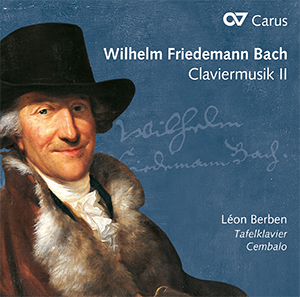
Claviermusik II
 Listen
(20)
Listen
(20)
- Allegro
- Grave
- Vivace
- Allegro
- Andante
- Presto
- Allegretto
- Suave
- Vivace
- Allegro
- Andante
- Vivace
- Fantasia in c
- Allegro ma non tanto
- Siciliano
- Vivace
- Allegro ma non molto
- Larghetto
- Presto
- Fantasia in e
Contents

-
Composer
Wilhelm Friedemann Bach
| 1710-1784Wilhelm Friedemann Bach, the oldest son of Johann Sebastian, enjoyed the reputation of an outstanding, but at the same time one of the most independent-minded composers of his age. His work represents the ambitious attempt to absorb the legacy of his father and to develop the taste of his own generation further. Lofty artistic ambitions are to be found in almost all of W. F. Bach's works – from the early piano pieces via the cantatas of his middle period to the late sonatas and fantasias. Wilhelm Friedemann Bach wrote keyboard and chamber music, concertos and sacred cantatas. On a high level of technical ability he created a fascinating synthesis of baroque complexities and the emotionally charged galant style. While his instrumental works were written for the most part in Dresden (1733–1746) and Berlin (1774–1784) and are in the style of splendid courtly music, the vocal works date from his time as organist and director of music at the Marktkirche in Halle (1746–1764); they are distinguished by their expressive boldness and virtuosity. Personal details
-
Editor
Dr. Thorsten Preuß
Executive producer BR Personal details
-
Preface writer
Peter Wollny
| 1961
-
Soloist
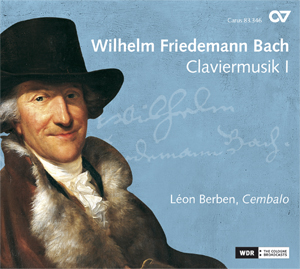
Leon Berben
Whether as an organist or harpsichordist, Léon Berben can be considered a master in his field. His extensive knowledge of music history and historical performance practice make him one of the leading figures of his generation in the field of early music. His repertoire embraces keyboard music from 1550 to 1790. He is the co-author of various articles in Die Musik in Geschichte und Gegenwart. His interpretations are given special weight by intensive study of the sources and constant research work, and his solo recordings on historic instruments have received great critical acclaim, winning several awards including the Diapason d’Or, the Choc du Monde de la Musique, as well as the Quarterly German Record Critics’ Award. Léon Berben was born in 1970 in Heerlen, The Netherlands, and lives in Cologne. He gained his solo diploma in organ and harpsichord in Amsterdam and at The Hague, studying with Gustav Leonhardt (whose last student he was), Rienk Jiskoot, Ton Koopman and Tini Mathot. He was the harpsichordist for Musica Antiqua Köln (Reinhard Goebel) from 2000, with whom he performed throughout Europe, Asia and North and South America, and recorded many CDs. Since the dissolution of the ensemble in 2006, he has pursued a solo career, appearing regularly at the most prestigious international festivals such as Klavier-Festival Ruhr, Internationaal Orgelfestival Haarlem, Schleswig-Holstein Musik Festival, Bodenseefestival, Festival Oude Muziek Utrecht, Rheingau Musikfestival, Festival de Saintes, Lucerne Festival, and the Festival de Música Antiga de Barcelona. He performs regulary with Concerto Melante, a chamber music ensemble of the Berliner Philharmoniker. Personal details
Reviews
Wie die erste Folge ist auch diese zweite wieder sehr interessant und musikalisch überzeugend. Berbens Spiel ist technisch souverän; seine Interpretationen sind immer spanned und fesselnd.
Johann van Veen, Toccata 96/2018
...musically Berben delivers outstanding performances.
Johann van Veen, musica-dei-donum.org, Herbst 2016
Und was Berben dabei an den Instrumenten vorführt, ist purer Sturm und Drang [...]. Zweifellos eine fantastische Einspielung [...].
Hagen Kunze, bach magazin, Herbst/Winter 2015/16
Leon Berben spielt die Sonaten und Phantasien mit hörbarem Verve und pianistischer Überlegenheit, arbeitet die Strukturen mit variierter Agogik heraus.
Rainer Goede, orgel-information.de, März/August 2015
… a superb album of W. F. Bach's keyboard music.
Lynn René Bayley, fanfaremag.com, 2. Juni 2015
There's a good chance that whatever your expectations of the music on this excellent CD by Dutch harpsichordist Léon Berben they will be modified, if not overturned. This is music which exudes excitement, originality, energy and color from first note to last. Berben responds admirably to these qualities. He is obviously enjoying the experience of presenting us with a couple of première recordings too: the other Fantasia here, in C minor [tr.13], and the F Major sonata [tr.s 17-19].
Mark Sealey, classical.net, 17.April 2015
Reviews on our website can only be submitted by customers with a registered user account. A check whether the rated products were actually purchased does not take place.
Frequent questions about this work
 There are no questions and answers available so far or you were unable to find an answer to your specific question about this work? Then click here and send your specific questions to our Customer Services!