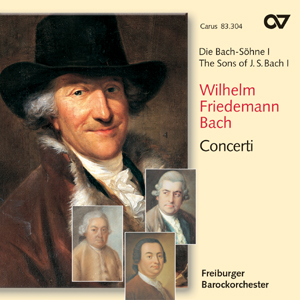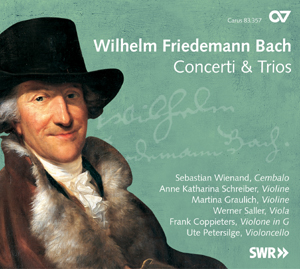
Concerti & Trios
 Ecouter
(12)
Ecouter
(12)
- Allegro
- Andante
- Presto
- Larghetto
- Allegro
- Presto
- Allegro
- Adagio
- Vivace
- Largo
- Allegro ma non troppo
- Vivace
Sommaire

-
Compositeur
Wilhelm Friedemann Bach
| 1710-1784Wilhelm Friedemann Bach, l'aîné des fils de Johann Sebastian, était connu comme l'un des meilleurs compositeurs de sa génération, mais aussi comme l'un des plus indépendants. Son œuvre témoigne de son ambition de poursuivre l'héritage de son père tout en faisant évoluer le goût musical de ses contemporains. Ses exigences artistiques de haut niveau sont présentes pratiquement dans toutes ses œuvres – des premières pièces pour clavier jusqu'aux sonates et fantaisies tardives, en passant par les cantates de la maturité. Wilhelm Friedemann Bach est l'auteur de pièces pour clavier, de musique de chambre, de concertos et de cantates sacrées. Il entreprit, avec un haut niveau de technique de composition, une synthèse attrayante entre le style complexe du haut-baroque et le style galant expressif. Alors qu'il composa principalement ses œuvres instrumentales à Dresde (1733–1746) et Berlin (1774–1784) , où il était contraint à un style de cour somptueux, ses œuvres vocales appartiennent à la période de Hallens, où il était organiste et directeur de la musique à l'église Saint Marc (1746–1764), et se distinguent par leurs audaces expressives et leur virtuosité. Plus d'information sur la personne
-
L'auteur de l'avant-propos
Peter Wollny
| 1961
-
Solist - clavecin
Sebastian Wienand
Sebastian Wienand (b. 1984) is one of the younger generation of harpsichordists and fortepianists. He began piano lessons at the age of five and fell in love with the instrument straight away. Even before encountering the fascinating world of Baroque music and historical instruments, it was clear to him that he wanted to make his career in music. Sebastian Wienand is now a much sought-after soloist and chamber music partner and performs with groups such as the Freiburg Baroque Orchestra, Akademie für Alte Musik Berlin, London Baroque, Les Plaisirs du Parnasse, Concerto Vocale and Ensemble l’Ornamento at national and international festivals including the Mozart Festival Salzburg, Musica Antiqua Bruges, the Mecklenburg-Vorpommern Festival, La Folle Journée, Schwetzingen Festival, and Innsbruck Festival of Early Music. He has also worked for several years as music assistant to the Belgian conductor René Jacobs in opera productions. He has performed a Mozart piano concerto with the Freiburg Baroque Orchestra at the Arts Festival in Hong Kong. A CD recording of Mozart’s Idomeneo conducted by René Jacobs, with Wienand playing the recitative accompaniments on fortepiano received the German Record Critics’ Annual Award in 2009. Various radio, CD and television recordings illustrate his wide-ranging artistic achievements. Plus d'information sur la personne
-
Solist - alto
Werner Saller
Werner Saller played several instruments, ranging from recorder, accordion and zither to trombone, and from double bass to gamba, before finally choosing the viola. Many years playing Bavarian folk music and consort music on the gamba have shaped his musical career. He studied in Munich and Lübeck, where he studied with Prof. Barbara Westphal. He has attended solo, chamber music and baroque viola courses with Michi Gaigg, Ingrid Seifert, Ronny Rogoff, Prof. Walter Levin, and Christoph Coin. He is a member of the Freiburg Baroque Orchestra and plays in various orchestral and chamber music groups including La Stagione, Freitagsakademie, and AlmaViva. Plus d'information sur la personne
-
Solist - violon
Martina Graulich
Martina Graulich, violin, has a special interest in early music, which led to her joining the Freiburg Baroque Orchestra. In 2003 the Ensemble Ciacona was founded which specializes in Bohemian, Italian and German violin music of the 17th and 18th centuries. Martina Graulich has been invited as a teacher to the Encontros de Musica da Casa de Mateus in Portugal. She has made numerous CD recordings, including the London Symphonies (Haydn) in the arrangement for quintet by Solomon with the Camerata of the 18th Century, Amsterdam. Her CD Pisendel & Dresden with violin sonatas from the Dresden court is on the Carus label (Carus 83.162). Plus d'information sur la personne
-
Solist - violon
Anne Katharina Schreiber
Depuis 1988, Anne Katharina Schreiber est membre du Freiburger Barockorchester, avec lequel elle se produit régulièrement en soliste lors de concerts et sur CDs. En sa qualité de premier violon, elle travaille souvent en outre avec d’autres orchestres baroques (p. ex. le Balthasar-Neumann-Ensemble) et des chefs d’orchestre tels qu’Ivor Bolton, Thomas Hengelbrock et Marcus Creed. Par ailleurs, elle joue souvent du répertoire moderne avec des formations comme l’ensemble recherche. Après avoir étudié avec Rainer Kussmaul, elle a obtenu son diplôme avec les félicitations. Anne Katharina Schreiber est membre du Trio Vivente ; elle est aussi une partenaire chambriste favorite d’Anner Bylsma, Gottfried von der Goltz, Ingo Goritzki et Rainer Kussmaul pour ne citer qu’eux. Plus d'information sur la personne
-
Solist - violoncelle
Ute Petersilge
Ute Petersilge, violoncello. She studied in Freiburg with Marcal Cervera, followed by a course in baroque cello in The Hague with Richte van der Meer. She then returned to Freiburg to play with the Freiburg Baroque Orchestra, and was involved in its founding, development and growth. At the same time she began playing in the Belgian orchestra Anima Eterna under the direction of Jos van Immerseel. Ute Petersilge continues to play frequently in both ensembles. Her repertoire ranges through all styles from the 17th to the 21st century. As well as orchestral and chamber music, she also performs solo repertoire. She has chosen to live in Forst bei Bruchsal, Baden, where she can prepare musical projects surrounded by nature and with her family, and where she always finds relaxation. She also has a great interest in teaching young beginners. Plus d'information sur la personne
-
Solist - violone
Frank Coppieters
Frank Coppieters, 8 foot G violone, is professor of double bass and chamber music at the Royal Conservatories of Music in Gent and Brussels. In Brussels he also teaches early double bass and G-violone. He performs both at home and abroad in ensembles including Il Gardellino, Ricercar Consort, Ensemble Explorations, Ensemble Ciacona, Bach Collegium Japan, the Amsterdam Baroque Orchestra, and the Freiburg Baroque Orchestra. He has played on several CD recordings. On modern double bass he has made a solo CD of virtuoso works for his instrument (Gailly Records). Plus d'information sur la personne
Critiques
Sebastian Wienand gives excellent performances of the solo lines. The irregularity of the keyboard parts comes off very well, and the interventions of the strings are as unexpected as they should be. In Wilhelm Friedemann's music the unpredictability has to be realised perfectly, and that is the case here.
(Johan van Veen, musicweb-international, Juli 2011)
[Sebastian Wienand is] a tremendously engaging player and a generous team player too: with the accompaniment of single strings these two concertos have an intense, concentrated chamber feel which actually makes a great deal of sense of Friedemann's slightly neurotic and highly strung instrumental style. [...] Sebastian Wienand, the intelligent harpsichordist, is certainly someone to watch out for in the future.
(Simon Heighes, International Record Review, Juni 2011)
[...] The overriding impression of this disc is of convincing and intelligent interpretations. Sebastian Wienand is a persuasive advocate for this repertoire: his technical control is evident throughout, and the clarity of articulation and expressive nuance ideally suited to the music. His solo string ensemble [...] play with conviction and an expressivity which matches Wienand's playing perfectly. [...]
(Warwick Cole, Early Music Review, April 2011)
[...] Das energiegeladene Spiel der Interpreten in Kombination mit den anspruchsvollen und noch weitestgehend unbekannten Werken sorgt für eine außerordentlich gute Bilanz bei der Bewertung dieser empfehlenswerten Aufnahme.
(Marion Beyer, klassik.com, 19.01.2011)
[...] ein Feuerwerk von funkelnden Details, das diese Musik so einzigartig macht. Maßgeblich dazu beigetragen haben auch die Interpreten rund um den Cembalisten Sebastian Wienand, deren Spiel ebenso unkonventionell und zupackend ausgefallen ist wie die Musik selbst.
(Jan Ritterstaedt, WDR 3 TonArt, 14.12.10)
Les évaluations sur notre site web ne peuvent être effectuées que par des clients disposant d'un compte d'utilisateur enregistré. Il n'est pas vérifié si les produits évalués ont été effectivement achetés.
Questions fréquentes sur l'œuvre
 Il n'y a pas encore de questions et réponses concernant cette œuvre ou vous n'avez pas trouvé la réponse à votre question sur l'œuvre ? Cliquez ici et envoyez votre question spécifique à notre service clients.