

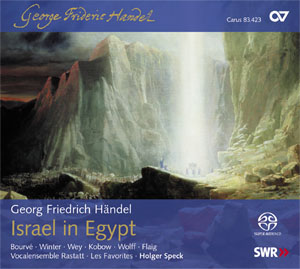
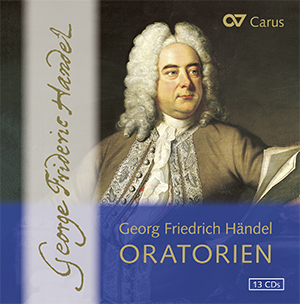
Monumental Oratorio: Handel began work on Israel in Egypt just three days after he completed the oratorio Saul. He completed it in less than a month. He first performed the monumental work in April 1739 in the King's Theatre in Haymarket. He continually revised this work until 1758.
The version recorded here is in the three-part form as it was originally conceived by Handel. With two mixed choirs, which essentially relate most of the plot, and an unusually large orchestra, this large-proportioned oratorio has a special place in Handel's creative output.
In addition to the hand-picked soloists, above all, the Vocalensemble Rastatt and the Barockensemble Les Favorites are outstanding. Under the direction of Holger Speck these musicians portray most impressively the contrast-filled spectrum, ranging from expressive lament to the festive and triumphant jubilation of the Israelites.
Explore


 Listen
(40)
Listen
(40)
- Quartet: When the ear heard him
- Quartet: They shall receive
- Air (Alto): Their land brought forth frogs
- Chorus: Thy right hand, O Lord
- Symphony
- Chorus: The sons of Israel do mourn
- Chorus: How is the mighty fall’n
- Soli and Chorus: The righteous shall be had
- Chorus: Their bodies are buried in peace
- Chorus: The people will tell of their wisdom
- Chorus: The merciful goodness of the Lord
- Recit. (Tenore): Now there arose a new king
- Solo and Chorus: And the children of Israel
- Recit. (Tenore): Then sent he Moses
- Chorus: They loathed to drink of the river
- Chorus: He spake the word
- Chorus: He gave them hailstones for rain
- Chorus: He sent a thick darkness
- Chorus: He smote all the firstborn of Egypt
- Chorus: But as for his people
- Chorus: Egypt was glad when they departed
- Chorus: He rebuked the Red Sea
- Chorus: And Israel saw that great work
- Chorus: Moses and the children of Israel
- Duet (Soprano I e II): The Lord is my strength
- Chorus: He is my God
- Duet (Basso I e II): The Lord is a man of war
- Chorus: The dephts have cover’d them
- Chorus: And with the blast of thy nostrils
- Air (Tenore): The enemy said, I will pursue
- Air (Soprano I): Thou didst blow with the wind
- Chorus: Who is like unto thee, O Lord
- Duet (Alto, Tenore): Thou in thy mercy hast led forth thy people
- Chorus: The people shall hear
- Air (Alto): Thou shalt bring them in
- Chorus: The Lord shall reign for ever and ever
- Recit. (Tenore): For the horse of Pharaoh
- Chorus: The Lord shall reign for ever and ever
- Recit. (Tenore): And Miriam the prophetess
- Solo and Chorus: Sing ye to the Lord
 Practise
-
 carus music, the Choir Coach
Üben mit carus music
carus music, the Choir Coach
Üben mit carus music
-
Practice aids
-
Practice aids voice part soprano
- Chorus: How is the mighty fall’n (Choir Coach, soprano 1)
- Chorus: They loathed to drink of the river (Choir Coach)
- Chorus: He smote all the firstborn of Egypt (Choir Coach)
- Chorus: Thy right hand, O Lord (Choir Coach, soprano 2)
- Chorus: How is the mighty fall’n (Choir Coach, Slow mode, soprano 1)
- Chorus: They loathed to drink of the river (Choir Coach, Slow mode)
- Chorus: He smote all the firstborn of Egypt (Choir Coach, Slow mode)
- Chorus: Thy right hand, O Lord (Choir Coach, Slow mode, soprano 2)
-
Practice aids voice part alto
- Chorus: How is the mighty fall’n (Choir Coach)
- Chorus: They loathed to drink of the river (Choir Coach)
- Chorus: He smote all the firstborn of Egypt (Choir Coach)
- Chorus: Thy right hand, O Lord (Choir Coach, Alto 2)
- Chorus: How is the mighty fall’n (Choir Coach, Slow mode)
- Chorus: They loathed to drink of the river (Choir Coach, Slow mode)
- Chorus: He smote all the firstborn of Egypt (Choir Coach, Slow mode)
- Chorus: Thy right hand, O Lord (Choir Coach, Slow mode, Alto 2)
-
Practice aids voice part tenore
- Chorus: How is the mighty fall’n (Choir Coach)
- Chorus: He spake the word (Choir Coach, Tenore 2)
- Chorus: Egypt was glad when they departed (Choir Coach)
- Chorus: Who is like unto thee, O Lord (Choir Coach, Tenore 1)
- Chorus: How is the mighty fall’n (Choir Coach, Slow mode)
- Chorus: He spake the word (Choir Coach, Slow mode, Tenore 2)
- Chorus: Egypt was glad when they departed (Choir Coach, Slow mode)
- Chorus: Who is like unto thee, O Lord (Choir Coach, Slow mode, Tenore 1)
-
Practice aids voice part basso
- Chorus: How is the mighty fall’n (Choir Coach)
- Chorus: They loathed to drink of the river (Choir Coach)
- Chorus: He smote all the firstborn of Egypt (Choir Coach)
- Chorus: Thy right hand, O Lord (Choir Coach, Basso 2)
- Chorus: How is the mighty fall’n (Choir Coach, Slow mode)
- Chorus: They loathed to drink of the river (Choir Coach, Slow mode)
- Chorus: He smote all the firstborn of Egypt (Choir Coach, Slow mode)
- Chorus: Thy right hand, O Lord (Choir Coach, Slow mode, Basso 2)
-
Purchase
Additional product information
Contents


-
Composer
Georg Friedrich Händel
| 1685-1759George Frideric Handel put his exceptionally versatile compositional abilities to the test at an early age. After moving to London in 1712, where he was appointed Composer of Musick for His Majesty’s Chapel Royal in 1723, he wrote numerous masterpieces for the royal court as well as his major opere serie. For many years he enjoyed triumphant successes with his operas, which were sung by outstanding performers, with serenades, and later also with oratorios such as Saul and Israel in Egypt. Over the years Handel’s reputation grew far beyond the city where he worked; some of his choral works, particularly Messiah, have enjoyed a performance tradition which remains unbroken to this day, and are sung by choirs throughout the world. Personal details
-
Preface writer
Till Reininghaus
| 1979
-
Choir
Vocalensemble Rastatt
Alongside its dedication to a core repertoire of composers such as Monteverdi, Schütz, Bach, Mozart, Haydn, Schumann, and Brahms, the Vocalensemble Rastatt & Les Favorites frequently explore new terrain with premiere performances. On the heels of its successes in national and international choir competitions, the ensemble has taken part in numerous internationally acclaimed CD recordings as well as radio, and television productions for SWR, Radio France, Deutschlandradio Kultur, and Deutschlandfunk. The Vocalensemble Rastatt & Les Favorites have performed in the Festspielhaus Baden-Baden, the Musikfest Bremen, the Kölner Philharmonie, the SWR RheinVokal Festival, the Europäisches Musikfest Stuttgart, the Schwetzinger Festspiele, the Deutschlandradio Kultur Wartburgkonzerte, the Internationale Musiktage im Dom zu Speyer, the Philharmonie in Mulhouse, and the Centre de Musique “Les Dominicains” in Guebwiller, France, among other venues. The flexible choir does not shy away from excursions into the world of opera, having performed Donizetti’s Lucia di Lammermoor and Bellini’s Norma with Edita Gruberova, and Mozart’s Don Giovanni and Così fan tutte with Rolando Villazón. Together with Klaus Maria Brandauer and the Chamber Orchestra of Europe, the choir also performed Mendelssohn’s Sommernachtstraum at the Musikfest Bremen. The ensemble is sponsored by the German state of Baden-Württemberg in co-operation with its “Kunst 2020” program, as well as by its home city of Rastatt. Personal details
-
Ensemble
Les Favorites
Alongside its dedication to a core repertoire of composers such as Monteverdi, Schütz, Bach, Mozart, Haydn, Schumann, and Brahms, the Vocalensemble Rastatt & Les Favorites frequently explore new terrain with premiere performances. On the heels of its successes in national and international choir competitions, the ensemble has taken part in numerous internationally acclaimed CD recordings as well as radio, and television productions for SWR, Radio France, Deutschlandradio Kultur, and Deutschlandfunk. The Vocalensemble Rastatt & Les Favorites have performed in the Festspielhaus Baden-Baden, the Musikfest Bremen, the Kölner Philharmonie, the SWR RheinVokal Festival, the Europäisches Musikfest Stuttgart, the Schwetzinger Festspiele, the Deutschlandradio Kultur Wartburgkonzerte, the Internationale Musiktage im Dom zu Speyer, the Philharmonie in Mulhouse, and the Centre de Musique “Les Dominicains” in Guebwiller, France, among other venues. The flexible choir does not shy away from excursions into the world of opera, having performed Donizetti’s Lucia di Lammermoor and Bellini’s Norma with Edita Gruberova, and Mozart’s Don Giovanni and Così fan tutte with Rolando Villazón. Together with Klaus Maria Brandauer and the Chamber Orchestra of Europe, the choir also performed Mendelssohn’s Sommernachtstraum at the Musikfest Bremen. The ensemble is sponsored by the German state of Baden-Württemberg in co-operation with its “Kunst 2020” program, as well as by its home city of Rastatt. Personal details
-
Conductor
Holger Speck
Holger Speck enjoys an international reputation as a charismatic conductor who succeeds both in realizing stylistic characteristics in an innovative manner and in conveying emotional content. Fanfare magazine from the USA attests to his “undeniable authority.” With his distinctive sense of sound and compelling, lively and authentic interpretations, he shapes the image of his own ensembles as well as the choirs and orchestras with which he works as a guest conductor. The president of the German Bundestag Dr. Wolfgang Schäuble engaged him and his Vocalensemble Rastatt for a concert during the G20 summit. Speck established the Grammy-nominated Vocalensemble Rastatt and the Baroque orchestra Les Favorites internationally with exciting concert programs and outstanding CD recordings on the Carus label containing music by Buxtehude, Telemann, Handel and Brahms, among others. For Deutsche Grammophon productions, he was responsible for the choral sections of the Mozart operas “Die Entführung aus dem Serail,” “Le nozze di Figaro,” “Così fan tutte,” and “Don Giovanni.” Holger Speck teaches at the University of Music in Karlsruhe; in addition to being the artistic director of Vocalensemble Rastatt & Les Favorites, he works as a guest conductor with the NDR Vokalensemble, the Freiburg Baroque Orchestra, the Akademie für Alte Musik Berlin, and the choir and orchestra of the Slovenian Philharmonic Orchestra in Ljubljana, among others. The ballet director John Neumeier engaged Speck to conduct his last major creation “Dona nobis pacem” with Bach’s Mass in B minor at the Hamburg State Opera and the Festspielhaus Baden-Baden. . Personal details
-
Soloist - soprano
Antonia Bourvé
Antonia Bourvé studied opera and lieder singing with Stephan Kohlenberg and Felicitas Strack at the Hochschule für Musik in Karlsruhe. Her studies continued with master classes with Brigitte Fassbaender and Anna Reynolds, and lieder classes with Mitsuko Shirai and Hartmut Höll. She was awarded a scholarship by the Richard Wagner Association and won first prize in the Kulturfonds Baden opera competition. A much sought-after soprano, Antonia Bourvé’s guest appearances include the title role in Mozart’s Zaide at the Staatstheater Nuremberg. She has also sung on CD recordings of Mozart’s Schauspieldirektor and Beethoven’s Scottish Songs. A further recording, which has been praised as a benchmark recording by the press, is Saint-Saëns’ Oratorio de Noël, conducted by Holger Speck on the Carus label (Carus 83.352) Personal details
-
Soloist - soprano
Cornelia Winter
The soprano Cornelia Winter studied at the Musikhochschulen in Frankfurt and Berlin with Elsa Cavelti and Ingrid Figur, and took part in master classes with Laura Sarti, Barbara Schlick and Paul Esswood. She has made guest appearances at the Nationaltheater Mannheim and the Stadttheater Heidelberg. She has sung with the “Ensemble Modern”, “Concerto Köln”, and “l‘Arpa Festante” in Germany and abroad. An outstanding example of her work to date is the CD “Landschaft mit entfernten Bekannten” by Heiner Goebbels, released in 2007, with the Ensemble Modern and the Deutscher Kammerchor, which was staged at the “Théatre des Amandiers” in Paris. Personal details
-
Soloist - alto
Michael Hofmeister
Whilst he was still a student Michael Hofmeister sang at the Staatsoper in Hanover, and in Berlin in a theatre project by Ruedi Häusermann. He performs with conductors including Enrique Mazzola, Konrad Junghänel, Michael Schneider and Holger Speck and directors such as Calixto Bieto, Peter Konwitschny and Trisha Brown. In addition to his operatic engagements, Michael Hofmeister enjoys a busy career in the Baroque music field and has sung at festivals including the Handel Festival in Halle. He sang in Adriana Hölszky’s Hybris and Salvatore Sciarrino’s Da Gelo a Gelov at the Schwetzingen Festival. He has also sung in the Sciarrino work at the Opéra National de Paris and the Grand Théâtre de Genève in the 2007/08 season. Personal details
-
Soloist - alto
Terry Wey
Terry Wey was born in Switzerland and received his first singing lessons as a member of the Vienna Boys’ Choir with Silvija V. Purchar, later studying with Kurt Equiluz and Christine Schwarz. As a boy treble he won prizes in several competitions (including the MIGROS Genossenschaftsbund [Cooperative Society] Zurich, Kärntner-Sparkasse [Savings Bank] and Wörthersee Music Scholarship). His first appearances with the “Clemencic Consort” under René Clemencic in 2003 brought him to the notice of the international concert and opera scene. He has performed with conductors including Thomas Hengelbrock, Marc Minkowski and Michael Hofstetter and orchestras such as the Balthasar-Neumann-Ensemble, Les Arts Florissants and Les Musiciens du Louvre Grenoble. Several CD recordings illustrate his achievements and versatility. Personal details
-
Soloist - tenor
Jan Kobow
-
Soloist - bass
Konstantin Wolff
Konstantin Wolff studied with Donald Litaker at the Hochschule für Musik in Karlsruhe. He won the Felix Mendelssohn Bartholdy Prize from the Stiftung Preußischer Kulturbesitz, was awarded a scholarship by the German National Academic Foundation and made his opera debut in 2005 at the Opera National de Lyon under William Christie in Monteverdi’s L’incoronazione di Poppea. His concert repertoire ranges from the early baroque to the 20th century. He has performed with conductors including Gerd Albrecht, Alun Francis, Riccardo Chailly, Ton Koopman, René Jacobs, Claudio Abbado, Sir Simon Rattle and Nicholas McGegan. His first solo CD, a recording of Lieder to texts by Victor Hugo, has been enthusiastically received. Personal details
-
Soloist - bass
Markus Flaig
| 1971
Reviews
[…] warmly recommended.
Philip Reed, Choir&Organ, Nov./Dez. 2009
Holger Speck und seine Musiker bereiten dem Zuhörer einen Klanggenuss der Sonderklasse. […] so meisterhaft gelungen, dass man der Aufnahme Referenzcharakter zusprechen kann.
Claus Dieter Hanauer, Badische Neueste Nachrichten, Oktober 2009
[...] Die unter der Leitung von Holger Speck lupenrein intonierenden Stimmen samt des begleitenden Barockensembles Les Favorites lassen dieses kontrastreiche Oratorium zu einem Fest für die Ohren werden. [...]
Udo Barth, Badisches Tagblatt, 5.1.2009
[...] The Sinfonia is ideally mournful... The Vocalensemble Rastatt perform the choruses with impeccable English pronouncation and an excellent grip on sonorities and phrasing [...] "He gave them hailstones for rain" and "He smote all the firstborn of Egypt" are excellent balanced and communicative [...] The Opening of Part 3 is stately and crisp, the ritornello of "Thou shalt bring them in" is ideally sweet and sentimental, and the final chorus is splendidly performed. Speck´s direction of his choir and orchestra is stylish and effective [...]
David Vickers, Gramophone, Juni 2009
Carus präsentiert exzellente Neueinspielung [...] Speck verbindet zudem zugespitzte Dramatisierung mit profunder Kenntnis des Chorgesangs [...] die beste Aufnahme! [...]
Diverdi, Madrid
[...] beim vielfach preisgekrönten Vocalensemble Rastatt unter Holger Speck ist diese Neueinspielung bestens aufgehoben [...]
Deutschlandfunk, Die neue Platte
Es ist einfach großartig, (die Plagen im II. Teil) mit der hier gezeigten Präzision, zupackender Dramatik und der nötigen großen Geste mitzuerleben [...]
Klassik.com
[...] die Riege der erlesenen Gesangssolisten, der besondere gestalterische Erfindungsreichtum aller Beteiligten sowie deren auftrumpfende Musizierlust halten den Hörer schlicht gefangen.
Recklinghäuser Zeitung
Reviews on our website can only be submitted by customers with a registered user account. A check whether the rated products were actually purchased does not take place.
No feedback available for this product.
Frequent questions about this work
 There are no questions and answers available so far or you were unable to find an answer to your specific question about this work? Then click here and send your specific questions to our Customer Services!