

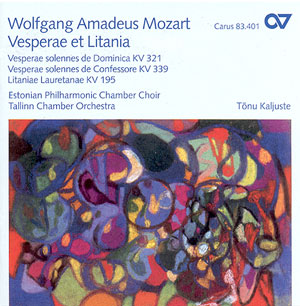
Vesperae et Litaniae (Kaljuste)
 Listen
(17)
Listen
(17)
- Dixit Dominus
- Confitebor tibi
- Beatus vir
- Laudate pueri
- Laudate Dominum
- Magnificat anima mea
- Kyrie eleison
- Sancta Maria
- Salus infirmorum
- Regina Angelorum
- Agnus Dei
- Dixit Dominus
- Confitebor tibi
- Beatus vir
- Laudate pueri
- Laudate Dominum
- Magnificat anima mea
 Additional material
-
 Digital text (without sheet music) incl. printing licence, html file, Introductory text, germanhtml file, Introductory text, german (Sample)Vorwort der Ausgabe Carus 40.056
Christine Martin
Wolfgang Amadeus Mozart komponierte die Litaniae Lauretanae KV 195 1774 in Salzburg. Durch ihre große Besetzung, ihre beachtliche Ausdehnung und ihre virtuosen Solopartien gehören sie zu den „Litaniae solemnes“, die im Salzburger Dom zur Aufführung kamen. Die Gliederung des Textes und die Charakterisierung der einzelnen Sätze stehen ganz in der Tradition der süddeutschen Litaneivertonung, die Mozart nicht zuletzt durch seinen Vater Leopold vermittelt wurde. Drei der insgesamt fünf Sätze – Kyrie, Sancta Maria und Regina angelorum – folgen in ihrer Ausprägung von Haupt- und Seitensatz, Durchführung und Reprise der Sonatenhauptsatzform. Dabei wird das vom Text vorgegebene Alternieren von Anrufung und Bitte häufig der musikalischen Form untergeordnet. Dennoch führt die Aneinanderreihung der Anrufungen weniger zur sonatenartigen Exposition und Verarbeitung von zwei Themen als zu einer ständigen Variation gleichen thematischen Materials. Außerdem integriert
...
-
Digital text (without sheet music) incl. printing licence, html file, singing text, english translationhtml file, singing text, english translation (Sample)
1. Kyrie (Soli SATB e Coro SATB) Lord have mercy,
Christ have mercy,
Lord have mercy.
Christ, hear us; Christ, hear us.
Father in heaven, God have mercy.
Son, Saviour of the world, have mercy.
Holy Spirit, God, have mercy.
Holy Trinity, one God, have mercy.2. Sancta Maria (Soli SATB e Coro SATB) Holy Mary, pray for us.
Holy mother of God, holy virgin of virgins, pray for us.
Mother of Christ, mother of divine grace,
mother most pure, mother most dear,
pray for us.
Mother inviolate, mother undefiled,
pray for us.
Mother most amiable, mother most admirable,
mother of our Creator, mother of our Saviour,
...
-
Digital text (without sheet music) incl. printing licence, html file, singing text, german translationhtml file, singing text, german translation (Sample)1. Kyrie (Soli SATB e Coro SATB)
Herr, erbarme dich,
2. Sancta Maria (Soli SATB e Coro SATB)
Christus, erbarme dich,
Herr, erbarme dich!
Christus, höre uns, Christus, erhöre uns!
Vater im Himmel, Gott, erbarme dich unser!
Sohn, Erlöser der Welt, Gott, erbarme dich unser!
Heiliger Geist, Gott, erbarme dich unser!
Heilige Dreieinigkeit, einziger Gott,
erbarme dich unser!Heilige Maria, bitte für uns,
heilige Mutter Gottes, heilige Jungfrau
der Jungfrauen, bitte für uns.
Mutter Christi, Mutter der göttlichen Gnade,
reinste Mutter, liebste Mutter,
bitte für uns.
Unverletzbare Mutter, unbefleckte Mutter,
bitte für uns.
Liebenswerte Mutter, verehrungswürdige Mutter,...
-
Digital text (without sheet music) incl. printing licence, html file, singing text, originalhtml file, singing text, original (Sample)1. Kyrie (Soli SATB e Coro SATB)
Kyrie eleison.
2. Sancta Maria (Soli SATB e Coro SATB)
Christe eleison.
Kyrie eleison.
Christe audi nos. Christe exaudi nos.
Pater de coelis Deus, miserere nobis.
Fili Redemptor mundi Deus, miserere nobis.
Spiritus Sancte Deus, miserere nobis.
Sancta Trinitas, unus Deus,
miserere nobis.Sancta Maria, ora pro nobis.
Sancta Dei genitrix, sancta Virgo virginum,
ora pro nobis.
Mater Christi, mater divinae gratiae,
mater purissima, mater castissima,
ora pro nobis.
Mater inviolata, mater intemerata,
ora pro nobis.
Mater amabilis, mater admirabilis,...
-
Digital text (without sheet music) incl. printing licence, html file, singing text, english translationhtml file, singing text, english translation (Sample)1. Dixit Dominus (Soli SATB e Coro SATB)
The Lord said to my Lord:
sit thou at my right hand,
until I make thine enemies thy footstool.
The Lord will send forth the sceptre of thy power out of Sion:
rule thou in the midst of thine enemies.
With thee is the principality in the day of thy strength in the brightness of the saints:
from the womb before the morning star I begot thee.
The Lord hath sworn, and He will not repent:
Thou art a priest for ever
according to the order of Melchisedech.
The Lord at thy right hand hath broken kings in the day of His wrath.
He shall judge among nations,
He shall fill ruins:
He shall crush the heads in the land of many.
He shall drink of the torrent in the way:...
-
Digital text (without sheet music) incl. printing licence, html file, singing text, german translationhtml file, singing text, german translation (Sample)1. Dixit Dominus (Soli SATB e Coro SATB)
Der Herr sprach zu meinem Herrn:
Setze dich zu meiner Rechten,
bis ich deine Feinde
zum Schemel deiner Füße lege.
Der Herr wird das Zepter deiner Macht ausstrecken aus Zion:
Herrsche mitten unter deinen Feinden!
Wenn du dein Heer aufbietest, wird dir dein Volk
willig folgen in heiligem Schmuck.
Deine Kinder werden dir geboren wie der Tau aus der Morgenröte.
Der Herr hat geschworen, und es wird ihn nicht gereuen:
Du bist ein Priester ewiglich nach der Weise Melchisedeks.
Der Herr zu deiner Rechten
wird zerschmettern die Könige am Tage seines Zorns.
Er wird richten unter den Heiden, wird viele erschlagen,...
-
Digital text (without sheet music) incl. printing licence, html file, singing text, originalhtml file, singing text, original (Sample)1. Dixit Dominus (Soli SATB e Coro SATB)
Dixit Dominus Domino meo:
Sede a dextris meis:
Donec ponam inimicos tuos,
scabellum pedum tuorum.
Virgam virtutis tuae emittet Dominus ex Sion:
dominare in medio inimicorum tuorum.
Tecum principium in die virtutis tuae
in splendoribus sanctorum:
ex utero ante luciferum genui te.
Juravit Dominus, et non poenitebit eum:
Tu es sacerdos in aeternum secundum ordinem Melchisedech.
Dominus a dextris tuis,
confregit in die irae suae reges.
Judicabit in nationibus, implebit ruinas:
conquasabit capita in terra multorum.
De torrente in via bibet:
propterea exaltabit caput.
Psalm 109...
-
Digital text (without sheet music) incl. printing licence, html file, Introductory text, englishhtml file, Introductory text, english (Sample)Text from the CD Carus 83.316
Konrad Küster (2000)
Translation (abridged): John CoombsThey occupy a position between Mozart’s settings of the Mass and his single-movement “shorter church works”: the substantial, multi-movement litanies and psalm cycles written while he was still at Salzburg. Undoubtedly their composition allowed him greater musical freedom than the settings of the Mass; because the latter were written for use at services which were organized down to the time allowed for the individual sections, the music had to be constructed along carefully defined lines.
On the other hand the vespers and litanies were not performed for Sunday or festival Masses, but in different liturgical circumstances. For the Offices of the Canonical Hours, even in the days of Gregorian plainsong, far more elaborate chants were used than at High Mass; vespers (the service at...
-
Digital text (without sheet music) incl. printing licence, html file, Introductory text, germanhtml file, Introductory text, german (Sample)Booklet-Text der CD Carus 83.316
Konrad Küster (2000)
Sie stehen zwischen den Messzyklen und den einsätzigen »kleineren Kirchenwerken« Mozarts: die umfangreichen, mehrsätzigen Litaneien und Psalmzyklen aus seiner Salzburger Zeit. Unverkennbar war in ihnen die musikalische Freiheit des Komponisten größer als in den Messzyklen: Weil diese sich in den Messgottesdienst einzufügen hatten, der bis in Details seines zeitlichen Ablaufes durchorganisiert war, bewegt sich auch die Musik in einem klar definierten Rahmen. Je nach Bedeutung des Gottesdienstes ermöglichte dieser zwar die Bildung eigenständiger Sätze (in der Missa solemnis), konnte aber auch die musikalischen Formen so begrenzen, wie es für die Missa brevis typisch ist; wenn beispielsweise am Ende von Gloria und Credo fugische Elemente entfaltet werden, dann nur als Andeutung weiter reichender Konzepte, und wenn zu den Worten »Et incarnatus est« der Eindruck eines eigenen
...
-
Digital text (without sheet music) incl. printing licence, html file, singing text, english translationhtml file, singing text, english translation (Sample)1. Dixit Dominus (Soli SATB e Coro SATB)
The Lord said to my Lord:
sit thou at my right hand,
until I make thine enemies thy footstool.
The Lord will send forth the sceptre of thy power out of Sion:
rule thou in the midst of thine enemies.
With thee is the principality in the day of thy strength in the brightness of the saints:
from the womb before the morning star
I begot thee.
The Lord hath sworn, and He will not repent:
Thou art a priest for ever
according to the order of Melchisedech.
The Lord at thy right hand hath broken kings in the day of His wrath.
He shall judge among nations,
He shall fill ruins:
He shall crush the heads in the land of many.
He shall drink of the torrent in the way:...
-
Digital text (without sheet music) incl. printing licence, html file, singing text, german translationhtml file, singing text, german translation (Sample)1. Dixit Dominus (Soli SATB e Coro SATB)
Der Herr sprach zu meinem Herrn:
Setze dich zu meiner Rechten,
bis ich deine Feinde
zum Schemel deiner Füße lege.
Der Herr wird das Zepter deiner Macht ausstrecken aus Zion:
Herrsche mitten unter deinen Feinden!
Wenn du dein Heer aufbietest,
wird dir dein Volk willig folgen in heiligem Schmuck.
Deine Kinder werden dir geboren wie der Tau aus der Morgenröte.
Der Herr hat geschworen, und es wird ihn nicht gereuen:
Du bist ein Priester ewiglich
nach der Weise Melchisedeks.
Der Herr zu deiner Rechten wird zerschmettern die Könige am Tage seines Zorns.
Er wird richten unter den Heiden, wird viele erschlagen,
wird Häupter zerschmettern über große Lande.
Er wird trinken vom Bach auf dem Wege,...
-
Digital text (without sheet music) incl. printing licence, html file, singing text, originalhtml file, singing text, original (Sample)1. Dixit Dominus (Soli SATB e Coro SATB)
Dixit Dominus Domino meo:
Sede a dextris meis:
Donec ponam inimicos tuos,
scabellum pedum tuorum.
Virgam virtutis tuae emittet Dominus ex Sion:
dominare in medio inimicorum tuorum.
Tecum principium in die virtutis tuae
in splendoribus sanctorum:
ex utero ante luciferum genui te.
Juravit Dominus, et non poenitebit eum:
Tu es sacerdos in aeternum
secundum ordinem Melchisedech. Dominus a dextris tuis,
confregit in die irae suae reges.
Judicabit in nationibus, implebit ruinas:
conquasabit capita in terra multorum.
De torrente in via bibet:
propterea exaltabit caput.
Psalm 109...
Contents


-
Composer
Wolfgang Amadeus Mozart
| 1756-1791As the son of the deputy Kapellmeister to the Salzburg Prince-Archbishop, Mozart was constantly surrounded by church music in his youth. On his travels Mozart became familiar with Italian church music, and later in Vienna he studied the works of Bach and Handel. After moving to Vienna he was faced with the new challenges of composing opera and piano concertos, and significantly the “C Minor Mass” KV 427, the greatest sacred work of the first Vienna years, remained unfinished. The last period of his life again shows a change of direction to church music: Mozart successfully applied to succeed the terminally ill Leopold Hoffmann as Kapellmeister at St Stephen's Cathedral, but he was unable to take up the position as he died before Hoffmann. A gem such as the “Ave verum” KV 618 and the incomplete Requiem KV 626 give us an idea of what Mozart might have achieved as a composer of sacred music if he had taken up this important position. Personal details
-
Preface writer
Konrad Küster
-
Ensemble
Estonian Philharmonic Chamber Choir
-
Ensemble
Tallinn Chamber Orchestra
-
Conductor
Tonu Kaljuste
For twenty years Tõnu Kaljuste (conductor) was artistic director and principal conductor of the Estonian Philharmonic Chamber Choir, which he founded in 1981, and the Tallinn Chamber Orchestra. Kaljuste has also been chief conductor of the Swedish Radio Choir and the Netherlands Chamber Choir. He has directed international choral seminars and workshops for several years and has worked as a guest conductor with leading orchestras and choirs throughout Europe, Australia and America. As well as immersing himself in the music of the great northern and eastern European moderns, such as Schnittke, Kurtag, Penderecki, Rautavaara and Kancheli, he has a deep affinity with the composers of his native Estonia, including Pärt, Tüür, Tormis and Eller. He has established an international reputation with his wide-ranging repertoire from opera, via the traditional symphonic repertoire to contemporary music. His numerous recordings have won many awards and have been nominated for Grammy awards. In 1999 he received the Cannes Classical Award in the category “Best 20th Century Choral Music” for his recording of Alfred Schnittke’s Psalms of Repentance. In 2004 he was awarded first prize by the Estonian State Foundation “Kultuurkapital.” The same year he became artistic director of the Nargen Festival, an annual, three-month long musical event on the coast of Estonia. He is a member of the Royal Swedish Academy of Music. Personal details
-
Soloist - tenor
Leif Aruhn-Solén
Reviews
Wolfgang Amadeus Mozart: Vesperae et Litania
Wolfgang Amadeus Mozart: Vesperae et Litania
Wolfgang Amadeus Mozart: Litaniae
Mit diesen beiden CDs liegt eine technisch und künstlerisch einwandfreie Dokumentation einer Sparte von Kirchenmusik vor, die mangels liturgischer Gelegenheit weniger Aufführungen erfährt als zum Beispiel die Messen Mozarts. Die Musizierfreude der Mitwirkenden und die differenzierte Ausgestaltung durch Tonu Kaljuste zeigt jedoch deutlich, dass dieses Verhältnis in Anbetracht der Qualität der Kompositionen nicht gerechtfertigt ist. Hörbar wird allerdings auch, wie wichtig gerade bei Mozart feines und intelligent abgestimmtes Musizieren ist, um all die wunderbaren Details wiederzugeben, die für die damalige Tagzeitenliturgie aufgewendet wurden. Sicher wünscht man sich keine lateinische, nur gehörte Vesper zurück, aber die künstlerische Qualität der Musik stimmt im Bezug auf unsere Praxis doch auch nachdenklich.
Quelle: Musica Sacra 6/2000, S. 44
Mozart komponierte in Salzburg vier Litaneien zwischen 1771 und 1776, darunter zwei Lauretanische und zwei Sakramentslitaneien. Dabei folgte er dem Typus der aus dem 17. Jahrhundert stammenden Kantatenlitanei, die aus einer Reihe unterschiedlicher Sätze besteht. Die beiden Vespern entstanden 1779 und 1780 und sind ebenfalls für den Salzburger Dom bestimmt. Wie in den Litaneien finden sich auch hier der „stile antico” mit seinen kontrapunktischen Imitationskünsten neben dem „stile moderno”, der sich durch Eingängigkeit und eher konzertant-virtuosen Charakter auszeichnen. Sie bieten den vorragend disponierten und musizierenden Solist(inn)en in den ariosen Teilen und Ensembles reichliche Gelegenheit, ihr Können zu zeigen (wie großartig ist etwa die Kadenz in der Sopranarie „Panis vivus” der Sakramentslitanei KV 125 gestaltet, um nur ein Detail von vielen zu erwähnen!). In gleicher Weise beeindruckend ist aber auch die Leistung des Estonian Philharmonic Choir und des Tallinn Chamber Orchestra unter der sachkundigen Leitung von Tonu Kaljuste. Zwei wirklich äußerst erfreuliche Einspielungen, die keine Wünsche offen lassen!
Quelle: Singende Kirche 4/2000, S. 268
MOZART - VESPERAE ET LITANIA
The Vesperae et Litania occupy a unique position between Mozart’s settings of the Mass and his single-movement ‚shorter church works’. The substantial, multi-movement litanies and psalm cycles were written while he was still at Saltzburg and their composition undoubtedly allowed him greater musical freedom than his settings of the mass. In this exemplary recording, the Estonian Philharmonic Choir is directed by its artistic director and principal conductor, Tonu Kaljuste.
Quelle: New Classics, 09/05
Reviews on our website can only be submitted by customers with a registered user account. A check whether the rated products were actually purchased does not take place.
Frequent questions about this work
 There are no questions and answers available so far or you were unable to find an answer to your specific question about this work? Then click here and send your specific questions to our Customer Services!