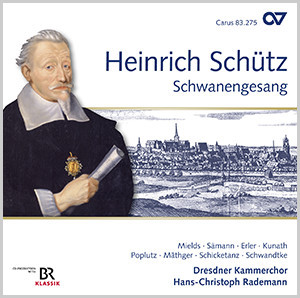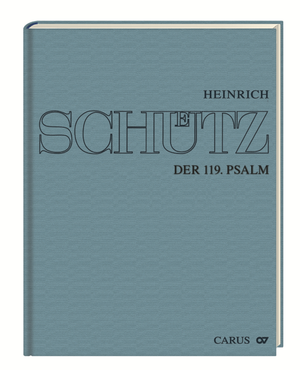
Psalm 119 (Schwanengesang), (Complete edition, vol. 18)
Stuttgart Schütz Edition
 View
View

 Listen
(12)
Listen
(12)
- Aleph und Beth. Wohl denen, die ohne Wandel leben
- Gimel und Daleth. Tue wohl deinem Knechte, dass ich lebe
- He und Waw. Zeige mir, Herr, den Weg deiner Rechte
- Zajin und Chet. Gedenke deinem Knechte an dein Wort
- Tet und Jod. Du tust Guts deinem Knechte an dein Wort
- Kaph und Lamed. Meine Seele verlanget nach deinem Heil
- Mem und Nun. Wie hab ich deine Gesetze so lieb
- Samech und Ajin. Ich hasse die Flattergeister
- Pe und Sade. Deine Zeugnisse sind wunderbarlich
- Qoph und Resch. Ich rufe von ganzem Herzen
- Schin und Taw. Die Fürsten verfolgen mich ohn Ursach
- German Magnificat. "Meine Seele erhebt den Herrn"
 Additional material
- Purchase additional material as a download product.
-
 Digital text (without sheet music) incl. printing licence, html file, singing text, english translationhtml file, singing text, english translation (Sample)
Psalm 100: Jauchzet dem Herren, alle Welt SWV 493 Make a joyful noise unto the Lord, all ye lands.
Serve the Lord with gladness:
come before his presence with singing.
Know ye that the Lord he is God:
it is he that hath made us, and not we ourselves;
we are his people, and the sheep of his pasture.
Enter into his gates with thanksgiving,
and into his courts with praise:
be thankful unto him, and bless his name.
For the Lord is good;
his mercy is everlasting;
and his truth endureth to all generations.
Ps 100
Glory be to the Father and to the Son,
and to the Holy Ghost,
as it was in the beginning, is now, and ever shall be,
world without end. Amen.
Doxology...
-
Digital text (without sheet music) incl. printing licence, html file, singing text, originalhtml file, singing text, original (Sample)
Der 100. Psalm: Jauchzet dem Herren, alle Welt SWV 493 Jauchzet dem Herren, alle Welt!
Dienet dem Herrn mit Freuden;
kommet vor sein Angesicht mit Frohlocken!
Erkennet, dass der Herre Gott ist!
Er hat uns gemacht, und nicht wir selbst,
zu seinem Volk und zu Schafen seiner Weide.
Gehet zu seinen Toren ein mit Danken,
zu seinen Vorhöfen mit Loben;
danket ihm, lobet seinen Namen!
Denn der Herr ist freundlich,
und seine Gnade währet ewiglich
und seine Wahrheit für und für.
Ps 100
Ehre sei dem Vater und dem Sohn
und auch dem heiligen Geiste,
wie es war im Anfang, jetzt und immerdar
und von Ewigkeit zu Ewigkeit. Amen.
Doxologie...
-
Digital text (without sheet music) incl. printing licence, html file, Introductory text, englishhtml file, Introductory text, english (Sample)Foreword of the Edition Carus 20.493
Werner Breig (abridged foreword of the Edition Carus 20.493)
Translation: Elizabeth RobinsonOn 28 September 1662 the rebuilt Dresden Schlosskapelle was consecrated. For this exceptional occasion Heinrich Schütz, now the “oldest Kapellmeister” of the Dresden court and living in retirement in Weißenfels, created an outstanding work in the form of a complete setting of Psalm 100 for double choir (SWV 493). It was the last of five compositions on this psalm; it was preceded by two compositions on the German text of the Lutheran Bible (SWV 36a and 36); the first of these – a three-choir work with double echo – can be dated to his period in Kassel between the years studying in Venice and taking up the position of Kapellmeister in Dresden, and is evidently Schütz’s earliest composition to a text from the Lutheran Bible. In between came two settings of the Latin Vulgate text (SWV 262 and 332). And so, Schütz’s stylistic development can be followed in his settings of Psalm 100 over almost five decades.
...
-
Digital text (without sheet music) incl. printing licence, html file, Introductory text, germanhtml file, Introductory text, german (Sample)Vorwort der Ausgabe Carus 20.493
Werner Breig
Am 28. September 1662 wurde die umgebaute Dresdner Schlosskapelle eingeweiht. Zu dieser außerordentlichen Gelegenheit schuf der inzwischen in Weißenfels im Ruhestand lebende „älteste Kapellmeister“ des Dresdner Hofes einen außerordentlichen Beitrag in Gestalt einer doppelchörigen vollständigen Vertonung des 100. Psalms (SWV 493). Es war die letzte von fünf Kompositionen über diesen Psalm; vorangegangen waren zwei Kompositionen über den deutschen Text der Luther-Bibel (SWV 36a und 36), von denen die erste – ein dreichöriges Werk mit doppeltem Echo – bereits in der Kasseler Zeit zwischen den venezianischen Studienjahren und dem Antritt des Dresdner Kapellmeisteramtes zu datieren ist und offenbar Schütz’ früheste Komposition über einen Text aus der Luther-Bibel darstellt. Dazwischen entstanden zwei Vertonungen des lateinischen Vulgata-Textes (SWV 262 und 332). An den Vertonungen des 100. Psalms lässt sich so Schütz’ stilistische Entwicklung über nahezu fünf Jahrzehnte verfolgen.
Die Erhaltung der späten Vertonung des 100. Psalms verdanken wir dem Umstand, dass Schütz das
...
-
Digital text (without sheet music) incl. printing licence, html file, singing text, english translationhtml file, singing text, english translation (Sample)
Deutsches Magnificat: Meine Seele erhebt den Herren SWV 494 My soul doth magnify the Lord,
and my spirit hath rejoiced in God my Saviour.
For he hath regarded the low estate of his handmaiden:
for, behold, from henceforth
all generations shall call me blessed.
For he that is mighty hath done to me
great things; and holy is his name.
He hath shewed strength with his arm;
he hath scattered the proud
in the imagination of their hearts.
He hath put down the mighty from their seats,
and exalted them of low degree.
He hath fi lled the hungry with good things;
and the rich he hath sent empty away.
He hath helped his servant Israel,
in remembrance of his mercy;
as he spake to our fathers,
to Abraham, and to his seed for ever.
Lk 1:46-55
...
-
Digital text (without sheet music) incl. printing licence, html file, singing text, originalhtml file, singing text, original (Sample)
Deutsches Magnificat: Meine Seele erhebt den Herren SWV 494 Meine Seele erhebt den Herren,
und mein Geist freuet sich Gottes, meines Heilandes.
Denn er hat die Niedrigkeit seiner Magd angesehen.
Siehe, von nun an
werden mich selig preisen alle Kindeskind,
denn er hat große Ding an mir getan,
der da mächtig ist und des Name heilig ist.
Er übet Gewalt mit seinem Arm
und zerstreuet, die hoffärtig sind
in ihres Herzens Sinn.
Er stößet die Gewaltigen vom Stuhl
und erhöhet die Niedrigen.
Die Hungerigen füllet er mit Gütern
und lässet die Reichen leer.
Er denket der Barmherzigkeit
und hilft seinem Diener Israel auf.
Wie er geredt hat unsern Vätern,
Abraham und seinem Samen ewiglich.
Lk 1,46–55
...
-
Digital text (without sheet music) incl. printing licence, html file, Introductory text, englishhtml file, Introductory text, english (Sample)?? Foreword of the Edition Carus 20.494/50
Werner Breig
Translation: Elizabeth RobinsonThe Latin version of the hymn of praise, sung by the Virgin Mary in response to the Archangel Gabriel’s Annunciation in St. Luke’s Gospel that she is to bear the son of God, begins with the word “Magnificat” (Luke 1,46–55: “Magnificat anima mea Dominum”). This ten-verse text has its established place as the canticle at Vespers, the penultimate divine office of the day. As a result the Magnificat became one of the most frequently-set texts in the Bible (for example, there are over
...
-
Digital text (without sheet music) incl. printing licence, html file, Introductory text, germanhtml file, Introductory text, german (Sample)Gek?rztes Vorwort der Ausgabe Carus 20.494/50
Werner Breig
Mit dem Wort „Magnificat“ beginnt die lateinische Fassung des Lobgesangs, den im Lukas-Evangelium die Jungfrau Maria als Antwort auf die Verkündigung des Erzengels Gabriel anstimmt, sie werde den Sohn Gottes gebären (Lukas 1,46–55: „Magnificat anima mea Dominum“). Dieser aus 10 Versen bestehende Text hat seinen festen Platz als sog. Canticum der Vesper, des vorletzten Stundengebetes des Tages. Dadurch wurde das Magnificat einer der meistvertonten Texte der Bibel (beispielsweise gibt es von Orlando di Lasso über 100 Magnificat-Kompositionen). Auch in der lutherischen Kirche, die die Vesper als liturgische Form beibehalten hat, entstand eine reiche Tradition von Magnificat-Kompositionen, als deren Gipfel das Magnificat von Johann Sebstian Bach (BWV 243) gilt. Dabei trat neben die lateinische Fassung der Vulgata in zunehmenden Maße die Übersetzung Martin Luthers „Meine Seele erhebt den Herrn“.
Heinrich Schütz hat über den Magnificat-Text vier Kompositionen in verschiedenen Besetzungen geschrieben: eine für vierstimmigen Chor (SWV 426), eine für Sopran, zwei Instrumente und Basso continuo (SWV
...
-
Digital text (without sheet music) incl. printing licence, html file, singing text, english translationhtml file, singing text, english translation (Sample)
Deutsches Magnificat: Meine Seele erhebt den Herren SWV 494 My soul doth magnify the Lord,
and my spirit hath rejoiced in God my Saviour.
For he hath regarded the low estate of his handmaiden:
for, behold, from henceforth
all generations shall call me blessed.
For he that is mighty hath done to me
great things; and holy is his name.
He hath shewed strength with his arm;
he hath scattered the proud
in the imagination of their hearts.
He hath put down the mighty from their seats,
and exalted them of low degree.
He hath fi lled the hungry with good things;
and the rich he hath sent empty away.
He hath helped his servant Israel,
in remembrance of his mercy;
as he spake to our fathers,
to Abraham, and to his seed for ever.
Lk 1:46-55
...
-
Digital text (without sheet music) incl. printing licence, html file, singing text, originalhtml file, singing text, original (Sample)
Deutsches Magnificat: Meine Seele erhebt den Herren SWV 494 Meine Seele erhebt den Herren,
und mein Geist freuet sich Gottes, meines Heilandes.
Denn er hat die Niedrigkeit seiner Magd angesehen.
Siehe, von nun an
werden mich selig preisen alle Kindeskind,
denn er hat große Ding an mir getan,
der da mächtig ist und des Name heilig ist.
Er übet Gewalt mit seinem Arm
und zerstreuet, die hoffärtig sind
in ihres Herzens Sinn.
Er stößet die Gewaltigen vom Stuhl
und erhöhet die Niedrigen.
Die Hungerigen füllet er mit Gütern
und lässet die Reichen leer.
Er denket der Barmherzigkeit
und hilft seinem Diener Israel auf.
Wie er geredt hat unsern Vätern,
Abraham und seinem Samen ewiglich.
Lk 1,46–55
...
-
Digital text (without sheet music) incl. printing licence, html file, singing text, english translationhtml file, singing text, english translation (Sample)
Aleph und Beth: Wohl denen, die ohne Wandel leben SWV 482 Blessed are the undefiled in the way,
who walk in the law of the Lord.
Blessed are they that keep his testimonies,
and that seek him with the whole heart.
They also do no iniquity:
they walk in his ways.
Thou hast commanded us to keep thy precepts diligently.
O that my ways were directed
to keep thy statutes!
Then shall I not be ashamed,
when I have respect unto all thy commandments.
I will praise thee with uprightness of heart,
when I shall have learned thy righteous judgments.
I will keep thy statutes:
O forsake me not utterly.
Wherewithal shall a young man cleanse his way?
by taking heed thereto according to thy word....
-
Digital text (without sheet music) incl. printing licence, html file, singing text, originalhtml file, singing text, original (Sample)
Aleph und Beth: Wohl denen, die ohne Wandel leben SWV 482 Wohl denen, die ohne Wandel leben,
die im Gesetze des Herren wandeln!
Wohl denen, die seine Zeugnis halten,
die ihn von ganzem Herzen suchen!
Denn welche auf seinen Wegen wandeln,
die tun kein Unrecht.
Du hast geboten, fleißig zu halten deine Befehl.
O dass mein Leben deine Rechte mit ganzem Ernst hielte!
Wenn ich schaue alleine auf deine Gebot,
so werde ich nicht zuschanden.
Ich danke dir von rechtem Herzen, dass du mich lehrest die Rechte deiner Gerechtigkeit.
Deine Rechte will ich halten;
verlass mich nimmermehr!
Wie wird ein Jüngling seinen Weg unsträflich gehen?
Wenn er sich hält nach deinen Worten.
Ich suche dich von ganzem Herzen;
lass mich nicht fehlen deiner Gebot!...
-
Digital text (without sheet music) incl. printing licence, html file, Introductory text, englishhtml file, Introductory text, english (Sample)Text from the CD Carus 83.275
Werner Breig
Translation: Elizabeth RobinsonThe Old Testament Book of Psalms in the translation by Martin Luther was by far the most important source of texts for Heinrich Schütz. Schütz’s earliest setting of a biblical text was Psalm 100 for three choirs (SWV 36a), which was then incorporated in a revised version in the printed collection Psalmen Davids. At the end of his output stood Psalm 119, known as his “Schwanengesang” [Swansong], which Schütz completed in 1671, a year before his death. Between these two works he composed well over a hundred psalm settings, some based on individual verses or groups of verses, but some settings of complete psalms.
However, the composer’s love for the psalter does not explain his decision to turn to Psalm 119 at a great age; not only is it extremely long with its 276 verses, but it also lacks the rich imagery
...
-
Digital text (without sheet music) incl. printing licence, html file, Introductory text, germanhtml file, Introductory text, german (Sample)Booklet-Text der CD Carus 83.275
Werner Breig
Das alttestamentliche Buch der Psalmen in der Übersetzung Martin Luthers ist für Heinrich Schütz die mit Abstand wichtigste Textquelle. Schütz’ früheste Bibeltextvertonung ist der dreichörige 100. Psalm (SWV 36a), der dann 1619 in revidierter Fassung in die Drucksammlung Psalmen Davids einbezogen wurde, und am Ende seines Œuvres steht der 119. Psalm, sein sogenannter „Schwanengesang“, den Schütz im Jahre 1671, also ein Jahr vor seinem Tode, noch abschließen konnte. Dazwischen entstanden weit über 100 Psalmtext-Vertonungen, denen zum Teil einzelne Verse oder Versgruppen, vielfach aber auch ganze Psalmen zugrundeliegen.
Die Liebe des Komponisten Schütz zum Psalter erklärt allerdings noch nicht seinen Entschluss, in höchstem Alter auf den 119. Psalm zuzugreifen, der nicht nur die exzessive Länge von 276 Versen
...
Contents


-
Composer
Heinrich Schütz
| 1585-1672Heinrich Schütz is regarded as the first German musician of European stature. As a choirboy from 1599 at the court of Landgrave Moritz of Hessen-Kassel, he received a thorough education. In 1608 he began a law degree in Marburg, but broke this off in 1609 in order, with the support of the Landgrave, to study composition with Giovanni Gabrieli, organist at St Mark’s in Venice. In 1613 Schütz returned to Kassel, but two years later was enticed away by Elector Johann Georg I of Saxony to the Dresden court as “Organist und Director der Musica”, where he held the position of Hofkapellmeister (court Kapellmeister) from 1617 until his death. Schütz’s great cycles of vocal works marked the high point of his reputation in Germany and northern Europe. But these represent only part of Schütz’s output; individual works are represented in printed collections with works by other composers, others only survive in manuscript, and much has been lost. The Stuttgart Schütz Edition makes available Schütz’s complete oeuvre, and all works are also published in practical Urtext editions. Personal details
-
Editor
Uwe Wolf
| 1961As a musicologist, Dr. Uwe Wolf is particularly at home in the 17th and 18th centuries. The focus of his work ranges from the time of Monteverdi and Schütz to Bach and the generation of Bach's sons and pupils through to Viennese Classicism. He has been head of the editorial department at Carus-Verlag since October 2011. Prior to this, he worked in Bach research for over 20 years. Personal details
-
Editor
Werner Breig
| 1932
Reviews
... Oft aber kommt Breig dem schützschen Idiom noch näher als sein großer Vorgänger: Manche Übergänge gelingen ihm nahtloser, manche Stellen - etwa die Musikalisierung der „eitlen Wahrheit” in der zehnten Motette - wirken zugespitzter, glänzender, konzertanter als die Lösungen Steudes.
Sven Hiemke, Musik & Kirche, Mai / Juni 2018
Reviews on our website can only be submitted by customers with a registered user account. A check whether the rated products were actually purchased does not take place.
Frequent questions about this work
 There are no questions and answers available so far or you were unable to find an answer to your specific question about this work? Then click here and send your specific questions to our Customer Services!