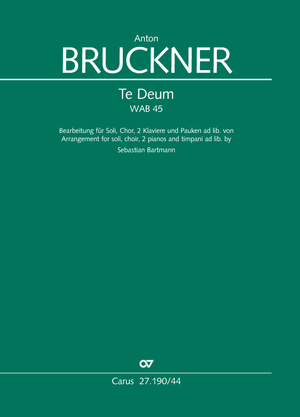
Anton Bruckner's Te Deum – a high point in the composer's output and one of the most important works of the sacred choral repertoire in the 19th century – is now available in a modern, scholarly edition. The Carus edition draws on both the two sources regarded as important, the autograph score and the first printed edition, with careful consideration given to variant readings. And so a music text has been prepared which reflects the composer's intentions as closely as possible. Great emphasis has been placed on a clear-to-read layout of the full score pages, as well as excellent legibility for the parts, which are available on sale. With current performance practice in mind, the clarinet parts are notated in B flat instead of A, corresponding with the first printed edition. The vocal score has been newly prepared to reflect current practical requirements. As an economical alternative, a chorus score is available.
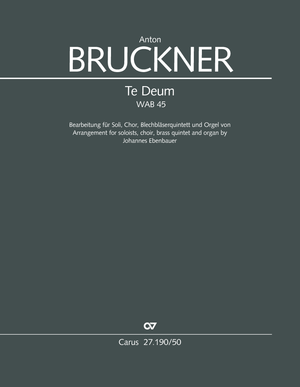
Thanks to the arrangement for brass quintet and organ (arr. J. Ebenbauer / Carus 27.190/50) it is possible to perform the work also in smaller settings.
Explore
 View
View


 Additional material
- Purchase additional material as a download product.
-
 Digital text (without sheet music) incl. printing licence, html file, singing text, english translationhtml file, singing text, english translation (Sample)
Te Deum (Coro SATB, Soli SAT) We praise thee, O God: we acknowledge thee to be the Lord.
All the earth doth worship thee: the Father everlasting.
To thee all Angels cry aloud: the Heavens, and all the Powers therein.
To thee Cherubim and Seraphim: continually do cry,
Holy, Holy, Holy: Lord God of Hosts;
Heaven and earth are full of the Majesty: of thy glory.
The glorious company of the Apostles: praise thee.
The goodly fellowship of the Prophets: praise thee.
The noble army of Martyrs: praise thee.
The holy Church throughout all the world: doth acknowledge thee;
The Father: of an infinite Majesty;
Thine honourable, true: and only Son;
Also the Holy Ghost: the Comforter.
Thou art the King of Glory: O Christ.
Thou art the everlasting Son: of the Father.
When thou tookest upon thee to deliver man: thou didst not abhor the Virgin&...
-
Digital text (without sheet music) incl. printing licence, html file, singing text, german translationhtml file, singing text, german translation (Sample)Te Deum (Coro SATB, Soli SAT)
Dich, Gott, loben wir, dich, Herr, preisen wir.
Te ergo (Soli SATB)
Dir, dem ewigen Vater, huldigt das Erdenrund.
Dir rufen die Engel alle, dir Himmel und Mächte insgesamt,
dir die Cherubim und Seraphim mit unaufhörlicher Stimme zu:
Heilig, heilig, heilig der Herr, der Gott der Scharen!
Voll sind Himmel und Erde von deiner hohen Herrlichkeit.
Dich preist der glorreiche Chor der Apostel,
dich der Propheten lobwürdige Zahl,
dich der Märtyrer leuchtendes Heer.
Dich preist über das Erdenrund die heilige Kirche;
dich, den Vater unermessbarer Majestät;
deinen wahren und einzigen Sohn;
und den Heiligen Geist, den Fürsprecher.
Du, König der Herrlichkeit, Christus,
Du bist des Vaters allewiger Sohn.
Du hast der Jungfrau Schoß nicht verschmäht,
bist Mensch geworden, den Menschen zu befreien.
Du hast bezwungen des Todes Stachel und denen, die glauben,
die Reiche der Himmel aufgetan.
Du sitzest zur Rechten Gottes in deines Vaters Herrlichkeit.
Als Richter, so glauben wir, kehrst du einst wieder.Dich bitten wir denn, komm deinen Dienern zu Hilfe,
die du erlöst mit kostbarem...
-
Digital text (without sheet music) incl. printing licence, html file, singing text, originalhtml file, singing text, original (Sample)
Te Deum (Coro SATB, Soli SAT) Te Deum laudamus: te Dominum confitemur.
Te aeternum Patrem omnis terra veneratur.
Tibi omnes angeli, tibi coeli et universae potestates:
tibi cherubim et seraphim incessabili voce proclamant:
Sanctus, Sanctus, Sanctus Dominus Deus Sabaoth.
Pleni sunt coeli et terra majestatis gloriae tuae.
Te gloriosus Apostolorum chorus,
te prophetarum laudabilis numerus,
te martyrum candidatus laudat exercitus.
Te per orbem terrarum sancta confitetur Ecclesia,
Patrem immensae majestatis;
venerandum tuum verum et unicum Filium;
Sanctum quoque Paraclitum Spiritum.
Tu rex gloriae, Christe.
Tu Patris sempiternus es Filius.
Tu ad liberandum suscepturus hominem, non horruisti Virginis uterum.
Tu devicto mortis aculeo, aperuisti credentibus regna coelorum.
Tu ad dexteram Dei sedes, in gloria Patris.
Judex crederis esse venturus.Te ergo (Soli SATB)
...
-
Digital text (without sheet music) incl. printing licence, html file, Introductory text, englishhtml file, Introductory text, english (Sample)Abridged foreword of the Edition Carus 27.190
Ernst Herttrich
Translation: David KosvinerAnton Bruckner’s Te Deum was composed between 1881 and 1885. After this, he only composed smaller secular works, only one of which – Psalm 150 – uses a large orchestra. Whereas the latter work was commissioned for the opening ceremony of the “Internationale Ausstellung für Musik- und Theaterwesen” (International Exhibition for Music and the Dramatic Arts) in 1892, the occasion for which the Te Deum was composed is not known. In a letter dated 10 May 1885 and addressed to the conductor Hermann Levi, Bruckner wrote that he had dedicated the work to God, “in thanksgiving for having survived so much suffering in Vienna.” Occasionally, also the supposition is expressed that he regarded the work as, in a certain sense, a reply to Berlioz’s great Te Deum; Bruckner had attended its first Viennese performance and found the work not ecclesiastical enough. In any event, Bruckner’s Te Deum can be considered to represent the apotheosis of his sacred compositions.
The Latin text of the Te Deum is often designated the Ambrosian Hymn of Praise
...
-
Digital text (without sheet music) incl. printing licence, html file, Introductory text, germanhtml file, Introductory text, german (Sample)Gekürztes Vorwort der Ausgabe Carus 27.190
Ernst Herttrich
Anton Bruckners Te Deum entstand in den Jahren 1881 bis 1885. Danach komponierte er nur noch kleinere geistliche Werke und von diesen nur noch eines, den 150. Psalm, mit großem Orchester. Während dieser ein Auftragswerk für die Eröffnung der Internationalen Ausstellung für Musik- und Theaterwesen im Jahr 1892 in Wien war, ist der Anlass für die Entstehung des Te Deum nicht bekannt. In einem Brief vom 10. Mai 1885 an den Dirigenten Hermann Levi schrieb Bruckner, er habe das Te Deum Gott gewidmet, „zur Danksagung für so viel überstandene Leiden in Wien“. Gelegentlich wird auch die Vermutung geäußert, er habe das Werk gewissermaßen als Antwort auf das große Te Deum von Berlioz verstanden, dessen Wiener Erstaufführung er beigewohnt hatte und das er als zu wenig kirchlich empfunden habe. In jedem Fall kann man im Te Deum den Höhepunkt von Bruckners geistlicher Musik sehen.
Der lateinische Text des Te Deum wird oft als Ambrosianischer Lobgesang (Hymnus Ambrosianus) apostrophiert, gemäß einer früheren Zuschreibung an
...
Purchase
Additional product information
-
Composer
Anton Bruckner
| 1824-1896Anton Bruckner was born in Ansfelden (Austria) in 1824 and did not have a particularly easy life. The Austrian composer came from a simple, rural background and was plagued by self-doubt throughout his life. After the death of his father, he was accepted as a choirboy at St Florian's Abbey at the age of 13. After several years as a school assistant and self-taught organ and piano studies, he initially worked as an organist in St Florian. In 1855 he was appointed cathedral organist in Linz. After an introduction to music theory and instrumentation by Simon Sechter and Otto Kitzler, Bruckner discovered Richard Wagner as an artistic role model, whom he admired throughout his life and also visited several times in Bayreuth.
In 1868 Anton Bruckner became professor of basso continuo, counterpoint and organ at the Vienna Conservatory, ten years later court organist. In 1891 he was awarded an honorary doctorate from the University of Vienna. He was regarded as an important organ virtuoso of his time, but his compositional recognition was a long time coming. It was not until the Symphony No. 7 in E major, composed between 1881 and 1883, with the famous Adagio, which was written under the impression of Wagner's death, that he received the recognition he had hoped for, even if he did not want to accept it in view of his tendency towards scepticism and self-criticism.
Anton Bruckner was a solitary composer who did not want to follow any school or doctrine. He wrote both sacred and secular works in all their facets. In addition to numerous motets, Bruckner composed three masses, the Missa Solemnis in B flat minor (1854) and the Te Deum (1881-84; CV 27.190/00), which is available from Carus-Verlag. As a symphonist, he wrote a total of nine symphonies and many symphonic studies from 1863 onwards, whereby he tended to revise finished versions several times. Bruckner's orchestral works were long considered unplayable, but for the tonal language of their time they were merely unusually bold sound monuments on the border between late Romanticism and Modernism, uniting traditions from Beethoven to Wagner and folk music.
Personal details
-
Editor
Ernst Herttrich
Reviews
Die übersichtliche Setzung der Noten ermöglicht sowohl Chorleitern als auch Sängern ein gutes Proben. Es steht außer Frage, dass Bruckners Meisterwerk alles andere als einfach einzustudieren ist, wenngleich viele Unisono-Stellen vorkommen. An dieser Stelle sei darauf hingewiesen, dass das vorliegende Werk auch in der gut funktionierenden The Choir App von carus music erhältlich und somit ein selbstständiges Üben der jeweiligen Singstimme über iPad oder iPhone möglich ist.
Joachim Werz, Musica Sacra, 4/2016
Als rundum vorzüglich bezeichne ich diese Neuausgabe des „Te Deums” von Anton Bruckner. Die mir vorliegende Dirigierpartitur und der Klavierauszug in gewohnter Carus-Qualität lassen keine Wünsche offen. Notenbild und Druckqualität sind erstklassig.
Gerhard Paulus, Württembergische Blätter für Kirchenmusik, 4/2016
Es gehört in der Tat zu den beeindruckendsten Vertonungen des Te Deum-Textes und zu einer der großartigsten Kompositionen der Kirchenmusikgeschichte überhaupt. Bruckner gelingt es in unvergleichlicher Weise, die archaische Kraft dieses uralten Hymnus' in der ihm eigenen Klangwelt zu entfalten.
singende kirche, 1/2016
Reviews on our website can only be submitted by customers with a registered user account. A check whether the rated products were actually purchased does not take place.
No feedback available for this product.
Frequent questions about this work
 There are no questions and answers available so far or you were unable to find an answer to your specific question about this work? Then click here and send your specific questions to our Customer Services!