Mass in A major
Orchestral version op. 12, 1860
The use of strongly contrasting themes, the developmental technique, and the broad sweep of an abundance of melodic invention are unmistakable hallmarks of the symphonic style. Beautiful wind passages, rippling harp arpeggios, and the romantic sound of the solo cello are features of the instrumentation.
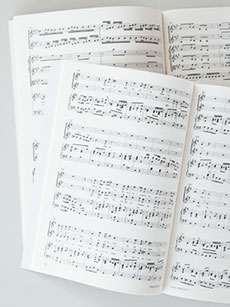
This edition contains both the orchestral version as well as a reduced (non-origina)l version with organ instead of wind instruments. The version for smaller forces made by Franck, with harp, cello, double bass, and organ instead of orchestra (organ version), is also available. All versions can be performed with the original three-part choral scoring (soprano, tenor, bass) as well as in a four-part version more suitable for modern use.
This edition contains both the orchestral version as well as a reduced (non-origina)l version with organ instead of wind instruments. The version for smaller forces made by Franck, with harp, cello, double bass, and organ instead of orchestra (organ version), is also available. All versions can be performed with the original three-part choral scoring (soprano, tenor, bass) as well as in a four-part version more suitable for modern use.
Explore
 View
View

Purchase
Additional product information
-
Composer
César Franck
| 1822-1890César Franck (1822–1890), a native of Liège, Belgium, studied in Paris and was active there at the Cavaillé-Coll organ of the Church of Sainte-Clotilde from 1859 until his death. In 1871 he was a co-founder of the “Société nationale de Musique”, later becoming its president. In 1872 he was appointed professor of organ at the Paris Conservatoire. His students included well-known personalities from French music history such as Ernest Chausson, Vincent d’Indy, Gabriel Pierné, Charles Tournemire, Louis Vierne and also, for a short while, Claude Debussy. In early July 1890 Franck had an accident with a horse-drawn omnibus, from the consequences of which he never recovered. He died on 8 November. Franck’s successors at Sainte-Clotilde were G. Pierné and (from 1898) Ch. Tournemire, one of Olivier Messiaen’s teachers. Personal details
Reviews on our website can only be submitted by customers with a registered user account. A check whether the rated products were actually purchased does not take place.
No feedback available for this product.
Frequent questions about this work
 There are no questions and answers available so far or you were unable to find an answer to your specific question about this work? Then click here and send your specific questions to our Customer Services!