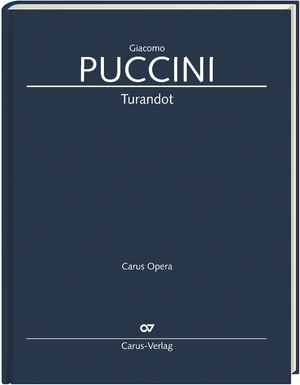
Turandot
Dramma lirico in tre atti e cinque quadri. Finali: Franco Alfano (II), Deborah Burton SC 91, 1923/24, Finale 2022
With his unfinished fairy-tale opera Turandot Giacomo Puccini has left a couple of riddles to posterity. First of all the work, which had its premiere after Puccini’s death, lacks a complete ending. Furthermore, practical adjustments and corrections usually added by the composer in the course of a scenic production or after the work’s premiere, are missing, too.
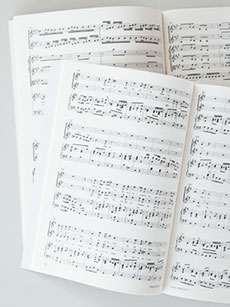
Thus Turandot has become a work, to which, in the course of time, many errors and inconsistencies have been added. Carus now offers a modern edition of Turandot with a focus on aspects of practical performance: clearly organized performance material with a musical text free from traditional errors and inconsistencies, with added performance instructions (where necessary), and with consistent articulation and dynamics. This new edition has been created by the Italian conductor and musicologist Andreas Gies.
With regard to the opera’s finale the Carus edition entails two alternative endings: firstly, the traditional second version of Franco Alfano’s completion (after Puccini’s death) from 1924. Secondly, a reconstructed finale by the American musicologist and Puccini scholar Deborah Burton from 2022. For this she has been able to draw on a significantly larger amount of musical material by Puccini than Alfano including some only recently discovered, hitherto unknown sketches. Therefore, her reconstruction comes much closer to Giacomo Puccini’s original dramaturgical intentions.
The Carus performance material is available with either the Alfano or the Burton finale.

-
Composer
Giacomo Puccini
| 1858-1924Giacomo Puccini came from a dynasty of church musicians who worked in the Tuscan city of Lucca. His Messa a 4 con orchestra, premiered there in 1880, seemed to point him toward a career in the same direction, but directly after this, he went to Milan Conservatoire with the aim of becoming an opera composer. His only independent orchestral works were written there as student works – the Preludio sinfonico (1882) and Capriccio sinfonico (1883), as well as some of his 16 complete surviving songs for voice and piano (Canti), which he composed, with frequent references to his operas, almost throughout his career. He achieved a breakthrough as an opera composer with Manon Lescaut (1893); between 1893 and 1904 he composed La Bohème, Tosca and Madama Butterfly, which remain his most frequently-performed works today. In recent years there has been a growing realisation that Puccini's entire output requires reappraisal. And so, he has increasingly come to be understood as a musician searching for a way forward into the modern age. Personal details
-
Songwriter / Librettist
Renato Simoni
-
Songwriter / Librettist
Giuseppe Adami
| 1878-1946
-
Arranger
Deborah Burton
| 1954
-
Arranger
Franco Alfano
| 1875-1954Franco Alfano (1875–1954) was an Italian composer of the late Romantic period, whose work stylistically bridges the tradition of Verismo with influences from French Impressionism and German late Romanticism. Although he is best known for completing Giacomo Puccini’s opera Turandot, his own body of work comprises numerous operas, orchestral works, art songs and chamber music.
Alfano’s compositional style is characterised by sophisticated harmony, richly coloured orchestration and a distinctive melodic approach, which is often linked to psychologically nuanced characterisation. In musicological research, his work is increasingly recognised as an independent contribution to early 20th-century Italian music, as it documents the development of opera beyond the conventions of verismo towards an expanded musical language.
Personal details
Reviews on our website can only be submitted by customers with a registered user account. A check whether the rated products were actually purchased does not take place.
Frequent questions about this work
 There are no questions and answers available so far or you were unable to find an answer to your specific question about this work? Then click here and send your specific questions to our Customer Services!