

Explore


Purchase
Additional product information
-
Composer
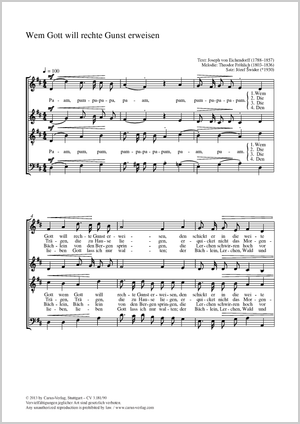
Józef Swider
| 1930-2014Józef Swider was born in Czechowice (Upper Silesia, Poland) in 1930. He studied piano, music theory and composition at the Conservatory of Music in Katowice and with Goffredo Petrassi in Rome as a stipendiary at the Accademia Santa Cecilia. Swider maintained his ties with the Katowice High School (later Music Academy) for over 40 years as a professor of composition, counterpoint and harmony, as well as Deputy Rector and long-serving Dean of the faculty for composition and music theory. In addition he was a professor on the Cieszyn campus of the Silesian University of Katowice, where he directed the Institute of Music Education for 15 years. Swider is actively involved in the Polish choral association as a composer, adviser and adjudicator at choral competitions. Personal details
-
Melody composed by
Friedrich Theodor Fröhlich
| 1803-1836
-
Songwriter / Librettist
Joseph von Eichendorff
| 1788-1857Joseph von Eichendorff wurde am 10. März 1788 in Lubowitz als Sohn eines katholischen Landadligen geboren. Bereits früh begannen seine ersten literarischen Versuche. Von 1805–1812 studierte Eichendorff Jura in Halle, Heidelberg und Wien. Dazwischen hörte er in Berlin Fichte und machte die Bekanntschaft mit wichtigen Persönlichkeiten der Romantik, wie z. B. Brentano, von Arnim und Kleist. Nach der Teilnahme als Lützowscher Jäger an den Befreiungskriegen ging Eichendorff in den preußischen Staatsdienst, in dem er bis zum Geheimen Regierungsrat aufstieg. Während seiner Zeit als preußischer Beamter entstanden auch die meisten seiner Werke. Nach seiner Pensionierung 1844 lebte Eichendorff weitgehend zurückgezogen bis zu seinem Tod am 26. November 1857. Prägend für Eichendorffs Werk waren die katholische Herkunft, die Teilnahme an den Befreiungskriegen und seine Bekanntschaft mit wichtigen romantischen Dichtern und Philosophen. Seine Lyrik betont in vielfältiger Weise die enge Verbindung von Poesie und Musik, viele seiner Gedichte sind mit musikalischen Symbolen und Konnotationen durchsetzt. So verwundert es nicht, dass Eichendorff zu den meist vertonten Dichtern des 19. Jahrhunderts gehört. Über 40 Werke mit Texten von Joseph von Eichendorff – darunter Kompositionen für unterschiedliche Besetzungen von Mendelssohn, Reger, Rheinberger, Schumann und Wolf – finden Sie im Internet unter Personal details
Reviews on our website can only be submitted by customers with a registered user account. A check whether the rated products were actually purchased does not take place.
No feedback available for this product.
Frequent questions about this work
 There are no questions and answers available so far or you were unable to find an answer to your specific question about this work? Then click here and send your specific questions to our Customer Services!