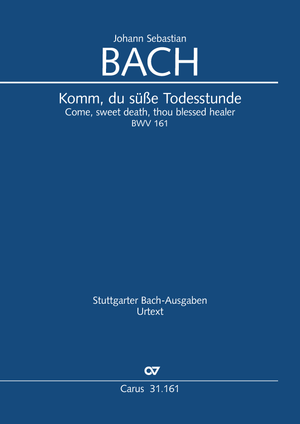
Come, sweet death, thou blessed healer
Cantata for the 16th Sunday after Trinity BWV 161, 1716
The cantate was most likely performed for the first time on 27 September, the 16th Sunday after Trinity, 1716 at the Schlosskirche in Weimar. The text originated from the Kantatenjahrgang (yearly cantata cycle), "Evangelisches Andachts-Opffer" (Evangelical Devotional Offering) by the secretary of the Weimar high conistory, Salomon Franck. The sermon text for the 16th Sunday after Trinity, the raising of the boy from the dead at Nain (Luke 7: 11-14), is only indirectly reflected in Franck's cantata text. In a prevalent interpretation from that period of this biblical text, the raising of the dead is seen as an allegory for the resurrection of the faithful.
Explore


 Additional material
- Purchase additional material as a download product.
-
 Digital text (without sheet music) incl. printing licence, html file, singing text, english translationhtml file, singing text, english translation (Sample)1 Aria (Alto)
Come, sweet death, thou blessed healer,
2 Recitativo (Tenore)
welcome rest,
perfect peace,
quiet everlasting.
Make my passing swift and easy,
tarry not,
come, O come!
Take me to my final haven.World, all your joys are brief,
a sugared poison bringing naught but grief,
a flashing star,
that burns to cinder,
thy roses filled with hidden thorns,
unnumbered, which will prick
my soul to touch the quick.
To me pale death is like a rosy morning,
when over gloomy night victorious,
the sun arises bright and glorious....
-
Digital text (without sheet music) incl. printing licence, html file, singing text, originalhtml file, singing text, original (Sample)1 Aria (Alto)
Komm, du süße Todesstunde,
2 Recitativo (Tenore)
da mein Geist
Honig speist
aus des Löwen Munde.
Mache meinen Abschied süße,
säume nicht,
letztes Licht,
dass ich meinen Heiland küsse.Welt! deine Lust ist Last!
Dein Zucken ist mir als ein Gift verhasst!
Dein Freudenlicht
ist mein Komete,
und wo man deine Rosen bricht,
sind Dornen ohne Zahl
zu meiner Seelen Qual!
Der blasse Tod
ist meine Morgenröte,
mit solcher geht mir auf die Sonne,...
Purchase
Additional product information
-
Composer
Johann Sebastian Bach
| 1685-1750Johann Sebastian Bach is one of the most important composers of Western music history. He came from a widely ramified musical dynasty, which produced numerous musicians and organists in the Thuringian-Saxon area.
Bach vocal
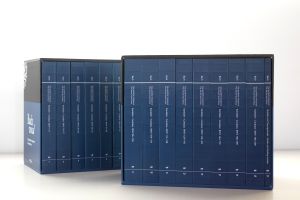
Ever since Carus-Verlag was founded in 1972, publishing the music of Johann Sebastian Bach has been a special focus for us. In the 2017 Reformation anniversary year we completed the Bach vocal project. Bach’s complete sacred vocal works are now available in modern “Urtext” editions, together with performance material. A complete edition of all the full scores is also available in a high quality box set.
Personal details
-
Editor
Uwe Wolf
| 1961As a musicologist, Dr. Uwe Wolf is particularly at home in the 17th and 18th centuries. The focus of his work ranges from the time of Monteverdi and Schütz to Bach and the generation of Bach's sons and pupils through to Viennese Classicism. He has been head of the editorial department at Carus-Verlag since October 2011. Prior to this, he worked in Bach research for over 20 years. Personal details
-
Songwriter / Librettist
Salomon Franck
| 1659-1725
-
Translator
Henry Drinker
Reviews on our website can only be submitted by customers with a registered user account. A check whether the rated products were actually purchased does not take place.
No feedback available for this product.
Frequent questions about this work
 There are no questions and answers available so far or you were unable to find an answer to your specific question about this work? Then click here and send your specific questions to our Customer Services!