

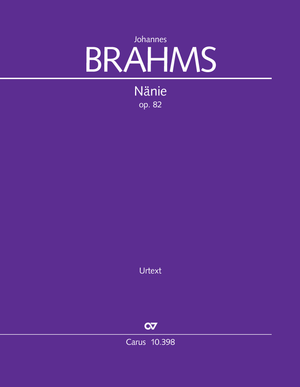
Brahms’ elegy Nänie op. 82, based on the poem by Friedrich von Schiller, was composed in 1880/81 following the death of the painter Anselm Feuerbach, whom Brahms greatly admired. In contrast with the poem, Brahms’ Nänie ends full of hope: after earthly decline, beauty can live on in art. As in his Deutsches Requiem op. 45, in Nänie Brahms creates a musical connection between mourning and consolation in an incomparable way. Inspired by the model of classical Roman-Greek laments, the work adopts the classical verse form chosen by Schiller – surely alluding to Feuerbach’s classically-inspired art.
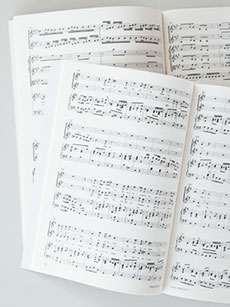
Scored for mixed chorus and orchestra, we are publishing the work in a modern Urtext edition. One or more harps can be used ad libitum. The primary source is the first printed edition of 1881. The latest scholarly discoveries as well as practical requirements have been taken into consideration. Performance material is available on sale as well as a vocal score, based on Brahms’s original vocal score, but in a revised performing version.
Explore
 Additional material
- Purchase additional material as a download product.
-
 Digital text (without sheet music) incl. printing licence, html file, singing text, originalhtml file, singing text, original (Sample)
Auch das Schöne muss sterben! Das Menschen und Götter bezwinget,
nicht die eherne Brust rührt es des stygischen Zeus.
Einmal nur erweichte die Liebe den Schattenbeherrscher,
und an der Schwelle noch, streng, rief er zurück sein Geschenk.
Nicht stillt Aphrodite dem schönen Knaben die Wunde,
die in den zierlichen Leib grausam der Eber geritzt.
Nicht errettet den göttlichen Held die unsterbliche Mutter,
wenn er, am skäischen Tor fallend, sein Schicksal erfüllt.
Aber sie steigt aus dem Meer mit allen Töchtern des Nereus,
und die Klage hebt an um den verherrlichten Sohn.
Siehe! Da weinen die Götter, es weinen die Göttinnen alle,
dass das Schöne vergeht, dass das Vollkommene stirbt.
Auch ein Klaglied zu sein im Mund der Geliebten, ist herrlich;
denn das Gemeine geht klanglos zum Orkus hinab.Friedrich von Schiller (1759–1805)
...
-
Digital text (without sheet music) incl. printing licence, html file, singing text, english translationhtml file, singing text, english translation (Sample)
And the beautiful too must die, even the beautiful die!
What men and gods has conquered not the iron heart, melts not the Stygian Jove.
Only once, for love, the Monarch of Shadows relented.
But at the threshold he called (he) back his gift.
Aphrodite stanches not the cruel wound,
which in the lovely body the cruel boar has torn.
Nor could mother immortal save the godly hero
falling at the gate of Troy, falling his fate fulfilled.
But from the sea she arises with the daughters of Nereus,
and she mourns loud lamenting for the son now glorified.
See, how mourn the gods, see, how mourn the goddesses all,
that the beautiful fades, mourn that the highest dies.
And a song of lament from heart of the loved is glorious,
ah, to go songless and silent to Orcus’ dark reign.Mrs. J. P. Morgan (1845–1920?)
...
Purchase
Additional product information
-
Composer
Johannes Brahms
| 1833-1897Johannes Brahms' study of musical tradition was of crucial importance to his output: he combined church modes, canonic technique, Baroque style and diction, Bach's counterpoint and Beethoven's thematic-motivic work with the harmonic and expressive achievements of Romanticism to form his own distinctive style. In this respect his choral songs and vocal quartets (e.g. the “Liebeslieder Waltzes” and “New Liebeslieder Waltzes”), often to folk song texts, in which a musical microcosm unfolds, are examplary. His “Deutsches Requiem”, available from Carus in several different versions, constitutes one of the most fascinating confessions of faith in the history of music. Personal details
-
Songwriter / Librettist
J. P. Morgan
-
Songwriter / Librettist
Friedrich Schiller
| 1759-1805
Reviews on our website can only be submitted by customers with a registered user account. A check whether the rated products were actually purchased does not take place.
No feedback available for this product.
Frequent questions about this work
 There are no questions and answers available so far or you were unable to find an answer to your specific question about this work? Then click here and send your specific questions to our Customer Services!