

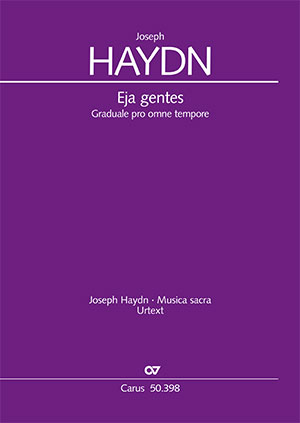
The Graduale pro omne tempore Eja gentes was discovered in a contemporary manuscript copy at the Lower Austrian pilgrimage basilica Sonntagberg. Joseph Haydn is named as the composer of this festive motet, very suitable for combination with classical Mass settings at services and concerts. The use of the organ as a solo instrument gives the work a particularly attractive character.
Explore


Purchase
Additional product information
-
Composer
Joseph Haydn
| 1732-1809As Kapellmeister to Prince Esterházy, Haydn composed numerous instrumental works and various operas, as well as making important contributions to the genre of church music, including fourteen Latin masses, of which only twelve are authentic or complete; these are complemented by motets and offertories, two important Te Deum settings, two Salve Reginas, a Stabat Mater, and the different versions of the Sieben Worte des Erlösers am Kreuze. The masses were composed continually between 1749 and 1802, except for the years 1783–1795, and therefore constitute the genre with which Haydn was occupied over the longest period of time. The six (authentic or complete) masses composed before 1782 are stylistically very different, and as well as short Missae breves there are more extended masses with rich orchestral scoring; by contrast the six so-called late masses, written from 1796 onwards, form a comparatively homogeneous group of more extensive works scored for large forces. With his two great oratorios Die Schöpfung (The Creation) (1798) and Die Jahreszeiten (The Seasons) (1801) Haydn established the tradition of the German oratorio for middle-class music making. Personal details
-
Editor
Armin Kircher
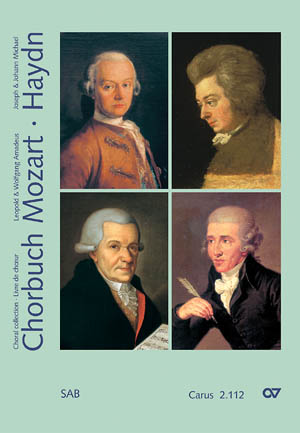
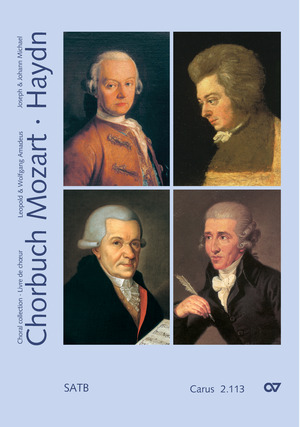
| 1966-2015Armin Kircher studied church music at the Mozarteum in Salzburg. Until his death he was Director of the Church Music Department of the Archdiocese of Salzburg, and since 1992 he had been administrative director of the Österreichische Werkwoche für Kirchenmusik (Austrian Week for Church Music). He was also Director of Music at St Peter's Abbey, Salzburg and organist at the Cajetan Church in Salzburg. The collections he edited for the Catholic liturgy have become established standard works, in particular the choral collections Chorbuch Mozart • Haydn, the Chorbuch Kirchenjahr (Choirbook for the Church Year) and publications for organ and choir for the new Catholic hymnbook Gotteslob. Armin Kircher also made a name as an arranger of beautiful settings for choir and organ. Personal details
Reviews
Wer Haydn mag, der wird auch dieses Stück mögen. [...] Es ist ein kleines, etwa drei Minuten langes, festliches Stück fröhlichen C-Dur-Charakters, das weder den Chor in seiner rein homophonen Struktur noch das Orchester noch den Organisten vor größere technische Schwierigkeiten stellt. Der Orgelpart ist auf jeden Fall leichter zu spielen als z. B. Mozarts Kirchensona- ten. Wegen des sehr allgemeinen Tex-tes [...] ist das Stück in jedem festlichen Gottesdienst einzusetzen, vielleicht als Ergänzung bei der Aufführung einer Haydn-Messe, unter denen es wohl der Mariazeller Messe in seiner Heiterkeit am nächsten steht. Dass Haydns Autorenschaft wegen des fehlenden Autographs nicht absolut gesichert ist, tut der Wirkung des Werks keinen Abbruch. Die Edition ist vorbildlich in der Klarheit des Notensatzes, mit Vorwort und kritischem Bericht
StR
Quelle: Musica Sacra, Heft 2 / 2008
(ci) [...] Das Stück ist gut zur Gabenbereitung einsetzbar. Aber auch als Schlussmotette setzt es einen feierlichen Akzent.
Kirchenmusik im Bistum Limburg 1/2009
Reviews on our website can only be submitted by customers with a registered user account. A check whether the rated products were actually purchased does not take place.
No feedback available for this product.
Frequent questions about this work
 There are no questions and answers available so far or you were unable to find an answer to your specific question about this work? Then click here and send your specific questions to our Customer Services!