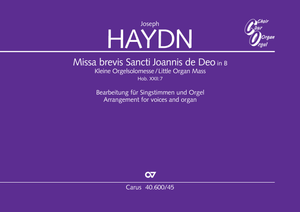
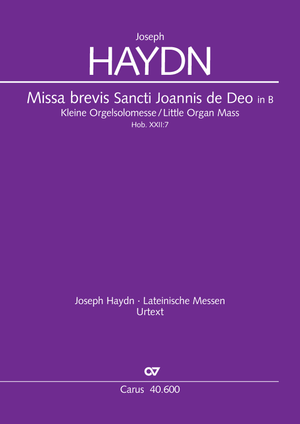
Missa brevis Sancti Joannis de Deo
Little Organ Mass Hob. XXII:7, 1778 (?) (terminus ante quem)
In the Gloria and Credo of his “Little Organ Mass”, Haydn takes the principle of the Missa brevis to the extreme: the entire text is distributed simultaneously among the four voices so that the long text in the Gloria is treated in 19 measures. Accordingly, one has to be rhythmically autonomous as a chorister. Rhythmic certainty on the part of each individual is also necessary for the fugal treatment of the voices in the Sanctus, with its unusual 6/8 meter. It is good that one can practice these movements slowly, using the app.
Simply practice. Anytime. Everywhere.
Whether at home on your tablet or PC or on the road on your smartphone: with carus music, the Choir Coach, you always have your choral works with you to practice! With the carus music choir app, you can listen to your score together with a first-class recording on any device and easily practice your own choir part with a coach. With carus music, your concert preparation is easy, efficient and fun to master!
Performers: Barbara Hendricks (soprano) – Rundfunkchor Leipzig, Staatskapelle Dresden – Sir Neville Marriner
Explore
 Additional material
- Purchase additional material as a download product.
-
 Digital text (without sheet music) incl. printing licence, html file, singing text, originalhtml file, singing text, original (Sample)Kyrie (Coro)
Kyrie eleison.
Gloria (Coro)
Christe eleison.
Kyrie eleison.B: Et in terra pax hominibus bonae voluntatis.
Laudamus te, benedicimus te, adoramus te, glorificamus te.
Quoniam tu solus Sanctus,
tu solus Dominus, tu solus Altissimus, Jesu Christe.
S: Gratias agimus tibi propter magnam gloriam tuam.
Domine Deus, Rex coelestis, Deus Pater omnipotens.
A: Domine Fili unigenite, Jesu Christe.
Qui tollis peccata mundi.
Suscipe deprecationem nostram,
qui sedes ad dexteram Patris, miserere nobis. T: Domine Deus, Agnus Dei, Filius Patris. Qui tollis peccata mundi, miserere nobis.SATB: Cum Sancto Spiritu, in gloria Dei Patris. Amen.
Credo (Coro)...
-
Digital text (without sheet music) incl. printing licence, html file, Introductory text, englishhtml file, Introductory text, english (Sample)Abridged Foreword of Edition Carus 40.600
Willi Schulze
Translation: E. D. EcholsWhereas the last six high masses are considered the crowning works of all his church compositions, Haydn’s early masses have met with widely differing appraisals, some complaining of imbalances in the voice leading while others claimed that there are weaknesses in the musical settings of the texts3. Five of the eight masses composed between 1750 and 1782 fall into the category of the missa brevis. They are extremely short and force even the extensive texts of the Gloria and Credo into a compact mold through the simultaneous declamation of certain text passages. The missae solemnes (the Great Organ Solo Mass, the Missa St. Caecilia and the Missa Cellensis or Mariazeller Messe), on the other hand, are broader in form and richer in the use of voices and instruments. In these works Haydn followed the traditional pattern for large-scale masses: formally with clear sectional divisions within the individual numbers; stylistically in the use of richly ornamented solo passages in connection with extended contrapuntal sections which in the respective concluding fugues of the Gloria and Credo reach their climax.
With the Missa Sancti
...
-
Digital text (without sheet music) incl. printing licence, html file, Introductory text, germanhtml file, Introductory text, german (Sample)Gekürztes Vorwort der Ausgabe Carus 40.600
Willi Schulze
Gegenüber Haydns Instrumentalschaffen wurde seine Kirchenmusik lange Zeit als weniger bedeutend angesehen. Selbst die späten Messen, die einzigen, die zu Haydns Lebzeiten gedruckt wurden, fanden, vielfach aus liturgischen Bedenken, nur langsam den Weg in die musikalische Praxis. Die frühen Messen, bis ins 19. Jahrhundert in zahlreichen Abschriften verbreitet, erfuhren erst in den vergangenen Jahrzehnten, vor allem durch die seit 1950 erscheinende Gesamtausgabe, allgemeine Beachtung.
Mit den beiden letzten Missae breves, der Missa Sancti Nicolai und der Missa Sancti Joannis de Deo, hat Haydn auch in dieser Gattung Meisterwerke geschaffen, die bereits zu seinen Lebzeiten zu den beliebtesten zählten – das zeigen ihre zahlreichen Abschriften. Besonders die Missa Sancti Joannis de Deo erlangte als sogenannte „Kleine Orgelsolomesse“ unter Haydns frühen Messen die weiteste Verbreitung. Als einzige unter den Missae breves ist sie vollständig in Haydns Eigenschrift erhalten. Der Name verweist auf den portugiesischen Mönch Johannes Ciudad (1495–1550) – Johannes von Gott nannte ihn der Bischof von Tuy – aus dessen Krankenfürsorge die
...
Purchase
Additional product information
-
Composer
Joseph Haydn
| 1732-1809As Kapellmeister to Prince Esterházy, Haydn composed numerous instrumental works and various operas, as well as making important contributions to the genre of church music, including fourteen Latin masses, of which only twelve are authentic or complete; these are complemented by motets and offertories, two important Te Deum settings, two Salve Reginas, a Stabat Mater, and the different versions of the Sieben Worte des Erlösers am Kreuze. The masses were composed continually between 1749 and 1802, except for the years 1783–1795, and therefore constitute the genre with which Haydn was occupied over the longest period of time. The six (authentic or complete) masses composed before 1782 are stylistically very different, and as well as short Missae breves there are more extended masses with rich orchestral scoring; by contrast the six so-called late masses, written from 1796 onwards, form a comparatively homogeneous group of more extensive works scored for large forces. With his two great oratorios Die Schöpfung (The Creation) (1798) and Die Jahreszeiten (The Seasons) (1801) Haydn established the tradition of the German oratorio for middle-class music making. Personal details
Reviews on our website can only be submitted by customers with a registered user account. A check whether the rated products were actually purchased does not take place.
No feedback available for this product.
Frequent questions about this work
 There are no questions and answers available so far or you were unable to find an answer to your specific question about this work? Then click here and send your specific questions to our Customer Services!