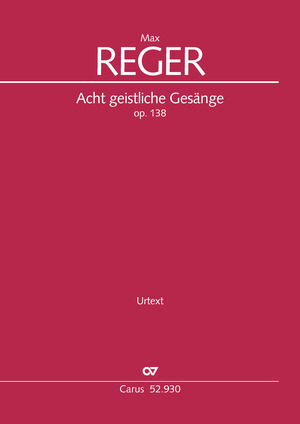
Acht geistliche Gesänge
op. 138
Separate edition from Volume 9, "Lieder und Chorwerke" of the Max Reger Hybrid Edition of Works.
 Listen
(8)
Listen
(8)
- A man can live and flourish
- Thou highest light, day without end
- The night advances
- And to our blessed lady
- In God's great name we go our way
- Lamb of God
- With God's own help, we go to war
- Our faith is in one true God
 Additional material
- Purchase additional material as a download product.
-
 Digital text (without sheet music) incl. printing licence, html file, singing text, english translationhtml file, singing text, english translation (Sample)
1. Der Mensch lebt und bestehet nur eine kleine Zeit A man can live and flourish for but a little time,
and all the world must perish with all its pomp and fame.
One only is eternal and beyond all motion,
and we are his possession.
Matthias Claudius
Translation: Jean Lunn2. Morgengesang Thou highest light, day without end,
thou God and my most faithful Lord,
from thee the light of grace goes forth
and brightly shines for all the earth.
This is our Saviour Jesus Christ,
for he is God’s own truth most blest,
and his gospel’s light glows sublime
until he draws all hearts to him.
He is the light of all the world,
in whom men clearly may behold
the bright and beauteous light of day
that brings them blessing and all joy.
Johannes Zwick
Translation: Jean Lunn3. Nachtlied
...
-
Digital text (without sheet music) incl. printing licence, html file, singing text, originalhtml file, singing text, original (Sample)
1. Der Mensch lebt und bestehet nur eine kleine Zeit Der Mensch lebt und bestehet nur eine kleine Zeit,
und alle Welt vergehet mit ihrer Herrlichkeit.
Es ist nur Einer ewig und an allen Enden
und wir in seinen Händen.
Matthias Claudius2. Morgengesang Du höchstes Licht, ewiger Schein,
du Gott und treuer Herre mein,
von dir der Gnaden Glanz ausgaht
und leuchtet schön gleich früh und spat.
Das ist der Herre Jesus Christ,
der ja die göttlich Wahrheit ist,
der mit sein’r Lehr hell scheint und leucht’,
bis er die Herzen zu sich zeucht.
Er ist der ganzen Welte Licht,
stellt jedem vor sein Angesicht
den hellen, schönen, lichten Tag,
an dem er selig werden mag.
Johannes Zwick3. Nachtlied
...
-
Digital text (without sheet music) incl. printing licence, html file, Introductory text, englishhtml file, Introductory text, english (Sample)Text from the CD Carus 83.326
Jürgen Schaarwächter
Translation (abridged): Elizabeth RobinsonMax Reger grew up as a Catholic in the Upper Palatinate and described himself as “Catholic to his fingertips.” By 1907, when he was appointed composition professor at the Leipzig Conservatory, he had become aware of the quality of the corpus of Protestant chorales. Adalbert Lindner reported Reger’s remark of 1898; “the Protestants don’t know what they have, with their chorales!” Reger had already come into close contact with the chorale at an early age. His friendship with the Protestant organist Karl Straube was exceptionally important in the following period, and when Reger married the divorced Protestant Elsa von Bercken in 1902, his break with the Catholic church was complete. Through Straube’s influence, Reger composed many works for use in the Protestant church, particularly in his time in Weiden
...
-
Digital text (without sheet music) incl. printing licence, html file, Introductory text, germanhtml file, Introductory text, german (Sample)Booklet-Text der CD Carus 83.326
Jürgen Schaarwächter
Als Max Reger 1907 seine Kompositionsprofessur am Leipziger Konservatorium antrat, war aus dem in der Oberpfalz aufgewachsenen Katholiken, der sich selbst als „katholisch bis in die Fingerspitzen“ bezeichnete, ein um die Qualität der protestantischen Choräle Bewusster geworden: Adalbert Lindner berichtet von Regers Ausspruch aus dem Jahr 1898 „Die Protestanten wissen nicht, was sie an ihrem Chorale haben!“ Schon in jungen Jahren war Reger mit dem Choral in engen Kontakt gekommen – als Suborganist der Weidener Pfarrkirche St. Michael, die von beiden Konfessionen genutzt wurde. Die Freundschaft zu dem – protestantischen – Organisten Karl Straube muss in der Folgezeit als von herausragender Bedeutung bezeichnet werden, und als Reger 1902 die geschiedene Protestantin
...
-
Digital text (without sheet music) incl. printing licence, html file, singing text, english translationhtml file, singing text, english translation (Sample)
Der Mensch lebt und bestehet nur eine kleine Zeit A man can live and flourish for but a little time,
and all the world must perish with all its pomp and fame.
One only is eternal and beyond all motion, and we are his possession.Matthias Claudius
Translation: Jean Lunn...
-
Digital text (without sheet music) incl. printing licence, html file, singing text, originalhtml file, singing text, original (Sample)
Der Mensch lebt und bestehet nur eine kleine Zeit Der Mensch lebt und bestehet nur eine kleine Zeit,
und alle Welt vergehet mit ihrer Herrlichkeit.
Es ist nur Einer ewig und an allen Enden
und wir in seinen Händen.Matthias Claudius
...
-
Digital text (without sheet music) incl. printing licence, html file, Introductory text, englishhtml file, Introductory text, english (Sample)Text from the CD Carus 83.326
Jürgen Schaarwächter
Translation (abridged): Elizabeth RobinsonMax Reger grew up as a Catholic in the Upper Palatinate and described himself as “Catholic to his fingertips.” By 1907, when he was appointed composition professor at the Leipzig Conservatory, he had become aware of the quality of the corpus of Protestant chorales. Adalbert Lindner reported Reger’s remark of 1898; “the Protestants don’t know what they have, with their chorales!” Reger had already come into close contact with the chorale at an early age. His friendship with the Protestant organist Karl Straube was exceptionally important in the following period, and when Reger married the divorced Protestant Elsa von Bercken in 1902, his break with the Catholic church was complete. Through Straube’s influence, Reger composed many works for use in the Protestant church, particularly in his time in Weiden
...
-
Digital text (without sheet music) incl. printing licence, html file, Introductory text, germanhtml file, Introductory text, german (Sample)Booklet-Text der CD Carus 83.326
Jürgen Schaarwächter
Als Max Reger 1907 seine Kompositionsprofessur am Leipziger Konservatorium antrat, war aus dem in der Oberpfalz aufgewachsenen Katholiken, der sich selbst als „katholisch bis in die Fingerspitzen“ bezeichnete, ein um die Qualität der protestantischen Choräle Bewusster geworden: Adalbert Lindner berichtet von Regers Ausspruch aus dem Jahr 1898 „Die Protestanten wissen nicht, was sie an ihrem Chorale haben!“ Schon in jungen Jahren war Reger mit dem Choral in engen Kontakt gekommen – als Suborganist der Weidener Pfarrkirche St. Michael, die von beiden Konfessionen genutzt wurde. Die Freundschaft zu dem – protestantischen – Organisten Karl Straube muss in der Folgezeit als von herausragender Bedeutung bezeichnet werden, und als Reger 1902 die geschiedene Protestantin
...
-
Digital text (without sheet music) incl. printing licence, html file, singing text, english translationhtml file, singing text, english translation (Sample)
Morgengesang Thou highest light, day without end,
thou God and my most faithful Lord,
from thee the light of grace goes forth
and brightly shines for all the earth.
This is our Saviour Jesus Christ,
for he is God’s own truth most blest,
and his gospel’s light glows sublime
until he draws all hearts to him.
He is the light of all the world,
in whom men clearly may behold
the bright and beauteous light of day
that brings them blessing and all joy.Johannes Zwick
Translation: Jean Lunn...
-
Digital text (without sheet music) incl. printing licence, html file, singing text, originalhtml file, singing text, original (Sample)
Morgengesang Du höchstes Licht, ewiger Schein,
du Gott und treuer Herre mein,
von dir der Gnaden Glanz ausgaht
und leuchtet schön gleich früh und spat.
Das ist der Herre Jesus Christ,
der ja die göttlich Wahrheit ist,
der mit sein’r Lehr hell scheint und leucht’,
bis er die Herzen zu sich zeucht.
Er ist der ganzen Welte Licht,
stellt jedem vor sein Angesicht
den hellen, schönen, lichten Tag,
an dem er selig werden mag.Johannes Zwick
...
-
Digital text (without sheet music) incl. printing licence, html file, Introductory text, englishhtml file, Introductory text, english (Sample)Text from the CD Carus 83.326
Jürgen Schaarwächter
Translation (abridged): Elizabeth RobinsonMax Reger grew up as a Catholic in the Upper Palatinate and described himself as “Catholic to his fingertips.” By 1907, when he was appointed composition professor at the Leipzig Conservatory, he had become aware of the quality of the corpus of Protestant chorales. Adalbert Lindner reported Reger’s remark of 1898; “the Protestants don’t know what they have, with their chorales!” Reger had already come into close contact with the chorale at an early age. His friendship with the Protestant organist Karl Straube was exceptionally important in the following period, and when Reger married the divorced Protestant Elsa von Bercken in 1902, his break with the Catholic church was complete. Through Straube’s influence, Reger composed many works for use in the Protestant church, particularly in his time in Weiden
...
-
Digital text (without sheet music) incl. printing licence, html file, Introductory text, germanhtml file, Introductory text, german (Sample)Booklet-Text der CD Carus 83.326
Jürgen Schaarwächter
Als Max Reger 1907 seine Kompositionsprofessur am Leipziger Konservatorium antrat, war aus dem in der Oberpfalz aufgewachsenen Katholiken, der sich selbst als „katholisch bis in die Fingerspitzen“ bezeichnete, ein um die Qualität der protestantischen Choräle Bewusster geworden: Adalbert Lindner berichtet von Regers Ausspruch aus dem Jahr 1898 „Die Protestanten wissen nicht, was sie an ihrem Chorale haben!“ Schon in jungen Jahren war Reger mit dem Choral in engen Kontakt gekommen – als Suborganist der Weidener Pfarrkirche St. Michael, die von beiden Konfessionen genutzt wurde. Die Freundschaft zu dem – protestantischen – Organisten Karl Straube muss in der Folgezeit als von herausragender Bedeutung bezeichnet werden, und als Reger 1902 die geschiedene Protestantin
...
-
Digital text (without sheet music) incl. printing licence, html file, singing text, english translationhtml file, singing text, english translation (Sample)
Unser lieben Frauen Traum And to our blessed lady
there came a dream one day,
that there beneath her bosom
there lived and grew a great tree.
And as the tree gave shadows,
even over every land,
Lord Jesus Christ, the Saviour,
just so has he been named.
Lord Jesus Christ, the Saviour,
he is our help indeed,
and by his bitter passion
he has redeemed the world.Anonymus
Translation: Jean Lunn...
-
Digital text (without sheet music) incl. printing licence, html file, singing text, originalhtml file, singing text, original (Sample)
Unser lieben Frauen Traum Und unser lieben Frauen,
der traumet ihr ein Traum:
wie unter ihrem Herzen
gewachsen wär ein Baum.
Und wie der Baum ein Schatten gäb
wohl über alle Land:
Herr Jesus Christ, der Heiland,
also ist er genannt.
Herr Jesus Christ, der Heiland
ist unser Heil und Trost,
mit seiner bittern Marter
hat er uns all erlöst.Anonymus
...
-
Digital text (without sheet music) incl. printing licence, html file, Introductory text, englishhtml file, Introductory text, english (Sample)Text from the CD Carus 83.326
Jürgen Schaarwächter
Translation (abridged): Elizabeth RobinsonMax Reger grew up as a Catholic in the Upper Palatinate and described himself as “Catholic to his fingertips.” By 1907, when he was appointed composition professor at the Leipzig Conservatory, he had become aware of the quality of the corpus of Protestant chorales. Adalbert Lindner reported Reger’s remark of 1898; “the Protestants don’t know what they have, with their chorales!” Reger had already come into close contact with the chorale at an early age. His friendship with the Protestant organist Karl Straube was exceptionally important in the following period, and when Reger married the divorced Protestant Elsa von Bercken in 1902, his break with the Catholic church was complete. Through Straube’s influence, Reger composed many works for use in the Protestant church, particularly in his time in Weiden
...
-
Digital text (without sheet music) incl. printing licence, html file, Introductory text, germanhtml file, Introductory text, german (Sample)Booklet-Text der CD Carus 83.326
Jürgen Schaarwächter
Als Max Reger 1907 seine Kompositionsprofessur am Leipziger Konservatorium antrat, war aus dem in der Oberpfalz aufgewachsenen Katholiken, der sich selbst als „katholisch bis in die Fingerspitzen“ bezeichnete, ein um die Qualität der protestantischen Choräle Bewusster geworden: Adalbert Lindner berichtet von Regers Ausspruch aus dem Jahr 1898 „Die Protestanten wissen nicht, was sie an ihrem Chorale haben!“ Schon in jungen Jahren war Reger mit dem Choral in engen Kontakt gekommen – als Suborganist der Weidener Pfarrkirche St. Michael, die von beiden Konfessionen genutzt wurde. Die Freundschaft zu dem – protestantischen – Organisten Karl Straube muss in der Folgezeit als von herausragender Bedeutung bezeichnet werden, und als Reger 1902 die geschiedene Protestantin
...
Contents


-
Composer
Max Reger
| 1873-1916Born in Brand, Bavaria, in 1873, Reger studied music in Munich and Wiesbaden with Hugo Riemann. From 1905 on he worked at the Academy in Munich as a teacher for organ and composition. He moved in 1907 to Leipzig to become the music director of the university until 1908 and professor of composition at the conservatory until his early death in 1916. Personal details
Reviews on our website can only be submitted by customers with a registered user account. A check whether the rated products were actually purchased does not take place.
Frequent questions about this work
 There are no questions and answers available so far or you were unable to find an answer to your specific question about this work? Then click here and send your specific questions to our Customer Services!