

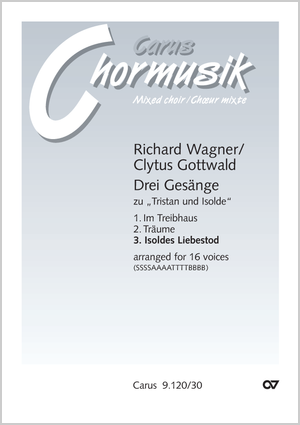
Isoldes Liebestod. Vocal transcription by Clytus Gottwald
Explore
 View
View
 Additional material
- Purchase additional material as a download product.
-
 Digital text (without sheet music) incl. printing licence, html file, singing text, originalhtml file, singing text, original (Sample)Unbenanntes Dokument Isoldes Liebestod
Mild und leise wie er lächelt,
wie das Auge hold er öffnet,
seht ihr’s, Freunde? Seht ihr’s nicht?
Immer lichter wie er leuchtet,
sternumstrahlet hoch sich hebt?
Seht ihr's nicht,
wie das Herz ihm mutig schwillt,
voll und hehr im Busen ihm quillt?
Wie den Lippen, wonnig mild,
süsser Atem sanft entweht:
Freunde! Seht!
Fühlt und seht ihr’s nicht?...
Purchase
Additional product information
-
Composer
Richard Wagner
| 1813-1883Born in 1813 in Leipzig, Richard Wagner grew up in a family very fond of theatre and he himself fell under its spell early. After failure in school and a mainly self-taught musical training (earliest compositions ~ 1830, Symphony in C 1832) 1833 initial employment as choir director in Wurzburg (completion of his first entire opera Die Feen). Start of years as a journeyman: Konigsberg, Riga, Paris, then as a court music director in Dresden, as a fugitive revolutionary in Zurich and finally as a protege of King Ludwig II. in Munich and Bayreuth, death in Venice in 1883. Personal details
-
Songwriter / Librettist
Richard Wagner
| 1813-1883Born in 1813 in Leipzig, Richard Wagner grew up in a family very fond of theatre and he himself fell under its spell early. After failure in school and a mainly self-taught musical training (earliest compositions ~ 1830, Symphony in C 1832) 1833 initial employment as choir director in Wurzburg (completion of his first entire opera Die Feen). Start of years as a journeyman: Konigsberg, Riga, Paris, then as a court music director in Dresden, as a fugitive revolutionary in Zurich and finally as a protege of King Ludwig II. in Munich and Bayreuth, death in Venice in 1883. Personal details
-
Arranger
Clytus Gottwald
| 1925-2023The choral conductor, composer and musicologist Clytus Gottwald (1925 - 2023) made significant contributions to contemporary choral music. As editor for New Music at Südfunk Stuttgart and founder and director of the Schola Cantorum Stuttgart, he was in productive exchange with his contemporaries, Pierre Boulez, Mauricio Kagel, György Ligeti, Luigi Nono, Karlheinz Stockhausen and many others. With his Schola Cantorum, a 16-voice chamber vocal ensemble, Gottwald decisively shaped the a cappella choral culture of the highest technical level that is taken for granted today. Clytus Gottwald's transcriptions of piano songs and instrumental pieces for unaccompanied choir are appreciated by choirs all over the world. Modelled on the style of Ligeti, his works set the highest of musical standards. Clytus Gottwald has received several awards for his services, including the Cultural Prize of Baden-Württemberg in 2009, the European Church Music Prize in 2012, and the Cross of Merit of the Federal Republic of Germany in 2014. His importance for the development of contemporary choral music cannot be overestimated. Personal details
Reviews on our website can only be submitted by customers with a registered user account. A check whether the rated products were actually purchased does not take place.
No feedback available for this product.
Frequent questions about this work
 There are no questions and answers available so far or you were unable to find an answer to your specific question about this work? Then click here and send your specific questions to our Customer Services!