

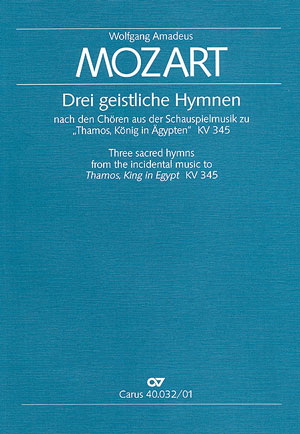
Three sacred hymnes
from the incidental music to “Thamos. King in Egypt“ KV 345



Contents

-
Composer
Wolfgang Amadeus Mozart
| 1756-1791As the son of the deputy Kapellmeister to the Salzburg Prince-Archbishop, Mozart was constantly surrounded by church music in his youth. On his travels Mozart became familiar with Italian church music, and later in Vienna he studied the works of Bach and Handel. After moving to Vienna he was faced with the new challenges of composing opera and piano concertos, and significantly the “C Minor Mass” KV 427, the greatest sacred work of the first Vienna years, remained unfinished. The last period of his life again shows a change of direction to church music: Mozart successfully applied to succeed the terminally ill Leopold Hoffmann as Kapellmeister at St Stephen's Cathedral, but he was unable to take up the position as he died before Hoffmann. A gem such as the “Ave verum” KV 618 and the incomplete Requiem KV 626 give us an idea of what Mozart might have achieved as a composer of sacred music if he had taken up this important position. Personal details
-
Editor
Jochen Reutter
Reviews
Wolfgang Amadeus Mozart: Drei geistliche Hymnen („Splendente te”, „Jesu, Rex tremendae”, „Ne pulvis”) nach den Chören aus der
Schon kurz nach Mozarts Tod wurden drei Chöre aus Mozarts o.g. Schauspiel mit geistlichen Texten versehen (geistliche Kontrafakte), um Mozarts hervorragende Musik in einen anderen Kontext zu retten - denn Johann Freiherr von Geblers Schauspiel „Thamos” erwies sich beim Publikum als glänzender Reinfall... Die klangprächtigen Chöre binden sich in ein groß besetztes Orchester mit diffizilem Anspruch (besonders in den Violinen) ein, übersteigen selbst aber nicht den Schwierigkeitsgrad z.B. der „Krönungsmesse”. Sehr zu empfehlen als Ergänzung zu Orchestermessen ähnlicher Besetzung - soweit zum liturgischen Kontext passend. Die Ausgabe entspricht dem gewohnt hohen Carus-Niveau.
Musik im Bistum Essen, Sonderausgabe II/1997
Reviews on our website can only be submitted by customers with a registered user account. A check whether the rated products were actually purchased does not take place.
Frequent questions about this work
 There are no questions and answers available so far or you were unable to find an answer to your specific question about this work? Then click here and send your specific questions to our Customer Services!