

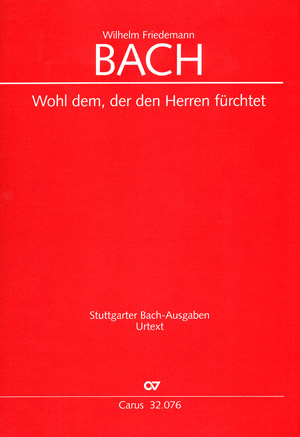
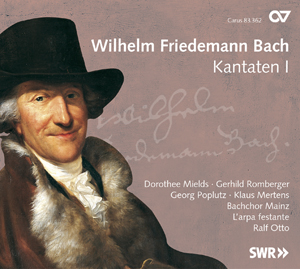
The cantata is one of the few surviving vocal works which Wilhelm Friedemann Bach composed during the eighteen years which he spent as organist and director of music at the Marktkirche in Halle (1746–1764). This cantata, published here for the first time in more than 250 years, was written to introduce the autumn sermons in 1752. A musically and technically demanding composition, it consists of two substantial choral movements, partly concertante and partly polyphonic, based on two biblical utterances. They surround a sensitive, while at the same time strictly contrapuntal, duet for soprano and alto with basso continuo in which “God’s sweet teaching for the soul” is described as the true “manna” of the faithful, forming a link with the sermons which are to follow. In the compactness of the musical construction and its intensity of expression W. F. Bach was clearly following in the footsteps of his father in this work.
Explore


 Listen
(3)
Listen
(3)
- Coro: Wohl dem, der den Herren fürchtet
- Duetto (Soprano, Alto): Gottes süße Seelenlehre
- Coro: Selig sind, die Gottes Wort hören
Purchase
Additional product information
Contents
-
Composer
Wilhelm Friedemann Bach
| -1784Wilhelm Friedemann Bach, the oldest son of Johann Sebastian, enjoyed the reputation of an outstanding, but at the same time one of the most independent-minded composers of his age. His work represents the ambitious attempt to absorb the legacy of his father and to develop the taste of his own generation further. Lofty artistic ambitions are to be found in almost all of W. F. Bach's works – from the early piano pieces via the cantatas of his middle period to the late sonatas and fantasias. Wilhelm Friedemann Bach wrote keyboard and chamber music, concertos and sacred cantatas. On a high level of technical ability he created a fascinating synthesis of baroque complexities and the emotionally charged galant style. While his instrumental works were written for the most part in Dresden (1733–1746) and Berlin (1774–1784) and are in the style of splendid courtly music, the vocal works date from his time as organist and director of music at the Marktkirche in Halle (1746–1764); they are distinguished by their expressive boldness and virtuosity. Personal details
-
Editor
Peter Wollny
| 1961
Reviews
(ci) [...] In den drei Sätzen kommt der musikalische Anspruch Bachs, der sich hörbar an dem seines Vaters orientiert, voll zur Geltung. Sowohl Chor als auch Orchester müssen hier technische Hochleistungen vollbringen, [...]
Kirchenmusik im Bistum Limburg 1/2009
Reviews on our website can only be submitted by customers with a registered user account. A check whether the rated products were actually purchased does not take place.
No feedback available for this product.
Frequent questions about this work
 There are no questions and answers available so far or you were unable to find an answer to your specific question about this work? Then click here and send your specific questions to our Customer Services!