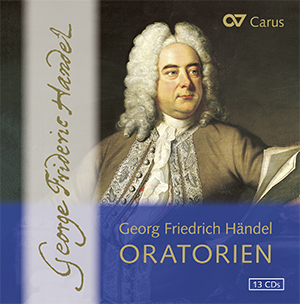
Die großen Händel-Oratorien


 Ecouter
(20)
Ecouter
(20)
- Sinfonia
- Chor: Greift zu, schlagt tot
- Rezit. (Tochter Zion): Verwegner Dorn
- Rezit. (Evang.): Und eine dicke Finsternis
- Recitative (Tenore): The praise of Bacchus
- Arioso (Soprano): Softly sweet, in Lydian measures
- Chorus: The many rend the skies
- Ouverture – Menuet
- Quartet: When the ear heard him
- Quartet: They shall receive
- Air (Alto): Their land brought forth frogs
- Chorus: Thy right hand, O Lord
- 3. Aria (Soprano): Come, thou goddess fair and free
- 9. Accompagnato (Soprano): Come, pensive nun
- 21. Aria (Soprano): Far from all resort of mirth
- 33. Aria (Tenore): There let Hymen oft appear
- 7. And he shall purify
- 15. Chorus: Glory to God in the highest
- 21. Chorus: Surely He hath borne our griefs
- 43. Air (Basso): The trumpet shall sound
 Compléments
-
 Texte numérique (sans notes), licence d'impression incluse, fichier html, paroles, traduction allemandefichier html, paroles, traduction allemande (Extrait)
Ouvertüre – Menuett
1. Rezitativ (Tenore) Aus Harmonie, aus heil’ger Harmonie
erwuchs dies Weltall, endlos weit.2. Accompagnato (Tenore) Als formlos die Natur noch war
und ganz verworren lag,
sich selbst noch kaum bewußt,
klang wie Musik des Schöpfers Wort:
„Erstarrte Welt, wach’ auf!“
Da ordneten sich Kalt und Heiss,
und Feucht und Trocken schieden sich,
gehorchend der Musik.3. Chor Aus Harmonie, aus heil’ger Harmonie
erwuchs dies Weltall, endlos weit:
Von Harmonie zu Harmonie
durchlief die Schöpfung aller Töne Klang
zur letzten Stufe, die da war der Mensch.4. Arie (Soprano)
...
-
Texte numérique (sans notes), licence d'impression incluse, fichier html, paroles, originalfichier html, paroles, original (Extrait)
Ouverture – Menuet
1. Recitative (Tenore) From harmony, from heav’nly harmony This universal frame began.
2. Accompagnato (Tenore) When nature underneath a heap
of jarring atoms lay,
and could not heave her head,
the tuneful voice was heard from high,
arise ye more than dead.
Then cold, and hot, and moist, and dry,
in order to their stations leap,
and Music’s pow’r obey.3. Chorus From harmony, from heav’nly harmony
this universal frame began:
from harmony to harmony
through all the compasss of the notes it ran,
the diapason closing full in man.4. Air (Soprano)
...
-
Texte numérique (sans notes), licence d'impression incluse, fichier html, Texte introductif, françaisfichier html, Texte introductif, français (Extrait)Avant-propos de l’édition Carus 10.372
Markus Schwering>
Traduction : Sylvie CoquillatDepuis le 15ème siècle, sainte Cécile, martyr romaine dès débuts du christianisme, fait l’objet d’un culte, les protestants en faisant même plus tard la protectrice de la musique d’église. D’un point de vue historique, la synthèse religieuse et musicale qu’elle incarne et qui est glorifiée dans la légende n’a aucune substance. Ce qui n’affecte en rien le culte cécilien – depuis des siècles, le 22 novembre fut et est célébré comme jour de sa commémoration par une fête de sainte Cécile accompagnée de prestations musicales. C’est aussi le cas à l’époque de Haendel à Londres. Depuis 1683, une Musical Society organise les festivités correspondantes, qui comprennent chaque fois la représentation d’une œuvre nouvelle avec référence thématique adéquate. Lorsque Haendel compose Alexander’s Feast et l’Ode for St. Cecilia’s Day, il s’inscrit donc dans une
...
-
Texte numérique (sans notes), licence d'impression incluse, fichier html, paroles, originalfichier html, paroles, original (Extrait)
Parte Prima
L’Allegro 1. Accompagnato (Tenore) Hence! loathed Melancholy,
of Cerberus and blackest midnight born,
in Stygian Cave forlorn
’mongst horrid shapes, and shrieks,
and sights unholy!
Find out some uncouth cell,
where brooding darkness spreads
his jealous wings,
and the night Raven sings;
there under Ebon shades,
and lowbrow’d Rocks,
as ragged as thy Locks,
in dark Cimmerian desert ever dwell.Il Penseroso 2. Accompagnato (Soprano) Hence! vain deluding Joys,
dwell in some idle brain,
...
-
Texte numérique (sans notes), licence d'impression incluse, fichier html, Texte introductif, en anglaisfichier html, Texte introductif, en anglais (Extrait)Text from the CD Carus 83.395
Markus Schwering
Translation: David KosvinerThe winter of 1740 was a severe one for the Londoners: the British capital experienced the worst cold in human memory, and the Thames was frozen over for several weeks. In the figurative sense, too, Handel had every reason to tremble – namely for the success of the new vocal work which he had completed within 17 days in January. After all, the frost had already prevented a performance of Acis and Galatea. On 27 February however, for the premiere of L’Allegro, il Penseroso ed il Moderato, every conceivable strategic measure had been taken against the frost. As the Daily Post reported, several fires were blazing during the concert at the Theatre Royal in Lincoln’s Inn Fields – and the music must also have played a part in warming up the first audience to hear it. Its positive reception is demonstrated by the fact that L’Allegro was performed repeatedly during
...
-
Texte numérique (sans notes), licence d'impression incluse, fichier html, Texte introductif, en allemandfichier html, Texte introductif, en allemand (Extrait)Booklet-Text der CD Carus 83.395
Markus Schwering
Der Winter des Jahres 1740 war hart für die Londoner: Die britische Hauptstadt erlebte die schlimmste Kälte seit Menschengedenken, und die Themse war über Wochen hinweg zugefroren. Händel hatte allen Grund, auch im übertragenen Sinn zu zittern – nämlich um den Erfolg seines neuen Vokalwerks, das im Januar innerhalb von 17 Tagen fertiggestellt worden war. Der Frost hatte immerhin schon eine Aufführung von Acis und Galatea verhindert. Indes waren am 27. Februar, als L’Allegro, il Penseroso ed il Moderato seine Premiere hatte, alle nur denkbaren strategischen Maßnahmen gegen die Kälte ergriffen worden. Im Theatre Royal in Lincoln’s Inn Fields loderten, wie die London Daily Post berichtete, während des Konzerts mehrere Feuer. Eingeheizt haben muss den ersten Zuhörern aber auch die Musik. Dass diese gut ankam, ist allein
...
-
Texte numérique (sans notes), licence d'impression incluse, fichier html, paroles, traduction en anglaisfichier html, paroles, traduction en anglais (Extrait)
Sinfonia
1. Soli and Chorus (Chorus of Believers) Come, ye cast out sinners,
death’s children, behold, here life doth end.
Your death with him shall die,
his ruin be your salvation.2a. Recitative (Evangelist) When Jesus sat down at the table
and with his disciples was eating the Easter lamb,
the symbol of his death,
he took the bread,
and gave thanks to the Highest and broke it,
gave it to them and said:2b. Accompagnato (Jesus) This is my body, take and eat it;
so you will not forget me.3. Aria (Daughter of Zion) God, for whom the infinite heavens,
and all space as space is too small,
is present here, in an unfathomable way,
...
-
Texte numérique (sans notes), licence d'impression incluse, fichier html, paroles, originalfichier html, paroles, original (Extrait)
Sinfonia
1. Soli und Chor (Chor der gläubigen Seelen) Kommet, ihr verworfnen Sünder,
Todeskinder, seht, hier stirbt das Leben.
Euer Tod soll mit ihm sterben,
sein Verderben wird euch Rettung geben.2a. Rezitativ (Evangelist) Als Jesus nun zu Tische saß,
und er das Osterlamm, das Bild von seinem Tod,
mit seinen Jüngern aß,
nahm er das Brot,
und wie er es, dem Höchsten dankend brach,
gab er es ihnen hin, und sprach:2b. Accompagnato (Jesus) Das ist mein Leib: Kommt, nehmet, esset,
damit ihr meiner nicht vergesset....
-
Texte numérique (sans notes), licence d'impression incluse, fichier html, Texte introductif, en anglaisfichier html, Texte introductif, en anglais (Extrait)Text from the CD Carus 83.424
Till Reininghaus
Translation: Elizabeth RobinsonBarthold Heinrich Brockes’ poem Der für die Sünde der Welt gemarterte und sterbende Jesus is one of the most influential and best-known Passion libretti of the early 18th century. For George Frideric Handel was by no means the only composer to set the text by the poet and future Hamburg city councilor Brockes. Shortly after the oratorio libretto was published in 1712 Reinhard Keiser, director of the Theater am Gänsemarkt, turned his attention to it. In 1716 Georg Philipp Telemann presented his own Brockes Passion for a Passion performance in Frankfurt; two years later, Johann Mattheson, the music director at Hamburg Cathedral, also decided to set the text. Handel’s setting, which was first performed in public on 3 April 1719 in the Refektorium of Hamburg Cathedral, therefore stands in the context of a whole series of compositions which are based
...
-
Texte numérique (sans notes), licence d'impression incluse, fichier html, Texte introductif, en allemandfichier html, Texte introductif, en allemand (Extrait)Booklet-Text der CD Carus 83.424
Till Reininghaus
Barthold Heinrich Brockes’ Dichtung Der für die Sünde der Welt gemarterte und sterbende Jesus gehört zu den einflussreichsten und bekanntesten Passionslibretti des frühen 18. Jahrhunderts. Denn Georg Friedrich Händel war keineswegs der einzige, der den Text des Dichters und späteren Hamburger Ratsherrn Brockes vertonte. Bereits kurz nach Erscheinen des Oratorienlibrettos 1712 hatte sich der Direktor des Theaters am Gänsemarkt Reinhard Keiser der Dichtung angenommen. 1716 legte Georg Philipp Telemann für eine Frankfurter Passionsaufführung eine eigene Brockes-Passion vor; zwei Jahre später entschied sich der Hamburger Domkantor Johann Mattheson ebenfalls für den Text. Händels Vertonung, die am 3. April 1719 erstmals öffentlich im Refektorium des Hamburger Doms unter Matthesons Leitung erklang, steht somit174 im Kontext einer ganzen Reihe von Kompositionen,
...
-
Texte numérique (sans notes), licence d'impression incluse, fichier html, paroles, traduction allemandefichier html, paroles, traduction allemande (Extrait)
Erster Teil
1. Sinfonia
2. Accompagnato (Tenor) Tröstet, tröstet (ihr) mein Volk,
sagt eur Gott,
redet freundlich mit Jerusalem
und rufet ihr zu,
dass ihr Frondienst ein Ende hat,
dass ihre Missetat vergeben.
Vernehmt die Stimme des Rufers in der Wüste:
bereitet dem Herrn den Weg
und bahnt in der Steppe
den Weg unserm Gott.
Jes 40,1–33. Arie (Tenor) Alle Täler sollen sich heben,
und Berg und Hügel werden flach.
Was krumm ist, werde grad
machet ebene Bahn im Hügelland.
Jes 40,44. Chor
...
-
Texte numérique (sans notes), licence d'impression incluse, fichier html, paroles, originalfichier html, paroles, original (Extrait)
Part the first
1. Sinfony
2. Accompagnato (Tenore) Comfort ye, comfort ye my people,
saith your God;
speak ye comfortably to Jerusalem,
and cry unto her,
that her warfare is accomplished,
that her iniquity is pardoned.
The voice of him that crieth in the wilderness,
prepare ye the way of the Lord,
make straight in the desert
a highway for our God.
Isa. 40:1–33. Air (Tenore) Ev’ry valley shall be exalted,
4. Chorus And the glory of the Lord shall be revealed,
and ev’ry mountain and hill made low,
the crooked straight
and the rough places plain.
Isa. 40:4
...
-
Texte numérique (sans notes), licence d'impression incluse, fichier html, Texte introductif, françaisfichier html, Texte introductif, français (Extrait)Texte du livret du CD Carus 83.219
Magda Marx-Weber
Traduction: Sylvie CoquillatL’idée de la composition du Messie est initiée par Charles Jennens, le librettiste. Il écrit en juillet 1741 à un ami qu’il espère pouvoir inciter Haendel à composer un nouvel oratorio biblique (« to set another Scripture Collection I have made for him »). Le 22 août 1741, Haendel commence la composition qu’il achève dès le 14 septembre. Le vice-roi irlandais l’invite à donner plusieurs concerts pendant la saison d’hiver 1741/42 à Dublin. Il se rend à Dublin avec quelques chanteurs seulement, sans connaître les conditions du lieu. Dès la première représentation extrêmement réussie de l’œuvre, le 13 avril 1742, il doit adapter quelques airs aux capacités des chanteurs irlandais. Comme il entreprend des modifications de ce genre pour des représentations ultérieures aussi, toute une série d’arias a été conservée dans plusieurs versions.
...
-
Texte numérique (sans notes), licence d'impression incluse, fichier html, Texte introductif, en anglaisfichier html, Texte introductif, en anglais (Extrait)Text from the CD Carus 83.219
Magda Marx-Weber
Translation: Elizabeth RobinsonThe stimulus for the composition of Messiah came from the librettist Charles Jennens. He wrote in July 1741 to a friend, that he hoped to be able to persuade Handel to compose a new biblical oratorio (“to set another Scripture Collection I have made for him”). Handel began work on the composition on 22 August 1741 and completed it on 14 September. He had received an invitation from the Irish viceroy to give several concerts in the 1741–42 winter season in Dublin. He travelled to Dublin with just a few of his own singers, without prior knowledge of the conditions there. Meanwhile, for the extremely successful first performance of the work on 13 April 1742, he had to adapt some of the arias to suit the abilities of the Irish singers. Since he also made alterations of this kind for later performances, a series of arias survive in several versions.
...
-
Texte numérique (sans notes), licence d'impression incluse, fichier html, Texte introductif, en allemandfichier html, Texte introductif, en allemand (Extrait)Booklet-Text der CD Carus 83.219
Magda Marx-Weber
Die Anregung zur Komposition des Messiah ging von dem Librettisten Charles Jennens aus. Dieser schrieb im Juli 1741 an einen Freund, er hoffe Händel dazu bewegen zu können, ein neues biblisches Oratorium zu komponieren („to set another Scripture Collection I have made for him“). Am 22. August 1741 begann Händel mit der Komposition, die er bereits am 14. September abschloss. Er hatte eine Einladung des irischen Vizekönigs erhalten, in der Wintersaison 1741/42 in Dublin mehrere Konzerte zu geben. Mit nur wenigen eigenen Sängern reiste er nach Dublin, ohne die dortigen Bedingungen zu kennen. Schon für die überaus erfolgreiche Erstaufführung des Werks am 13. April 1742 musste er einige Arien den Fähigkeiten der irischen Sänger anpassen. Da er derartige Veränderungen auch für spätere Aufführungen vornahm, sind eine Reihe von Arien in mehreren Fassungen überliefert.
...
-
Texte numérique (sans notes), licence d'impression incluse, fichier html, paroles, traduction allemandefichier html, paroles, traduction allemande (Extrait)
Erster Teil
1. Ouvertüre
2. Rezitativ (Tenore) Es war beim Königsfest, als Persien gewonnen war
durch Philipps kriegerischen Sohn.
In erhabener Pracht
saß der göttergleiche Held
auf seinem Herrscherthron,
umringt von seiner tapfern Feldherrn Schar,
die Ros’ und Myrten froh bekränzt,
wie sie durch ihren Sieg verdient.
Zur Seite ihm die liebliche Thais saß
geschmückt wie eine Braut des Morgenlandes,
in jugendlichem Glanz und stolzer Freude.3. Arie (Tenore) und Chor Glücklich, glücklich, glücklich Paar!
Allein der Tapfere verdient die Schöne.4. Rezitativ (Tenore) Timotheus, der erhöht
unter den Sängern sitzt
...
-
Texte numérique (sans notes), licence d'impression incluse, fichier html, paroles, originalfichier html, paroles, original (Extrait)
First Part
1. Ouverture
2. Recitative (Tenore) ’Twas at the royal feast, for Persia won
by Philip’s warlike son.
Aloft in awful state
the god-like hero sate
on his imperial throne;
his valiant peers were plac’d around,
their brows with roses and with myrtles bound.
So should desert in arms be crown’d.
The lovely Thais by his side
sate like a blooming Eastern bride,
in flow’r of youth, and beauty’s pride.3. Air (Tenore) and Chorus Happy, happy, happy pair!
None but the brave deserves the fair.4. Recitative (Tenore) Timotheus plac’d on high,
amid the tuneful quire,
...
Sommaire


-
Compositeur
Georg Friedrich Händel
| 1685-1759Georg Friedrich Händel a démontré très tôt ses capacités de composition universelle exceptionnelles. Après s'être installé à Londres en 1712, il y créa - nommé Composer of Musick for His Majesty's Chapel Royal en 1723 - de nombreux chefs-d'œuvre pour la cour royale ainsi que ses grandes séries d'opéras : pendant des années, il connut des succès triomphants avec des opéras chantés par des interprètes d'exception ou avec des sérénades, plus tard aussi avec des oratorios comme "Saul" ou "Israel in Egypt". Au fil des années, la renommée de Haendel s'est étendue bien au-delà de son lieu de travail ; certaines de ses œuvres chorales, notamment le "Messiah", disposent d'une tradition d'exécution qui ne s'est jamais démentie et sont chantées par des chœurs du monde entier. Plus d'information sur la personne
-
L'auteur de l'avant-propos
Felix Loy
| 1963
-
Chœur
Kammerchor Stuttgart
The Kammerchor Stuttgart is regarded as one of the best ensembles of its kind. Over its fifty-year existence, Frieder Bernius has developed the choir into an exceptional ensemble acclaimed by audiences and press alike. This has led to invitations for the choir to perform at all the important European festivals. In Germany the chamber choir performs at festivals and in concert halls in repertoire ranging from the 17th to the 21st century. Frieder Bernius and his ensemble have received numerous accolades for their contribution to new music. The Kammerchor Stuttgart has made over 80 CDs and LPs, numerous of which have been awarded international recording prizes (including the Edison award, Diapason d’or, Gramophone Choice, Classical Internet Award, International Classical Music Award, and German Record Critics’ Award prizes). The International Federation for Choral Music has invited the ensemble to sing at the 1st, 4th and 10th World Symposia on Choral Music in Vienna, Sydney and Seoul. Regular tours of North America and Asia since 1988 and a South America tour reflect the Kammerchor Stuttgart’s international reputation. Since 1984 the top ensemble has also been invited to Israel biennially. Plus d'information sur la personne
-
Chœur
Vocalensemble Rastatt
Alongside its dedication to a core repertoire of composers such as Monteverdi, Schütz, Bach, Mozart, Haydn, Schumann, and Brahms, the Vocalensemble Rastatt & Les Favorites frequently explore new terrain with premiere performances. On the heels of its successes in national and international choir competitions, the ensemble has taken part in numerous internationally acclaimed CD recordings as well as radio, and television productions for SWR, Radio France, Deutschlandradio Kultur, and Deutschlandfunk. The Vocalensemble Rastatt & Les Favorites have performed in the Festspielhaus Baden-Baden, the Musikfest Bremen, the Kölner Philharmonie, the SWR RheinVokal Festival, the Europäisches Musikfest Stuttgart, the Schwetzinger Festspiele, the Deutschlandradio Kultur Wartburgkonzerte, the Internationale Musiktage im Dom zu Speyer, the Philharmonie in Mulhouse, and the Centre de Musique “Les Dominicains” in Guebwiller, France, among other venues. The flexible choir does not shy away from excursions into the world of opera, having performed Donizetti’s Lucia di Lammermoor and Bellini’s Norma with Edita Gruberova, and Mozart’s Don Giovanni and Così fan tutte with Rolando Villazón. Together with Klaus Maria Brandauer and the Chamber Orchestra of Europe, the choir also performed Mendelssohn’s Sommernachtstraum at the Musikfest Bremen. The ensemble is sponsored by the German state of Baden-Württemberg in co-operation with its “Kunst 2020” program, as well as by its home city of Rastatt. Plus d'information sur la personne
-
Ensemble
Kölner Kammerchor
-
Ensemble
Les Favorites
Alongside its dedication to a core repertoire of composers such as Monteverdi, Schütz, Bach, Mozart, Haydn, Schumann, and Brahms, the Vocalensemble Rastatt & Les Favorites frequently explore new terrain with premiere performances. On the heels of its successes in national and international choir competitions, the ensemble has taken part in numerous internationally acclaimed CD recordings as well as radio, and television productions for SWR, Radio France, Deutschlandradio Kultur, and Deutschlandfunk. The Vocalensemble Rastatt & Les Favorites have performed in the Festspielhaus Baden-Baden, the Musikfest Bremen, the Kölner Philharmonie, the SWR RheinVokal Festival, the Europäisches Musikfest Stuttgart, the Schwetzinger Festspiele, the Deutschlandradio Kultur Wartburgkonzerte, the Internationale Musiktage im Dom zu Speyer, the Philharmonie in Mulhouse, and the Centre de Musique “Les Dominicains” in Guebwiller, France, among other venues. The flexible choir does not shy away from excursions into the world of opera, having performed Donizetti’s Lucia di Lammermoor and Bellini’s Norma with Edita Gruberova, and Mozart’s Don Giovanni and Così fan tutte with Rolando Villazón. Together with Klaus Maria Brandauer and the Chamber Orchestra of Europe, the choir also performed Mendelssohn’s Sommernachtstraum at the Musikfest Bremen. The ensemble is sponsored by the German state of Baden-Württemberg in co-operation with its “Kunst 2020” program, as well as by its home city of Rastatt. Plus d'information sur la personne
-
Ensemble
Winchester Cathedral Choir
Winchester Cathedral Choir is one of England's leading cathedral choirs with a repertoire extending from Weelkes and Byrd to Howells, Leighton and Tavener. It consists of 16-20 boy choristers and 12 Lay Clerks. The choirboys receive their schooling at The Pilgrims' School, where they learn to play at least one instrument. The Lay Clerks are experienced musicians, often with careers in singing or teaching. The choir's main commitment is to singing at cathedral services. In addition it gives performances at home and abroad, having sung at the Henry Wood Proms in the Royal Albert Hall with the BBC Symphony Orchestra, and recently in Florence Cathedral. In 2003 the choir appeared with The English Concert in Göttingen in a celebrated performance of Handel's Jephtha. Plus d'information sur la personne
-
Ensemble
FestspielOrchester Göttingen
Depuis sa création en 2006, le FestspielOrchester Göttingen (FOG) a su convaincre tout autant public et critique et sa riche palette chromatique ainsi que sa sonorité légère, souple et sensuelle lui valent une reconnaissance générale. Le FOG rassemble des spécialistes de la pratique d’exécution historique venus d’orchestres de musique ancienne de renommée internationale comme Les Arts Florissants, l’Akademie für Alte Musik Berlin, Concerto Köln, le Freiburger Barockorchester, le Philharmonia Baroque Orchestra (San Francisco), Il Complesso Barocco et l’Orchestra of the 18th Century sous la direction de Nicholas McGegan pour constituer une formation sonore homogène et créer ainsi un ensemble qui confirme une fois de plus la réputation du Festival international Haendel de Göttingen en tant que festival innovant de première catégorie. Lors de la saison 2008, l’orchestre a été invité à jouer l’oratorio Samson à Dresde, Hanovre, Kassel et Halle/Saale et a soulevé l’enthousiasme du public et de la presse présente : « Les Göttinger jouent comme des dieux », selon le journal Mitteldeutsche Zeitung à propos du concert à Halle/Saale. Pour l’année commémorative Haendel 2009 qui célèbre le 250ème anniversaire de la mort du compositeur, le FestspielOrchester Göttingen est invité à une production d’opéra scénique entre autres au Drottningholm Slotstheater à Drottningholm/Suède. Plus d'information sur la personne
-
Ensemble
Collegium Cartusianum
The period instrument ensemble Collegium Cartusianum, founded in 1988 as successor to the Barockorchester Koln, has a repertoire ranging from Monteverdi to Brahms. The ensemble’s participation in the complete recording of Wolfgang Amadeus Mozart’s masses conducted by Peter Neumann earned it an outstanding reputation, subsequently confirmed by many concerts, radio broadcasts and CD recordings. As well as collaborating with the Kolner Kammerchor, the Collegium Cartusianum has also received international acclaim for its performances of J. S. Bach’s Orchestral Suites as well as Mozart and Beethoven symphonies. With Mozart’s Il Re Pastore, Mendelssohn’s St. Paul and Elijah, and Dvo?ak’s Requiem the orchestra has extended its repertoire to include opera and romantic works. It has appeared at many leading festivals in Europe and Japan, recently at the Leipzig Bach Festival with a Handel-Bach program, with Handel’s Serenata Aci, Galatea e Polifemo in Krakow and Essen at the second “Fest fur Alte Musik” in Cologne in February 2012. Plus d'information sur la personne
-
Orchestre
Barockorchester Stuttgart
The Barockorchester Stuttgart, which was founded by Bernius in 1985, specializes in 18th century music. The musicians are among the leading representatives of historical performance practice and perform exclusively on original instruments. The ensemble dedicates itself to a large extent to the revival of 18th century operas. It has performed at numerous international festivals, among others in Rome, Dresden and Göttingen. Plus d'information sur la personne
-
Chef d'orchestre
Frieder Bernius
| 1947Le travail de Frieder Bernius jouit d’une grande reconnaissance à l’échelle mondiale. Il est très sollicité à l’international, tant comme chef d’orchestre que comme professeur. Ses partenaires artistiques sont principalement le Chœur de chambre de Stuttgart, l’Orchestre baroque de Stuttgart, la Hofkapelle de Stuttgart et la Philharmonie classique de Stuttgart. C’est en 1968, avec la création du Chœur de chambre de Stuttgart, qu’il a posé les bases de sa carrière exceptionnelle, qu’il a rapidement fait de cet ensemble l’un des plus éminents de son genre. Qu’il s’agisse d’œuvres vocales de Monteverdi, Bach, Haendel, Mozart, Beethoven, Fauré et Ligeti, de musiques de théâtre de Mendelssohn ou de symphonies de Haydn, Burgmüller et Schubert, le travail de Frieder Bernius vise toujours un son à la fois fidèle à l’idéal sonore original et d’une personnalité incomparable. Il se consacre aussi bien à la redécouverte d’opéras du XVIIIe siècle qu’aux créations de compositions contemporaines. Il porte un intérêt particulier à l’histoire de la musique du sud-ouest de l’Allemagne. Le travail de Frieder Bernius est largement documenté sur disques et CD sous le label Carus. De nombreux enregistrements ont été récompensés par des prix internationaux. Dans le cadre du Festival choral allemand de Stuttgart, Frieder Bernius s’est vu décerner un CD d’or par les éditions Carus pour son intégrale de la musique vocale sacrée de Felix Mendelssohn Bartholdy. Plus d'information sur la personne
-
Chef d'orchestre
Peter Neumann
| 1940-2025In recent years Peter Neumann, born in Karlsruhe, has made a name for himself particularly as a conductor of Handel’s music. This is demonstrated both by the concert series “250 Years Handel Oratorios” which he initiated – performing nine music dramas in accordance with Handel’s concert schedule of 1749–1752 – and by his numerous CD recordings. He has performed masterworks from vocal and orchestral music in the European musical capitals and at many renowned festivals, ranging from Monteverdi’s L’Orfeo and Vespers for the Blessed Virgin (Palais Garnier, Paris) through J. S. Bach’s passions (last in Moscow, Oslo and Versailles) and Mass in B minor (BBC Proms) to Debussy’s Le Martyre de Saint Sébastien at the MusikTriennale in Cologne. 2010, Peter Neumann and his ensembles Kolner Kammerchor and Collegium Cartusianum were guests at the Rheingau Music Festival with Schumann’s Das Paradies und die Peri and at the Schumann Festival in Dusseldorf as well as the Leipzig Bach Festival in 2011. In June 2012 he made his highly acclaimed debut at the Cologne Opera with Handel’s Alcina. As a guest conductor, Neumann has collaborated with, among others, ChorWerkRuhr, the Netherlands Chamber Choir, the SWR Vokalensemble Stuttgart, the NDR Choir, the Schola Cantorum Tokyo, the Concertgebouw Orchestra Amsterdam, the Jerusalem Symphony Orchestra, the Junge Deutsche Philharmonie and Concerto Koln. Highlights of his extensive discography include the complete recording of Mozart’s masses (Gramophone “Crown of Crowns”), Schutz’s Musical Vesper, Schumann’s Missa sacra (Diapason d’Or) and recordings of Bach’s St. John Passion and Handel’s Alexander’s Feast and Brockes Passion (Carus). Plus d'information sur la personne
-
Chef d'orchestre
Holger Speck
Holger Speck enjoys an international reputation as a charismatic conductor who succeeds both in realizing stylistic characteristics in an innovative manner and in conveying emotional content. Fanfare magazine from the USA attests to his “undeniable authority.” With his distinctive sense of sound and compelling, lively and authentic interpretations, he shapes the image of his own ensembles as well as the choirs and orchestras with which he works as a guest conductor. The president of the German Bundestag Dr. Wolfgang Schäuble engaged him and his Vocalensemble Rastatt for a concert during the G20 summit. Speck established the Grammy-nominated Vocalensemble Rastatt and the Baroque orchestra Les Favorites internationally with exciting concert programs and outstanding CD recordings on the Carus label containing music by Buxtehude, Telemann, Handel and Brahms, among others. For Deutsche Grammophon productions, he was responsible for the choral sections of the Mozart operas “Die Entführung aus dem Serail,” “Le nozze di Figaro,” “Così fan tutte,” and “Don Giovanni.” Holger Speck teaches at the University of Music in Karlsruhe; in addition to being the artistic director of Vocalensemble Rastatt & Les Favorites, he works as a guest conductor with the NDR Vokalensemble, the Freiburg Baroque Orchestra, the Akademie für Alte Musik Berlin, and the choir and orchestra of the Slovenian Philharmonic Orchestra in Ljubljana, among others. The ballet director John Neumeier engaged Speck to conduct his last major creation “Dona nobis pacem” with Bach’s Mass in B minor at the Hamburg State Opera and the Festspielhaus Baden-Baden. . Plus d'information sur la personne
-
Chef d'orchestre
Nicholas McGegan
Pour le journal londonien Independent, Nicholas McGegan est « l’un des chefs d’orchestre baroques les plus renommés de sa génération ». Le magazine New Yorker le qualifie d’ « expert du style du 18ème siècle ». Le Cleveland Plain Dealer trouve le mot juste en disant que Nicholas McGegan est un « lièvre bienvenu et plein d’énergie qui relève de son sel rythmique toutes les choses du baroque ». Il est connu internationalement en tant que tel pour des interprétations qui font rimer autorité avec enthousiasme, exigence scientifique avec jouissance et responsabilité administrative avec gaieté protestante. McGegan occupe depuis plus de 20 ans la fonction de directeur musical du Philharmonia Baroque installé à San Francisco ; à ce titre, il a conduit l’orchestre grâce à de mémorables concerts au Carnegie Hall, lors des Proms de Londres, au Concertgebouw d’Amsterdam et lors du Festival international Haendel – dont il est le directeur artistique depuis 1991 – au sommet de la pratique d’exécution historique, en faisant l’orchestre baroque numéro un en Amérique. À Göttingen ainsi qu’avec le PBO, il a posé des standards de la pratique d’exécution historique : en explorant, avec sérieux mais sans le moindre dogmatisme, et comprenant ici que la musique du passé n’était pas un objet de musée ou d’académie mais doit s’inscrire dans un dialogue vivant avec le public afin de garantir des deux côtés de la scène plaisir et divertissement. McGegan est un pionnier du transfert de la pratique d’exécution historique dans les orchestres symphoniques conventionnels au-delà du petit monde des instruments historiques. La discographie de McGegan inclut le premier enregistrement mondial de l’oratorio de Haendel Susanna, qui s’est vu décerner le Gramophone Award et a été nominé pour le Grammy. Récemment sont parus des enregistrements de Solomon, Samson et Acis et Galatée de Haendel (Carus). Ce dernier est une perle rare dans le sens où on peut l’entendre dans l’arrangement peu représenté de Félix Mendelssohn Bartholdy. D’origine anglaise, Nicholas McGegan a étudié à Oxford, Cambridge et au Royal College of Music de Londres. L’université Georg-August de Göttingen lui a remis une chaire de professeur honorifique et le maire de la ville de San Francisco a proclamé un Nicholas McGegan Day officiel, en reconnaissance de deux décennies de travail hors pair avec le Philharmonia Baroque. McGegan est titulaire des insignes honorifiques du Royal College of Music de Londres, et du Prix Haendel du Festival Haendel de Halle. Plus d'information sur la personne
-
Solist - soprano
Antonia Bourvé
Antonia Bourvé studied opera and lieder singing with Stephan Kohlenberg and Felicitas Strack at the Hochschule für Musik in Karlsruhe. Her studies continued with master classes with Brigitte Fassbaender and Anna Reynolds, and lieder classes with Mitsuko Shirai and Hartmut Höll. She was awarded a scholarship by the Richard Wagner Association and won first prize in the Kulturfonds Baden opera competition. A much sought-after soprano, Antonia Bourvé’s guest appearances include the title role in Mozart’s Zaide at the Staatstheater Nuremberg. She has also sung on CD recordings of Mozart’s Schauspieldirektor and Beethoven’s Scottish Songs. A further recording, which has been praised as a benchmark recording by the press, is Saint-Saëns’ Oratorio de Noël, conducted by Holger Speck on the Carus label (Carus 83.352) Plus d'information sur la personne
-
Solist - soprano
Dominique Labelle
Dominique Labelle, originaire de Montréal, a fêté ses premiers succès en interprétant Donna Anna dans la production de Peter Sellar de Don Giovanni de Mozart, qui a été donnée à New York, Paris et Vienne. Son répertoire s’étend aujourd’hui de Bach jusqu’au lauréat du prix Pulitzer 2006, Yehudi Wyner. Dominique Labelle a travaillé avec des chefs d’orchestre de Boulez à Zinman et a souvent chanté en Europe. Parmi les grands moments de sa carrière, citons les représentations de Belshazzar de Haendel ou la Passion selon saint Matthieu de Bach, ainsi que la Symphonie n° 2 de Mahler, le Requiem de Verdi et des Lieder de Wyner. La soprano a su soulever à plusieurs reprises l’enthousiasme du public de Göttingen: par exemple dans le rôle-titre de Rodelinda de Haendel (2000), en interprétant Armida dans Rinaldo (2004) et Angelica dans Orlando (2008), comme aussi dans la première mondiale de Gloria de Haendel (2001). Dans le répertoire d’opéra, elle a chanté avec grand succès e.a. le rôle-titre dans Lucia di Lammermoor et Violetta dans La Traviata. Sa discographie comprend des œuvres du 17ème au 21ème siècle. L’enregistrement d’Arminio de Haendel s’est vu décerner le Prix Haendel en 2002. Plus d'information sur la personne
-
Solist - soprano
Claron McFadden
La soprano Claron McFadden a accompli sa formation à l’Eastman School of Music de Rochester (New York). Elle a pu fêter sa première prestation à Glyndebourne dans le rôle-titre de Lulu sous la direction de Sir Andrew Davis. A Karlsruhe, on a pu l’entendre dans le rôle-titre de Rodelinda de Haendel sous la direction de Trevor Pinnock, à Halle dans le rôle de Semele, et elle s’est produite dans toute l’Europe avec Les Arts Florissants. En dehors de son activité de soliste dans les grands rôles d’oratorio de son registre vocal, Claron McFadden est aussi une interprète demandée de musique contemporaine, notamment des oeuvres de Dirk Brossé et de Harrison Birtwistle. Sous la direction d’Oliver Knussen, elle a chanté la Lulu-Suite avec le Residentie Orkest, on a pu l’entendre aussi dans la 14ème Symphonie de Chostakovitch et dans les Illuminations de Britten au Concertgebouw. Parmi ses nombreux enregistrements pour le CD, citons Paul Celan Songs de Birtwistle, Bachianas Brasileiras de Villa-Lobos, Les Indes Galantes de Rameau et King Arthur de Purcell avec William Christie, Acis and Galatea et Ottone de Haendel, ainsi que le nouvel enregistrement de Alexander Balus avec The King’s Consort. Plus d'information sur la personne
-
Solist - soprano
Carolyn Sampson
Equally at home on the concert and opera stages, Carolyn Sampson has enjoyed notable successes all over the world. In addition to engagements with, among others, the English National Opera, the Glyndebourne Festival, the Boston Early Music Festival, the Opéra de Paris, the Opéra de Lille, the Opéra de Montpellier as well as the Opéra National du Rhin, she has sung concerts, among others at the BBC Proms. In Europe her many appearances have included concerts with the Royal Concertgebouw Orchestra, The English Concert, Freiburg Baroque Orchestra, Symphony Orchestra of the Bayerischer Rundfunk, WDR Symphony Orchestra, Vienna Philharmonic, Orchestra dell’Accademia Nazionale di Santa Cecilia, and the Leipzig Gewandhaus Orchestra. In the US Carolyn Sampson has featured as soloist with San Francisco Symphony, Detroit Symphony Orchestra, St Paul Chamber Orchestra and Philadelphia Orchestra. Her many recordings include a highly-acclaimed CD of Stravinsky’s Les Noces and Mass. Her recording of Purcell songs was selected as Editor’s Choice in the December 2007 issue of Gramophone Magazine, as was her first recital CD, Fleurs, in May 2015. Plus d'information sur la personne
-
Solist - soprano
Simone Kermes
Internationally Simone Kermes is one of the most sought after sopranos for dramatic roles. Her unusually large vocal range predestined her for the virtuoso works of the baroque masters, but also for soprano roles and arias of Mozart, Haydn and Beethoven. Artistic engagements have taken her to the largest, most famous concert halls in the world. She has given solo concerts in such venues as Carnegie Hall, Tchaikovsky Hall in Moscow, and the Palau de la music in Barcelona. In addition to many radio and television productions she has recorded many CDs. She has received numerous awards for her solo albms, including the annual prize of the German Record Critics, the Diapason d’Or, BBC music choice, Gramophone Disc of the month and the ECHO Classic award. Plus d'information sur la personne
-
Solist - soprano
Cornelia Winter
The soprano Cornelia Winter studied at the Musikhochschulen in Frankfurt and Berlin with Elsa Cavelti and Ingrid Figur, and took part in master classes with Laura Sarti, Barbara Schlick and Paul Esswood. She has made guest appearances at the Nationaltheater Mannheim and the Stadttheater Heidelberg. She has sung with the “Ensemble Modern”, “Concerto Köln”, and “l‘Arpa Festante” in Germany and abroad. An outstanding example of her work to date is the CD “Landschaft mit entfernten Bekannten” by Heiner Goebbels, released in 2007, with the Ensemble Modern and the Deutscher Kammerchor, which was staged at the “Théatre des Amandiers” in Paris. Plus d'information sur la personne
-
Solist - soprano
Nele Gramß
La formation musicale vaste et approfondie de la soprano Nele Gramß puise déjà ses sources dans son contexte familial. Elle a étudié tout d’abord la musique d’école et la viole de gambe puis le chant à Wurtzbourg, Munich et Amsterdam. Margreet Honig, Barbara Schlick et Monika Bürgener sont et ont été des professeurs importants pour elle. Même si son vaste répertoire comprend la musique de toutes les époques et genres musicaux, Nele Gramß se consacre de préférence à la musique du 17ème siècle. Elle interprète en priorité les oratorios de Bach ainsi que les œuvres de Monteverdi, Schütz et la polyphonie vocale. En dehors de l’oratorio, la musique de chambre est son champ d’activité majeur : elle est un membre permanent des ensembles « Movimento » et « Gesualdo Consort Amsterdam » et se produit en récitals de lied avec sa partenaire au piano Annie Gicquel. On peut l’entendre avec les ensembles et les orchestres les plus divers à titre d’invitée. L’été dernier, elle a participé à deux représentations de Jeanne d’Arc de Honegger, un autre grand moment récent ont été les représentations scéniques de Saul de Haendel à l’église Saint-Égide de Nuremberg. Plus d'information sur la personne
-
Solist - soprano
Johanna Winkel
Originaire de Minden, Johanna Winkel a tout d’abord appris le piano et le violoncelle. En 2002, elle a commencé des études de chant au Conservatoire de musique de Detmold, tout d’abord auprès de Mechthild Böhme, plus tard de Caroline Thomas. Master classes avec Christa Ludwig, Christina Scheppelmann, les King’s Singers, Ralf Popken et à l’Académie de musique ancienne de Berlin. Un contrat d’invitée au Landestheater de Detmold en 2006 a suivi. Récompensée plusieurs fois dans la discipline opéra, Johanna Winkel a été en outre en 2008 demi-finaliste du Concours Hans Gabor Belvedere à Vienne et a remporté la première place du concours international Cantilena à Bayreuth en 2009. Dans les genres du concert et de l’oratorio, Johanna Winkel est une soliste demandée depuis plusieurs années. On peut déjà l’entendre en soliste dans plusieurs productions pour le CD. Plus d'information sur la personne
-
Solist - soprano
Maria Keohane
Maria Keohane is a Swedish soprano whose repertoire spans a wide spectrum of music styles from baroque to contemporary, including chamber music, opera and oratorios. She has performed in Claudio Monteverdi’s Il Ritorno d’Ulisse in Patria with Gothenburg Theatre, Peri’s Euridice with Drottningholm Court Theatre, and in Verdi’s Don Carlos with The Royal Danish Theatre in Copenhagen. She has sung Brahms’ Requiem at the Gothenburg Concert hall, Bach’s Wedding Cantata with Philharmonia Baroque Orchestra in San Francisco and Handel’s Il Trionfo del Tempo e del Disinganno with Concerto Copenhagen at Wiener Konzerthaus. Maria Keohane is frequently engaged as an oratorio soloist and has appeared as a soloist at arenas including Tanglewood, Concertgebouw in Amsterdam, Halle Handel Festspiele and Edinburgh Festival with conductors such as Jerome Correas, Eric Ericson, Martin Gester, Gustav Leonhardt, Andrew Manze, Nicholas McGegan, Lars Ulrik Mortensen, Andrew Parrott, Stephen Stubbs, Jos van Veldhoven, and Christopher Warren-Green. Plus d'information sur la personne
-
Solist - soprano
Julia Doyle
Born in the North of England, Soprano Julia Doyle studied at Cambridge University before pursuing a singing career. She is now fast establishing a reputation as a specialist in Baroque repertoire throughout Europe and beyond. Highlights include Bach St John Passion at the Concertgebouw (Gardiner) and St Matthew Passion at Alice Tully Hall in New York (Herreweghe), Handel Occasional Oratorio in Halle (The English Concert), Haydn Scena di Berenice with the BBC Philharmonic Orchestra (Noseda), Mozart Exsultate Jubilate at the Cite de la Musique in Paris (Arsys Bourgogne), Handel Messiah at the Royal Albert Hall with the Royal Philharmonic Orchestra (Cooke), and in the Palace of Versailles with The King’s Consort (King), Handel arias at the Wigmore Hall (London Handel Orchestra) and with the Scottish Chamber Orchestra (Watkins), Bach BWV 147 with the BBC Philharmonic Orchestra (Mena), Christmas Oratorio with RTE Orchestra Dublin (Halls) and BWV 202 with Music of the Baroque in Chicago (Kraemer). Plus d'information sur la personne
-
Solist - alto
Daniel Taylor
Daniel Taylor is one of the most sought-after countertenors worldwide. He performs with numerous international ensembles and symphony orchestras. As a recitalist, he has performed in the Konzerthaus Vienna, at the Frick Collection New York, in the Forbidden Concert Hall Beijing, Lufthansa Baroque Festival and Wigmore Hall London. He appeared in Jeremy Podeswa’s prize-winning film Five Senses. As an opera singer he has performed at Glyndebourne (Handel’s Theodora), the Metropolitan Opera New York (Handel’s Giulio Cesare), the Bavarian State Opera (Handel’s Rinaldo), Edinburgh (Gluck’s Orfeo), Welsh National Opera (Handel’s Jephtha) and the Canadian Opera (Handel’s Tolomeo). Daniel Taylor studied literature, music and philosophy before studying completing his exams in music and religious studies at the University of Montreal. Daniel Taylor is a professor at the Conservatoire de musi que in Montreal. Plus d'information sur la personne
-
Solist - alto
Tim Mead
Tim Mead a étudié la musicologie et le chant auprès de Charles Brett au King’s College de Cambridge. Il a ensuite obtenu plusieurs bourses au Royal College of Music de Londres et a pu y poursuivre sa formation auprès de Robin Blaze. Parmi ses plus récents engagements, entre autres les rôles-titres de Giulio Cesare pour le Glyndebourne Festival Opera et Siroe pour Oper der Zeit avec Andreas Spering, de même que le rôle-titre dans Orfeo ed Euridice de Gluck sous la direction de Marcus Creed avec l’ Akademie für Alte Musik et le rôle d’Ottone dans Il Coronazione di Poppea pour l’Opéra de Lyon sous la direction de William Christie. On a pu encore entendre Tim Mead avec l’Academy of Ancient Music sous la direction de Paul Goodwin dans la Missa Bruxellensis de Biber, dans le Messiah avec la Manchester Camerata et Nicholas Kraemer, et dans l’Occasional Oratorio avec The King’s Consort. Parmi ses enregistrements, des soli pour altus d’oeuvres chorales de Scarlatti, ainsi que des Odes de Purcell. Plus d'information sur la personne
-
Solist - alto
Michael Hofmeister
Whilst he was still a student Michael Hofmeister sang at the Staatsoper in Hanover, and in Berlin in a theatre project by Ruedi Häusermann. He performs with conductors including Enrique Mazzola, Konrad Junghänel, Michael Schneider and Holger Speck and directors such as Calixto Bieto, Peter Konwitschny and Trisha Brown. In addition to his operatic engagements, Michael Hofmeister enjoys a busy career in the Baroque music field and has sung at festivals including the Handel Festival in Halle. He sang in Adriana Hölszky’s Hybris and Salvatore Sciarrino’s Da Gelo a Gelov at the Schwetzingen Festival. He has also sung in the Sciarrino work at the Opéra National de Paris and the Grand Théâtre de Genève in the 2007/08 season. Plus d'information sur la personne
-
Solist - alto
Terry Wey
Terry Wey was born in Switzerland and received his first singing lessons as a member of the Vienna Boys’ Choir with Silvija V. Purchar, later studying with Kurt Equiluz and Christine Schwarz. As a boy treble he won prizes in several competitions (including the MIGROS Genossenschaftsbund [Cooperative Society] Zurich, Kärntner-Sparkasse [Savings Bank] and Wörthersee Music Scholarship). His first appearances with the “Clemencic Consort” under René Clemencic in 2003 brought him to the notice of the international concert and opera scene. He has performed with conductors including Thomas Hengelbrock, Marc Minkowski and Michael Hofstetter and orchestras such as the Balthasar-Neumann-Ensemble, Les Arts Florissants and Les Musiciens du Louvre Grenoble. Several CD recordings illustrate his achievements and versatility. Plus d'information sur la personne
-
Solist - alto
Jan Thomer
Le contre-ténor bâlois Jan Thomer a étudié le chant de 2005 à 2008 à la Schola Cantorum Basiliensis auprès de Gerd Türk, Dominique Vellard, Ulrich Messthaler et Andreas Scholl et poursuit aujourd’hui sa formation auprès du prof. Scot Weir à Zurich. Il est lauréat du Concours suisse musical de la jeunesse (avec les félicitations) ainsi que de la Fondation Friedl Wald. Il a suivi les master classes de Jakob Stämpfli, Rosa Dominguez et Margreet Honig. Parmi ses activités musicales, citons son travail de chanteur dans l’ensemble français « Gilles Binchois » et ses prestations de soliste, e. a. au Festival de Davos « Young artists in concert » (2007) ou à l’opéra de Zurich (2008, 2009). Plus d'information sur la personne
-
Solist - mezzo-soprano
Elvira Bill
La mezzosoprano Elvira Bill étudie le chant auprès du prof. Christoph Prégardien au Conservatoire de musique de Cologne. Jusqu’à son baccalauréat à Mönchengladbach, Reinhard Becker (Wuppertal) e. a. lui a apporté des impulsions importantes pour le chant. Son répertoire s’étend des maîtres anciens à la musique contemporaine. Dans le domaine de la pratique d’exécution historique, elle est en plus suivie par le contre-ténor Kai Wessel. L’oratorio est un centre de gravité de son activité de concertiste soliste. À titre de soliste, Elvira Bill a chanté sous la direction de Marcus Creed, Peter Neumann, Robin Gritton, Christopher Hogwood et de beaucoup d’autres chefs d’orchestre. Au théâtre de Krefeld-Mönchengladbach, elle a chanté dans l’opéra Der Riese vom Steinfeld de Friedrich Cerha. Des tournées de concerts l’ont conduite dans beaucoup de villes d’Allemagne, en France, en Autriche, au Benelux, en Italie, au Portugal, en Hongrie, en Russie, en Chine et en Oman. Plus d'information sur la personne
-
Solist - ténor
Markus Brutscher
Markus Brutscher a accompli sa formation musicale auprès des Regensburger Domspatzen et des Augsburger Domsingknaben et a étudié au Conservatoire des Arts à Berlin avec Norma Sharp et à Londres avec Rudolph Piernay. Dès ses études, il était un ténor très demandé et s’est produit sous la direction de nombreux chefs d’orchestre renommés et lors de grands festivals internationaux. Son vaste répertoire s’étend des œuvres du début de l’époque baroque à nos jours. Ces dernières années, l’opéra a pris toujours plus d’importance dans la carrière de Markus Brutscher. Une coopération permanente le lie à des chefs tels que Marc Minkowski, Alessandro de Marci, Thomas Hengelbrock, Frieder Bernius, Peter Neumann, Roland Wilson, Michael Schneider, Martin Haselböck, Helmut Müller Brühl etc. Markus Brutscher a participé à nombre de productions pour la radio et le CD. Plus d'information sur la personne
-
Solist - ténor
Jan Kobow
-
Solist - ténor
Michael Slattery
Après ses études à la Juilliard School de New York, le jeune ténor américain Michael Slattery chante son premier Requiem de Mozart sous la direction d’Esa-Pekka Salonen avec le Los Angeles Philharmonic. C’est aussi avec eux qu’il interprète en 2006 Akhnaten de Philip Glass. Son répertoire rassemble aussi e. a. les oratorios de Haendel et les cantates de Bach. Récemment, il a tenu ses premières masterclasses dans des universités américaines. L’International Herald Tribune décrit Slattery comme un chanteur au « goût américain qui aurait fait le bonheur de Bernstein », et effectivement, son talent pour la musique de ce maître l’a déjà entraîné à se produire dans toute l’Europe : de Paris au Royal Festival Hall de Londres où il a interprété le rôle-titre de Candide de Bernstein, un rôle dans lequel on avait pu l’entendre initialement à Rome. Récemment, il a repris le rôle-titre de L’Orfeo de Monteverdi pour le Glimmerglass Opera de l’État de New York, après avoir déjà chanté ce rôle sous la direction d’Emmanuelle Haïm au Théâtre du Châtelet à Paris. En dehors de la musique, Michael Slattery se consacre aussi à la peinture, et le Glimmerglass Opera a présenté dernièrement une exposition de ses œuvres. Plus d'information sur la personne
-
Solist - ténor
Benjamin Hulett
Tenor Benjamin Hulett graduated from New College, Oxford. He was a principal singer with the Hamburgische Staatsoper, where his roles included Oronte (Alcina), Jaquino (Fidelio), Arbace (Idomeneo), Tamino (Die Zauberflöte) and Ferrando (Così fan tutte). He made his debuts with the Bavarian State Opera as Oronte, the Theater an der Wien in Johannes Kalitzke’s Die Besessenen, the Salzburg Festival in Elektra, the Baden-Baden Festival in Salome and the Deutsche Staatsoper in Henze’s Phaedra. He sang Arbace with Europa Galante and Biondi, made a return to Hamburg as a guest artist for Tamino and Narraboth (Salome), and sang his first Peter Quint (Turn of the Screw) for Opera North. Recent appearances include Das Paradies und die Peri at the Edinburgh Festival with Norrington, Missa Solemnis with Herreweghe, Serenade for Tenor, Horn and Strings with Hogwood, Creation with Haim, the Bruckner Requiem with Zehetmair, his first Fenton (Falstaff) for Opera Holland Park, the title role in J. C. Bach’s Lucio Silla with Bolton at the Salzburg Mozartwoche, and Tamino in concert with the Berlin Philharmonic Orchestra and Rattle. He makes his debut for the Royal Opera House, Covent Garden, as Edmondo in Manon Lescaut. Plus d'information sur la personne
-
Solist - ténor
Virgil Hartinger
Virgil Hartinger studied at the Mozarteum in Salzburg, the Eastman School of Music and the Oberlin Conservatory in the USA, and has taken part in master classes with Thomas Hampson, Ernst Haefliger and Richard Miller. He has worked with conductors including Jamie Laredo, Ton Koopman, Peter Neumann, Paul O’Dette, Reinhard Goebel, Christophe Coin and Sigiswald Kuijken. His repertoire ranges from the renaissance to contemporary works in concert and operatic repertoire. While still studying, he began a busy concert schedule which has taken him to the Salzburg Festival, the Folle Journée in Nantes and Lisbon, the Concertgebouw (Amsterdam), Theâtre des Champs Élysées (Paris), Prinzregententheater (Munich) and Carnegie Hall. Plus d'information sur la personne
-
Solist - ténor
James Oxley
James Oxley a étudié au Royal College of Music et à Oxford. En 1994, il a été 1er lauréat de l’International Vocal Competition en Hollande. Depuis, il se produit sur les plus grandes scènes de concert d’Europe et du monde entier. On a pu entendre James Oxley interpréter l’Évangéliste dans une retransmission à l’échelle européenne de la Passion selon saint Matthieu de J. S. Bach sous la direction de Philippe Herreweghe. Son terrain de prédilection est en outre la musique française et il travaille très régulièrement avec Herviquet, Christophe Rousset, Martin Gester et Jean-Claude Malgoire. James Oxley a été l’invité de l’Opéra de Rennes pour chanter e. a. les rôles de Lenski (Eugène Onéguine) et Belmonte (l’Enlèvement), il a interprété à l’English National Opera le rôle de Lucano dans Poppea de Monteverdi et à l’Opéra de Rouen le rôle de Ferrando (Così fan tutte), le Pilote (Le Vaisseau fantôme) et le rôle-titre de Candide. Il est membre du groupe The Factory, une compagnie de théâtre expérimentale à Londres. James Oxley donne régulièrement des master classes et est professeur invité au Royal College of Music. Plus d'information sur la personne
-
Solist - basse
Konstantin Wolff
Konstantin Wolff studied with Donald Litaker at the Hochschule für Musik in Karlsruhe. He won the Felix Mendelssohn Bartholdy Prize from the Stiftung Preußischer Kulturbesitz, was awarded a scholarship by the German National Academic Foundation and made his opera debut in 2005 at the Opera National de Lyon under William Christie in Monteverdi’s L’incoronazione di Poppea. His concert repertoire ranges from the early baroque to the 20th century. He has performed with conductors including Gerd Albrecht, Alun Francis, Riccardo Chailly, Ton Koopman, René Jacobs, Claudio Abbado, Sir Simon Rattle and Nicholas McGegan. His first solo CD, a recording of Lieder to texts by Victor Hugo, has been enthusiastically received. Plus d'information sur la personne
-
Solist - basse
Roderick Williams
Roderick Williams comes from north London and received his operatic training at the Guildhall School of Music. He has sung most of the major Mozart baritone roles for Opera North, as well as Figaro in Rossini's The Barber of Seville. In addition to such English opera composers as Tippett, Birtwistle and Britten, he has performed Henze, Richard Strauss, Stravinsky and Wagner. He has given song recitals at the London Wigmore Hall and at numerous festivals. Recent CD recordings include Lennox Berkeley's A Dinner Engagement, the first recording of Vaughan Williams's Willow Wood with the Royal Liverpool Philharmonic Orchestra, and two discs with the pianist Iain Burnside featuring songs by Finzi and Vaughan Williams. His own compositions have been premiered in the Wigmore Hall and Barbican Hall. Plus d'information sur la personne
-
Solist - basse
Markus Flaig
| 1971
-
Solist - basse
Peter Harvey
Peter Harvey’s hundred or so recordings span eight centuries of music, with the High Baroque particularly well represented. He has performed and recorded all of J. S. Bach’s major vocal works and many of the cantatas. From the French Baroque, he has made many recordings of Campra, Lully, Lalande and others, including a recent solo disc with London Baroque of Rameau’s secular cantatas for bass voice. The Gabrieli Consort’s recording of Haydn’s Creation, on which Peter sings Adam, won the 2008 Gramophone Award. Peter directs the Magdalena Consort, specializing in the performance of the music of Bach with small ensembles. He is increasingly returning to the Lied repertoire, and has recently recorded Schubert’s Die Winterreise with pianist Gary Cooper. Plus d'information sur la personne
-
Solist - basse
Michael Dahmen
Le baryton Michael Dahmen étudie depuis 2006 auprès du Christoph Prégardien au Conservatoire de musique de Cologne. Depuis, il se produit comme chanteur d’opéra et de concert en Allemagne et à l’étranger, p. ex. en Italie, en France, en Suisse, au Brésil et au Mexique. Sur la scène lyrique, il a chanté e. a. Masetto (Don Giovanni) et Dr. Falke (La Chauve-Souris). Son activité de concert avec des partenaires aussi prestigieux que le pianiste Michael Gees, le gambiste Christophe Coin, les chefs d’orchestre Peter Neumann et Marcus Creed est documentée à la radio et sur CD et a conduit le boursier Wagner à chanter e. a. au Festival international Bach de Schaffhausen et au Festival Beethoven de Bonn. Plus d'information sur la personne
-
Solist - basse
Andreas Wolf
The German bass baritone Andreas Wolf received his first musical education at the Landesgymnasium for music in Wernigerode, Germany, and was also a member of the renowned youth choir Rundfunk-Jugendchor Wernigerode. In 2002 he received a scholarship at the University of Music in Detmold and started his music studies. Andreas Wolf sang the role of Guglielmo in Così fan Tutte at Teatro Real in Madrid, Falke in Die Fledermaus and Jupiter in Platée both at the Staatstheater Stuttgart, Elviro in Handel’s Serse at the Theater an der Wien and Zoroastre in Handel’s Orlando at Scottish Opera. With Les Arts Florissants he performed the role of Aeneas in Dido and Aeneas in New York and Moscow and at the festival in Aix-en-Provence he appeared as Nanni in Haydn’s L’Infedeltà delusa. He has already had the pleasure of working with conductors like William Christie, Andreas Spering, Jérémie Rhorer, Alessandro De Marchi, René Jacobs, Jean-Christophe Spinosi, Paul Goodwin and Marcus Creed. Plus d'information sur la personne
Critiques
Die Einspielungen im Schuber sind auf höchstem Niveau musiziert und eine perfekte Möglichkeit, ins Wesen der Händelschen Musik einzusteigen ...
Michael Bender, Württembergische Blätter für Kichenmusik, Februar 2017
... das Collegium Cartusianum sowie der stets bemerkenswerte Kölner Kammerchor sind vorbildlich in der Gestaltung, die Spannung zwischen Intro- und Extrovertiertheit erklingt in bunter Folge.
Marcus Budwitius, opernlounge.de
Très vigilant dans l'articulation texte/ musique et orchestre/soliste, il [Peter Neumann] apporte un soutien efficace derrière ses solistes et son choeur [...].
[Peter Neumann] wacht sehr aufmerksam über die Artikulation von Text und Musik wie auch über das Orchester und die Solisten. Dadurch leistet er wirkungsvolle Unterstützung seiner Solisten und seines Chores [...]. Jérôme Angouillant, Clic Musique !, Oktober 2016
There is so much to enjoy with this Carus set and I’m sure with repeated listening more enjoyment will accrue.
Michael Cookson, musicweb-international.com, September 2016
Ein deutsches und fünf englische Oratorien von Georg Friedrich Händel umfasst eine ausgesprochen liebevoll gestaltete Box
APA, 07.06.2016
Was hier [Messiah] an Einfühlungsvermögen und Perfektion zu hören ist, rechtfertigt allein den Kauf der ganzen Box.
kulturradio.de, Bernhard Schrammek, 30.05.2016
Handel’s hugely successful oratorios made a lasting impression on English music and their continuing popularity is celebrated in this excellent collection.
Händels äußerst erfolgreiche Oratorien hinterließen einen bleibenden Eindruck in der englischen Musik und ihre andauernde Beliebtheit wird durch diese exzellente Kollektion zum Ausdruck gebracht
new-classics.co.uk
Les évaluations sur notre site web ne peuvent être effectuées que par des clients disposant d'un compte d'utilisateur enregistré. Il n'est pas vérifié si les produits évalués ont été effectivement achetés.
Questions fréquentes sur l'œuvre
 Il n'y a pas encore de questions et réponses concernant cette œuvre ou vous n'avez pas trouvé la réponse à votre question sur l'œuvre ? Cliquez ici et envoyez votre question spécifique à notre service clients.