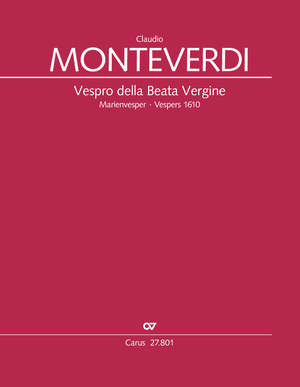
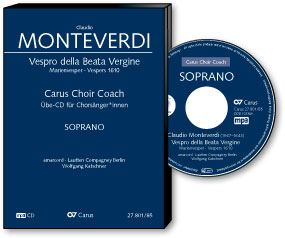
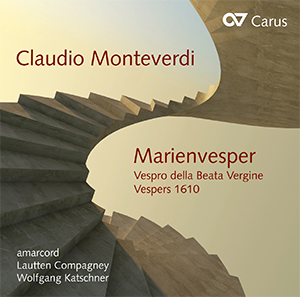
Monteverdi’s Vespers 1610 is now one of those pieces – like Handel’s Messiah or Bach’s Passions – which every choral singer wants to sing at some point. But reading the music notation alone is a challenge for choral singers more familiar with 18th and 19th century repertoire! And you have to get used to the church modes, the independence of the individual parts, the strongly contrasting sections, and much more besides. Then a performance will be an unforgettable experience. Guaranteed!
The underlying recording was made using a historical tuning. It sounds approximately a semitone higher than our modern piano tuning.
Simply practice. Anytime. Everywhere.
Whether at home on your tablet or PC or on the road on your smartphone: with carus music, the Choir Coach, you always have your choral works with you to practice! With the carus music choir app, you can listen to your score together with a first-class recording on any device and easily practice your own choir part with a coach. With carus music, your concert preparation is easy, efficient and fun to master!
Performers: amarcord – Lautten Compagney Berlin – Wolfgang Katschner
Explore
 Listen
(24)
Listen
(24)
- Purchase the work as a CD or download.
- Deus in adjutorium
- Dixit Dominus
- Nigra sum
- Laudate pueri
- Pulchra es
- Laetatus sum
- Duo Seraphim
- Nisi Dominus
- Audi caelum
- Lauda Jerusalem
- Sonata sopra Sancta Maria
- Ave maris stella
- Magnificat anima mea
- Et exsultavit
- Quia respexit
- Quia fecit mihi magna
- Et misericordia
- Fecit potentiam
- Deposuit potentes de sede
- Esurientes implevit bonis
- Suscepit Israel
- Sicut locutus est
- Gloria Patri
- Sicut erat in principio
 Practise
-
 carus music, the Choir Coach
Üben mit carus music
carus music, the Choir Coach
Üben mit carus music
-
Practice aids
-
Practice aids voice part soprano
- Deus in adjutorium (Choir Coach, soprano 1)
- Deus in adjutorium (Choir Coach, Slow mode, soprano 1)
- Deus in adjutorium (Choir Coach, soprano 2)
- Deus in adjutorium (Choir Coach, Slow mode, soprano 2)
- Dixit Dominus (Choir Coach, soprano 1)
- Dixit Dominus (Choir Coach, Slow mode, soprano 1)
- Dixit Dominus (Choir Coach, soprano 2)
- Dixit Dominus (Choir Coach, Slow mode, soprano 2)
- Laudate pueri (Choir Coach, soprano 1)
- Laudate pueri (Choir Coach, Slow mode, soprano 1)
- Laudate pueri (Choir Coach, soprano 2)
- Laudate pueri (Choir Coach, Slow mode, soprano 2)
- Laetatus sum (Choir Coach, soprano 1)
- Laetatus sum (Choir Coach, Slow mode, soprano 1)
- Laetatus sum (Choir Coach, soprano 2)
- Laetatus sum (Choir Coach, Slow mode, soprano 2)
- Nisi Dominus (Choir Coach, soprano 1)
- Nisi Dominus (Choir Coach, Slow mode, soprano 1)
- Nisi Dominus (Choir Coach, soprano 2)
- Nisi Dominus (Choir Coach, Slow mode, soprano 2)
- Audi caelum (Choir Coach, soprano 1)
- Audi caelum (Choir Coach, Slow mode, soprano 1)
- Audi caelum (Choir Coach, soprano 2)
- Audi caelum (Choir Coach, Slow mode, soprano 2)
- Lauda Jerusalem (Choir Coach, soprano 1)
- Lauda Jerusalem (Choir Coach, Slow mode, soprano 1)
- Lauda Jerusalem (Choir Coach, soprano 2)
- Lauda Jerusalem (Choir Coach, Slow mode, soprano 2)
- Ave maris stella (Choir Coach, soprano 1)
- Ave maris stella (Choir Coach, Slow mode, soprano 1)
- Ave maris stella (Choir Coach, soprano 2)
- Ave maris stella (Choir Coach, Slow mode, soprano 2)
- Magnificat anima mea (Choir Coach, soprano 1)
- Magnificat anima mea (Choir Coach, Slow mode, soprano 1)
- Magnificat anima mea (Choir Coach, soprano 2)
- Magnificat anima mea (Choir Coach, Slow mode, soprano 2)
- Et misericordia (Choir Coach, soprano 1)
- Et misericordia (Choir Coach, Slow mode, soprano 1)
- Et misericordia (Choir Coach, soprano 2)
- Et misericordia (Choir Coach, Slow mode, soprano 2)
- Sicut erat in principio (Choir Coach, soprano 1)
- Sicut erat in principio (Choir Coach, Slow mode, soprano 1)
- Sicut erat in principio (Choir Coach, soprano 2)
- Sicut erat in principio (Choir Coach, Slow mode, soprano 2)
-
Practice aids voice part alto
- Deus in adjutorium (Choir Coach)
- Deus in adjutorium (Choir Coach, Slow mode)
- Dixit Dominus (Choir Coach)
- Dixit Dominus (Choir Coach, Slow mode)
- Laudate pueri (Choir Coach, Alto 1)
- Laudate pueri (Choir Coach, Slow mode, Alto 1)
- Laudate pueri (Choir Coach, Alto 2)
- Laudate pueri (Choir Coach, Slow mode, Alto 2)
- Laetatus sum (Choir Coach)
- Laetatus sum (Choir Coach, Slow mode)
- Nisi Dominus (Choir Coach, Alto 1)
- Nisi Dominus (Choir Coach, Slow mode, Alto 1)
- Nisi Dominus (Choir Coach, Alto 2)
- Nisi Dominus (Choir Coach, Slow mode, Alto 2)
- Audi caelum (Choir Coach)
- Audi caelum (Choir Coach, Slow mode)
- Lauda Jerusalem (Choir Coach, Alto 1)
- Lauda Jerusalem (Choir Coach, Slow mode, Alto 1)
- Lauda Jerusalem (Choir Coach, Alto 2)
- Lauda Jerusalem (Choir Coach, Slow mode, Alto 2)
- Ave maris stella (Choir Coach, Alto 1)
- Ave maris stella (Choir Coach, Slow mode, Alto 1)
- Ave maris stella (Choir Coach, Alto 2)
- Ave maris stella (Choir Coach, Slow mode, Alto 2)
- Magnificat anima mea (Choir Coach)
- Magnificat anima mea (Choir Coach, Slow mode)
- Magnificat anima mea (Choir Coach)
- Magnificat anima mea (Choir Coach, Slow mode)
- Et misericordia (Choir Coach)
- Et misericordia (Choir Coach, Slow mode)
- Sicut erat in principio (Choir Coach)
- Sicut erat in principio (Choir Coach, Slow mode)
-
Practice aids voice part tenore
- Deus in adjutorium (Choir Coach, Tenore 1)
- Deus in adjutorium (Choir Coach, Slow mode, Tenore 1)
- Deus in adjutorium (Choir Coach, Tenore 2)
- Deus in adjutorium (Choir Coach, Slow mode, Tenore 2)
- Dixit Dominus (Choir Coach, Tenore 1)
- Dixit Dominus (Choir Coach, Slow mode, Tenore 1)
- Dixit Dominus (Choir Coach, Tenore 2)
- Dixit Dominus (Choir Coach, Slow mode, Tenore 2)
- Laudate pueri (Choir Coach, Tenore 1)
- Laudate pueri (Choir Coach, Slow mode, Tenore 1)
- Laudate pueri (Choir Coach, Tenore 2)
- Laudate pueri (Choir Coach, Slow mode, Tenore 2)
- Laetatus sum (Choir Coach, Tenore 1)
- Laetatus sum (Choir Coach, Slow mode, Tenore 1)
- Laetatus sum (Choir Coach, Tenore 2)
- Laetatus sum (Choir Coach, Slow mode, Tenore 2)
- Nisi Dominus (Choir Coach, Tenore 1)
- Nisi Dominus (Choir Coach, Slow mode, Tenore 1)
- Nisi Dominus (Choir Coach, Tenore 2)
- Nisi Dominus (Choir Coach, Slow mode, Tenore 2)
- Audi caelum (Choir Coach, Tenore 1)
- Audi caelum (Choir Coach, Slow mode, Tenore 1)
- Audi caelum (Choir Coach, Tenore 2)
- Audi caelum (Choir Coach, Slow mode, Tenore 2)
- Lauda Jerusalem (Choir Coach)
- Lauda Jerusalem (Choir Coach, Slow mode)
- Ave maris stella (Choir Coach, Tenore 1)
- Ave maris stella (Choir Coach, Slow mode, Tenore 1)
- Ave maris stella (Choir Coach, Tenore 2)
- Ave maris stella (Choir Coach, Slow mode, Tenore 2)
- Magnificat anima mea (Choir Coach, Tenore 1)
- Magnificat anima mea (Choir Coach, Slow mode, Tenore 1)
- Magnificat anima mea (Choir Coach, Tenore 2)
- Magnificat anima mea (Choir Coach, Slow mode, Tenore 2)
- Et misericordia (Choir Coach)
- Et misericordia (Choir Coach, Slow mode)
- Sicut erat in principio (Choir Coach, Tenore 1)
- Sicut erat in principio (Choir Coach, Slow mode, Tenore 1)
- Sicut erat in principio (Choir Coach, Tenore 2)
- Sicut erat in principio (Choir Coach, Slow mode, Tenore 2)
- Nisi Dominus (Choir Coach)
- Nisi Dominus (Choir Coach, Slow mode)
- Nisi Dominus (Choir Coach)
- Nisi Dominus (Choir Coach, Slow mode)
-
Practice aids voice part basso
- Deus in adjutorium (Choir Coach)
- Deus in adjutorium (Choir Coach, Slow mode)
- Dixit Dominus (Choir Coach)
- Dixit Dominus (Choir Coach, Slow mode)
- Laudate pueri (Choir Coach, Basso 1)
- Laudate pueri (Choir Coach, Slow mode, Basso 1)
- Laudate pueri (Choir Coach, Basso 2)
- Laudate pueri (Choir Coach, Slow mode, Basso 2)
- Laetatus sum (Choir Coach)
- Laetatus sum (Choir Coach, Slow mode)
- Nisi Dominus (Choir Coach, Basso 1)
- Nisi Dominus (Choir Coach, Slow mode, Basso 1)
- Nisi Dominus (Choir Coach, Basso 2)
- Nisi Dominus (Choir Coach, Slow mode, Basso 2)
- Audi caelum (Choir Coach)
- Audi caelum (Choir Coach, Slow mode)
- Lauda Jerusalem (Choir Coach, Basso 1)
- Lauda Jerusalem (Choir Coach, Slow mode, Basso 1)
- Lauda Jerusalem (Choir Coach, Basso 2)
- Lauda Jerusalem (Choir Coach, Slow mode, Basso 2)
- Ave maris stella (Choir Coach, Basso 1)
- Ave maris stella (Choir Coach, Slow mode, Basso 1)
- Ave maris stella (Choir Coach, Basso 2)
- Ave maris stella (Choir Coach, Slow mode, Basso 2)
- Magnificat anima mea (Choir Coach, Basso 1)
- Magnificat anima mea (Choir Coach, Slow mode, Basso 1)
- Magnificat anima mea (Choir Coach, Basso 2)
- Magnificat anima mea (Choir Coach, Slow mode, Basso 2)
- Quia fecit mihi magna (Choir Coach, Basso 1)
- Quia fecit mihi magna (Choir Coach, Slow mode, Basso 1)
- Quia fecit mihi magna (Choir Coach, Basso 2)
- Quia fecit mihi magna (Choir Coach, Slow mode, Basso 2)
- Et misericordia (Choir Coach, Basso 1)
- Et misericordia (Choir Coach, Slow mode, Basso 1)
- Et misericordia (Choir Coach, Basso 2)
- Et misericordia (Choir Coach, Slow mode, Basso 2)
- Sicut erat in principio (Choir Coach, Basso 1)
- Sicut erat in principio (Choir Coach, Slow mode, Basso 1)
- Sicut erat in principio (Choir Coach, Basso 2)
- Sicut erat in principio (Choir Coach, Slow mode, Basso 2)
-
 Additional material
- Purchase additional material as a download product.
-
 Digital text (without sheet music) incl. printing licence, html file, singing text, english translationhtml file, singing text, english translation (Sample)
1. Deus in adjutorium Make haste, O God, to deliver me.
Make haste to help me, O Lord.
Glory be to the Father, and to the Son,
and to the Holy Ghost;
as it was in the beginning,
is now, and ever shall be:
world without end. Amen.
Alleluia.
Ingressus of the Vespers. Psalms 69:2 (Vulgate 69:2)2. Dixit Dominus The Lord said unto my Lord,
sit thou at my right hand,
until I make thine enemies
thy footstool.
The Lord shall send the rod of thy strength out of Zion:
rule thou in the midst of thine enemies.
Thine shall be the dominion in the day of thy power,
...
-
Digital text (without sheet music) incl. printing licence, html file, singing text, german translationhtml file, singing text, german translation (Sample)1. Deus in adjutorium
Gott, auf meine Hilfe sei bedacht.
Herr, eile mir zu helfen.
2. Dixit Dominus
Ehre sei dem Vater und dem Sohne
und dem Heiligen Geiste:
wie es war im Anfange
und jetzt und allezeit
und von Ewigkeit zu Ewigkeit. Amen.
Alleluja.
Vesper-Ingressus. Psalm 69,2 (Vulgata 69,2)Es sprach der Herr zu meinem Herrn:
Setze dich zu meiner Rechten,
bis ich deine Feinde hinlege als Schemel für deine Füße.
Das Zepter deiner Macht wird der Herr von Sion ausgehen lassen:
Herrsche inmitten deiner Feinde.
Bei dir ist Herrschaft am Tage deiner Macht
im Glanze der Heiligen;
ich habe dich aus meinem Schoße gezeugt vor...
-
Digital text (without sheet music) incl. printing licence, html file, singing text, originalhtml file, singing text, original (Sample)1. Deus in adjutorium
Deus in adjutorium meum intende:
Domine ad adjuvandum me festina.
2. Dixit Dominus
Gloria Patri, et Filio,
et Spiritui Sancto.
Sicut erat in principio,
et nunc, et semper,
et in saecula saeculorum. Amen.
Alleluja.
Vesper-Ingressus. Psalm 69,2 (Vulgata 69,2)Dixit Dominus Domino meo:
Sede a dextris meis.
Donec ponam inimicos tuos
scabellum pedum tuorum.
Virgam virtutis tuae emittet
Dominus ex Sion:
dominare in medio inimicorum tuorum.
Tecum principium in die virtutis tuae
in splendoribus sanctorum:...
-
Digital text (without sheet music) incl. printing licence, html file, Introductory text, englishhtml file, Introductory text, english (Sample)Text from the CD Carus 83.394
Uwe Wolf
Translation: Elizabeth Robinson1610. Claudio Monteverdi has been in service in Mantua for about 20 years, for the last seven as “maestro della musica” to the Duke of Mantua. Thanks to this employment he was able to write works including the operas L’Orfeo (1607) and L’Arianna (1608) which enjoyed great success beyond the region. But the numerous duties of his position drained his energies. He found it difficult to recover from the death of his wife in the autumn of 1607 and after her funeral initially did not want to return to Mantua at all. A church music position which might provide regular employment seemed worth striving for, but he was turned down for one such position, that of succeeding Giovanni Giacomo Gastoldi, who had died in 1609, as maestro di cappella at S. Barbara in Mantua. In 1610 Monteverdi had the opportunity
...
-
Digital text (without sheet music) incl. printing licence, html file, Introductory text, germanhtml file, Introductory text, german (Sample)Booklet-Text der CD Carus 83.394
Uwe Wolf
1610. Claudio Monteverdi ist seit rund 20 Jahren in Mantuaer Diensten, seit sieben Jahren als „maestro della musica“ des Duca di Mantova. Dieser Anstellung verdanken wir u. a. die Opern L’Orfeo (1607) und L’Arianna (1608), mit denen Monteverdi große, überregional beachtete Erfolge feiern konnte. Aber die zahlreichen Verpflichtungen seines Amtes zehren an Monteverdi, der sich zudem nur schwer von dem Tod seiner Frau im Herbst 1607 erholen kann und nach deren Beisetzung er zunächst sogar gar nicht mehr nach Mantua zurückkehren wollte. Erstrebenswert scheint Monteverdi eine kirchenmusikalische Anstellung, von der er sich einen geregelteren Dienst erhoffen kann, doch die Nachfolge des 1609 verstorbenen Kapellmeisters an S. Barbara in Mantua, Giovanni Giacomo Gastoldi, bleibt ihm verwehrt. In dieser Situation bietet sich Monteverdi 1610
...
Purchase
Additional product information
Contents


-
Composer
Claudio Monteverdi
| 1567-1643During his youth in Cremona, Monteverdi received his first musical training from Marc'Antonio Ingegneri, the maestro di cappella at the Cathedral. After making his name with his first publications, including his First Book of Madrigals, he moved to the Gonzaga court in Mantua in 1590: he remained in the service of the family for twenty-two years, first as singer and violist, and later as maestro di cappella. There he composed further books of madrigals and, with L'Orfeo in 1607, one of the earliest operas in the history of music. The Vespers of the Blessed Virgin were also written in Mantua in 1610. In 1613 became Monteverdi maestro di cappella at St Mark's in Venice. He spent thirty musically fruitful years in this post. He composed sacred works, but remained interested in secular music and published his most extensive secular collections with books six to eight of his Madrigals. After the opening of the Venice opera house in 1637, the first public opera house ever , he returned to composing opera once more: both of his late operas, Il ritorno d'Ulisse in Patria and L'incoronazione di Poppea received their first performances here. Personal details
Reviews on our website can only be submitted by customers with a registered user account. A check whether the rated products were actually purchased does not take place.
No feedback available for this product.
Frequent questions about this work
 There are no questions and answers available so far or you were unable to find an answer to your specific question about this work? Then click here and send your specific questions to our Customer Services!