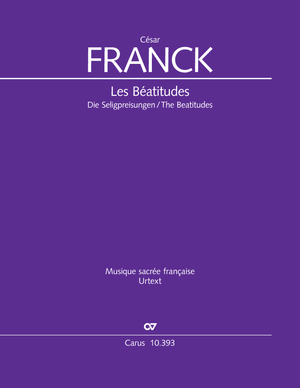
Five short sacred compositions
The five short church compositions brought together in this volume were all written for liturgical use in the church of Ste. Clotile in Paris, where Franck was appointed in 1858 in the dual capacity of organist and maître de chapelle.
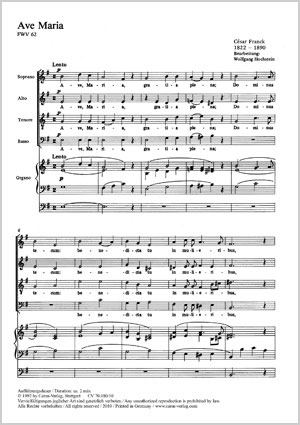
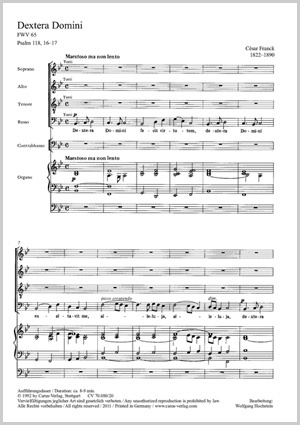
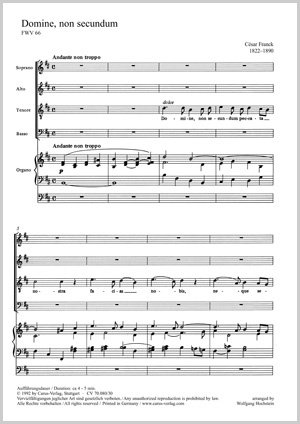
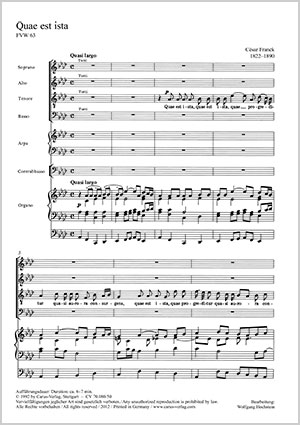
Our selection contains the motets Domine non secundum, Ave Maria in E minor and Panis angelicus, together with the offertories Quae est ista and Dextera Domini.
Total duration: 25 minutes
Separate editions available
 View
View

Contents

-
Composer
César Franck
| 1822-1890César Franck (1822–1890), a native of Liège, Belgium, studied in Paris and was active there at the Cavaillé-Coll organ of the Church of Sainte-Clotilde from 1859 until his death. In 1871 he was a co-founder of the “Société nationale de Musique”, later becoming its president. In 1872 he was appointed professor of organ at the Paris Conservatoire. His students included well-known personalities from French music history such as Ernest Chausson, Vincent d’Indy, Gabriel Pierné, Charles Tournemire, Louis Vierne and also, for a short while, Claude Debussy. In early July 1890 Franck had an accident with a horse-drawn omnibus, from the consequences of which he never recovered. He died on 8 November. Franck’s successors at Sainte-Clotilde were G. Pierné and (from 1898) Ch. Tournemire, one of Olivier Messiaen’s teachers. Personal details
Reviews
César Franck, Fünf kleine Kirchenwerke
César Franck, Fünf kleine Kirchenwerke
Die „Fünf kleinen Kirchenwerke” dieser Ausgabe, nämlich Domine non secundum, Ave Maria, Panis angelicus, Quae est ista und Dextera Domini sind in der vorliegenden Form (bearbeitet für vierstimmigen gemischten Chor von Wolfgang Hochstein) 1992 neu herausgegeben worden. Zu ihrer Entstehungszeit (um 1859) war die Funktion der Kirchenchöre ebenso eingeschränkt wie vielfach auch heute wieder, so dass Franck diese Werke, die zur liturgischen Verwendung an St. Clothilde in Paris bestimmt waren, für dreistimmigen Chor (STB) konzipierte. Alle Stücke verlangen die Orgel als Begleitinstrument, einige noch zusätzlich Harfe, (Cello und Kontrabass, Panis angelicus, Dextera und Quas sogar noch Gesangssolisten, Bei eingeschränkten Mitteln (finanzieller und organisatorischer Art - wer engagiert für ein 5-Minuten-Werk im Gottesdienst eine Harfe...?) wären Arrangements für Chor und Orgel u.U. denkbar.
Die fünf Kompositionen sind - um es mit zwei Worten zu sagen - einfach wunderschön und nicht nur für die Liturgie, sondern auch für das Konzert eine Bereicherung.
Andreas König
Quelle: Kirchenmusik im Erzbistum Bamberg 12/1993, S. 45
Reviews on our website can only be submitted by customers with a registered user account. A check whether the rated products were actually purchased does not take place.
Frequent questions about this work
 There are no questions and answers available so far or you were unable to find an answer to your specific question about this work? Then click here and send your specific questions to our Customer Services!