Explore



 Listen
(1)
Listen
(1)
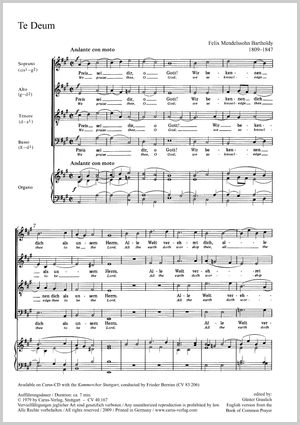
- Te Deum a 4
Purchase
Additional product information
-
Composer
Felix Mendelssohn Bartholdy
| 1809-1847Felix Mendelssohn Bartholdy (1809–1847) is regarded as one of the most important composers of the Romantic period. His compositions combine the formal clarity of the Viennese Classical period with the heightened expressiveness of the 19th century. His engagement with the music of Johann Sebastian Bach was particularly influential; he played a key role in its rediscovery through the performance of the St Matthew Passion in 1829.
Among his best-known vocal works are his two oratorios, Paulus and Elias, as well as his chorale cantata Verleih uns Frieden gnädiglich. Furthermore, Mendelssohn worked as a conductor, pianist and music teacher, and made a significant contribution to the professionalisation of the concert scene and to the development of the Leipzig Conservatoire. His work occupies a central position in 19th-century music history and combines a sense of tradition with Romantic sound aesthetics.
Personal details
-
Editor
Günter Graulich
| 1926The publisher, church musician and teacher Günter Graulich is one of the major personalities in German publishing of the post-war period. With his wife Waltraud he founded Carus-Verlag Stuttgart in 1972, which he built up from a 2-person family firm to a medium-sized business with around 60 employees. A trained church musician and Kantor for many years at the Matthäuskirche Stuttgart, he also directed the Motettenchor Stuttgart for 50 years. With his choir he made LP and CD recordings, and undertook numerous concert tours to other European countries and America. Personal details
Reviews
Mendelssohn Bartholdy, Felix: „Te Deum”
Mendelssohn Bartholdy, Felix: „Te Deum”
Der 17jährige Mendelssohn schrieb 1826 ein achtstimmiges Te Deum für die von Friedrich Zelter gegründete und auf achtstimmige Literatur spezialisierte Berliner Singakademie. Das gesamte Werk ist auf reichhaltige Klangentfaltung ausgelegt, auch die Solisten werden deshalb chorisch eingesetzt, eine deutliche Hommage an die Technik der venezianischen Mehrchörigkeit. Dementsprechend kontrastreich fällt auch das kompositorische Prinzip aus: große homophone Blöcke; rein vierstimmige Sätze im Wechsel mit achtstimmigen; ein vierstimmiger, sich zur Achtstimmigkeit entfaltender Satz; große Besetzung im Wechsel mit der kleinen; tiefe Lagen kontrastierend zu höheren; homophone im Wechsel mit polyphonen Strukturen usw. Ein ideales Werk, dem sich zwei (evtl. durch einen kooperierenden Kirchenmusiker/in betreute) Chöre widmen können, die stimmlich ungefähr gleich besetzt sind, die Lust haben, sich auf Achtstimmigkeit und Doppelchörigkeit einzulassen, und die neben Praetorius, Pachelbel oder Schütz auch einmal etwas anderes Achtstimmiges suchen...
Reiner Schuhenn
Quelle: Musik im Bistum Essen, Sonderausgabe III/1998, S. 13
Reviews on our website can only be submitted by customers with a registered user account. A check whether the rated products were actually purchased does not take place.
No feedback available for this product.
Frequent questions about this work
 There are no questions and answers available so far or you were unable to find an answer to your specific question about this work? Then click here and send your specific questions to our Customer Services!