

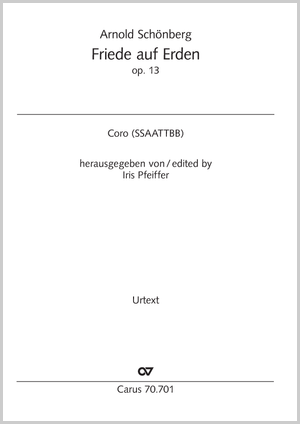
Friede auf Erden (Peace on earth) op. 13 is regarded as Arnold Schoenberg’s last tonal composition and is one of the few choral works of the Second Viennese School. On the same day that he completed his op. 13, Schoenberg made the first sketches for his 2nd String Quartet, a key work in atonal music.
Although Schoenberg later orchestrated Friede auf Erden, he intended the piece to be performed unaccompanied. To help rehearsing the work, this choral score contains the piano transcription made by Anton Webern for use in rehearsals for the planned first performance.
The text for op. 13 is a secular Christmas poem by Conrad Ferdinand Meyer. At the time of its composition (1907), Schoenberg thought the vision of a “reine Harmonie unter Menschen” (pure harmony amongst people) described in the poem was conceivable, but he later distanced himself from this idea. What remained is a composition of great artistic power and depth – a real showpiece for ambitious choirs!
Explore


 Listen
(1)
Listen
(1)
- Peace on Earth
 Practise
-
 carus music, the Choir Coach
Üben mit carus music
carus music, the Choir Coach
Üben mit carus music
-
Practice aids
-
Practice aids voice part soprano
- Peace on Earth (Choir Coach, soprano 1)
- Peace on Earth (Choir Coach, Slow mode, soprano 1)
- Peace on Earth (Choir Coach, soprano 2)
- Peace on Earth (Choir Coach, Slow mode, soprano 2)
-
Practice aids voice part alto
- Peace on Earth (Choir Coach, Alto 1)
- Peace on Earth (Choir Coach, Slow mode, Alto 1)
- Peace on Earth (Choir Coach, Alto 2)
- Peace on Earth (Choir Coach, Slow mode, Alto 2)
-
Practice aids voice part tenore
- Peace on Earth (Choir Coach, Tenore 1)
- Peace on Earth (Choir Coach, Slow mode, Tenore 1)
- Peace on Earth (Choir Coach, Tenore 2)
- Peace on Earth (Choir Coach, Slow mode, Tenore 2)
-
Practice aids voice part basso
- Peace on Earth (Choir Coach, Basso 1)
- Peace on Earth (Choir Coach, Slow mode, Basso 1)
- Peace on Earth (Choir Coach, Basso 2)
- Peace on Earth (Choir Coach, Slow mode, Basso 2)
-
Purchase
Additional product information
-
Composer
Arnold Schönberg
| 1874-1951Arnold Schoenberg was an Austrian composer, music theorist and painter who is considered one of the most influential composers of the 20th century.
Schoenberg grew up in Vienna and took violin lessons from the age of nine. He began experimenting with composition at an early age. He initially worked as a bank clerk, but decided to pursue a career as a composer at the turn of the century. Friede auf Erden (Peace on Earth), Op. 13, one of the few choral works of the Second Viennese School, is considered Arnold Schoenberg's last tonal composition before he developed atonality between 1906 and 1909. Around 1920, he formulated the twelve-tone technique, which had a decisive influence on 20th-century music. As a central figure of the Second Viennese School and teacher of important composers such as Alban Berg and Anton Webern, Schoenberg's innovations influenced the development of serial and electronic music. In 1933, Schoenberg emigrated to the United States and became an American citizen in 1941. He died on 13 July 1951 in Los Angeles.
Personal details
-
Editor
Iris Pfeiffer
-
Songwriter / Librettist
Conrad Ferdinand Meyer
| 1825-1898
Reviews on our website can only be submitted by customers with a registered user account. A check whether the rated products were actually purchased does not take place.
No feedback available for this product.
Frequent questions about this work
 There are no questions and answers available so far or you were unable to find an answer to your specific question about this work? Then click here and send your specific questions to our Customer Services!