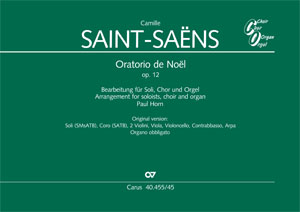
In 1858 Camille Saint-Saëns composed his Oratorio de Noël for five vocal soloists, mixed choir, strings, organ and harp. The work, sung in Latin, is based on texts from the Old and New Testaments, the Psalms and Gospels, as well as the Catholic Christmas liturgy. A distinctive chamber music-like instrumentation, with lyrical soloistic parts and a modest choral part combine to create a basic pastoral mood which has led this Christmas Oratorio to become one of the most performed works by Saint-Saëns. Carus offers this work both in its original version and in an arrangement in which the choir is accompanied solely by an organ.
Also available in a version for Choir & Organ (Carus 40.455/45).
Explore
 View
View


 Listen
(12)
Listen
(12)
- Prélude
- Et pastores erant / Gloria in altissimus Deo
- Expectans exspectavi Dominum
- Domine, ego credidi
- Benedictus
- Quare fremuerunt gentes
- Tecum principium
- Alleluia
- Consurge, Filia Sion
- Tollite hostias
- Terzett (Tecum principium)
- Quintet et Choeur (Consurge)
 Practise
-
 carus music, the Choir Coach
Üben mit carus music
carus music, the Choir Coach
Üben mit carus music
-
Practice aids
-
Practice aids voice part soprano
- Et pastores erant / Gloria in altissimus Deo (Choir Coach)
- Domine, ego credidi (Choir Coach, soprano 1)
- Domine, ego credidi (Choir Coach, soprano 2)
- Quare fremuerunt gentes (Choir Coach)
- Consurge, Filia Sion (Choir Coach)
- Tollite hostias (Choir Coach)
- Et pastores erant / Gloria in altissimus Deo (Choir Coach, Slow mode)
- Domine, ego credidi (Choir Coach, Slow mode, soprano 1)
- Domine, ego credidi (Choir Coach, Slow mode, soprano 2)
- Quare fremuerunt gentes (Choir Coach, Slow mode)
- Consurge, Filia Sion (Choir Coach, Slow mode)
- Tollite hostias (Choir Coach, Slow mode)
-
Practice aids voice part alto
- Et pastores erant / Gloria in altissimus Deo (Choir Coach)
- Domine, ego credidi (Choir Coach, Alto 1)
- Domine, ego credidi (Choir Coach, Alto 2)
- Quare fremuerunt gentes (Choir Coach)
- Consurge, Filia Sion (Choir Coach)
- Tollite hostias (Choir Coach)
- Domine, ego credidi (Choir Coach, Slow mode, Alto 1)
- Domine, ego credidi (Choir Coach, Slow mode, Alto 2)
- Quare fremuerunt gentes (Choir Coach, Slow mode)
- Consurge, Filia Sion (Choir Coach, Slow mode)
- Tollite hostias (Choir Coach, Slow mode)
-
Practice aids voice part tenore
- Et pastores erant / Gloria in altissimus Deo (Choir Coach)
- Quare fremuerunt gentes (Choir Coach)
- Consurge, Filia Sion (Choir Coach)
- Tollite hostias (Choir Coach)
- Et pastores erant / Gloria in altissimus Deo (Choir Coach, Slow mode)
- Quare fremuerunt gentes (Choir Coach, Slow mode)
- Consurge, Filia Sion (Choir Coach, Slow mode)
- Tollite hostias (Choir Coach, Slow mode)
-
Practice aids voice part basso
- Et pastores erant / Gloria in altissimus Deo (Choir Coach)
- Quare fremuerunt gentes (Choir Coach)
- Consurge, Filia Sion (Choir Coach)
- Tollite hostias (Choir Coach)
- Et pastores erant / Gloria in altissimus Deo (Choir Coach, Slow mode)
- Quare fremuerunt gentes (Choir Coach, Slow mode)
- Consurge, Filia Sion (Choir Coach, Slow mode)
- Tollite hostias (Choir Coach, Slow mode)
-
 Additional material
- Purchase additional material as a download product.
-
 Digital text (without sheet music) incl. printing licence, html file, singing text, originalhtml file, singing text, original (Sample)1. Prélude (Archi, Organo) 2. Récit et chœur
Et pastores erant in regione eadem vigilantes,
et custodientes vigilias noctis super gregem suum.
Et ecce Angelus Domini stetit juxta illos,
et claritas Dei circumfulsit illos,
et timuerunt timore magno.
Et dixit illis Angelus:
Nolite timere!
Ecce enim evangelizo vobis gaudium magnum,
quod erit omni populo:
quia natus est vobis hodie Christus
Dominus in civitate David.
Et hoc vobis signum:
Invenietis infantem pannis involutum,
et positum in praesepio.
Et subito facta est cum Angelo
multitudo militiae coelestis,
laudantium Deum, et dicentium:
Gloria in altissimis Deo,...
-
Digital text (without sheet music) incl. printing licence, html file, singing text, english translationhtml file, singing text, english translation (Sample)1. Prélude (Archi, Organo) 2. Récit et chœur
And there were shepherds in the same country
in the fields with their folds,
guarding their flocks by night.
And, lo, the angel of the Lord came to them
and the glory of the Lord shone around them,
and they were sore afraid.
And the angel said to them:
Do not fear!
Behold, I bring you tidings of great joy,
which shall be to all people:
For unto you this day is born the Saviour
Christ the Lord, in the city of David.
And this shall be a sign to you:
You will find the child wrapped in swaddling clothes,
lying in a manger.
And suddenly there was with the angel
a multitude of the heavenly host
praising God and saying:...
-
Digital text (without sheet music) incl. printing licence, html file, singing text, german translationhtml file, singing text, german translation (Sample)1. Prélude (Archi, Organo) 2. Récit et chœur
Und es waren Hirten in derselben Gegend
auf dem Felde bei den Hürden,
die hüteten des Nachts ihre Herde.
Und siehe, des Herrn Engel trat zu ihnen,
und die Klarheit des Herren leuchtete um sie;
und sie fürchteten sich sehr.
Und der Engel sprach zu ihnen:
Fürchtet euch nicht!
Siehe, ich verkündige euch große Freude,
die allem Volk widerfahren wird;
denn euch ist heute der Heiland geboren,
welcher ist Christus, der Herr, in der Stadt Davids.
Und das habt zum Zeichen:
Ihr werdet finden das Kind in Windeln gewickelt
und in einer Krippe liegen.
Und alsbald war da bei dem Engel
die Menge der himmlischen Heerscharen,
die lobten Gott und sprachen:...
-
Digital text (without sheet music) incl. printing licence, html file, Introductory text, frenchhtml file, Introductory text, french (Sample)Texte du livret du CD Carus 83.352
Herbert Lölkes
Traduction (abrégé) : Sylvie Coquillat« Un classique à une époque moderne »
Camille Saint-Saëns – Musique religieuseLorsque Camille Saint-Saëns s’éteignit en 1921 à l’âge de 86 ans, il avait traversé plusieurs époques musicales et évolutions stylistiques. Son image tenace de conservateur soucieux de la tradition ne put cependant empêcher, contribua même à ce que la bourgeoisie amatrice d’art le considérât – aux côtés de l’excentrique Berlioz – comme l’un des représentants majeurs de la Musique française du 19ème siècle. Sa signification se fondait ici non seulement sur sa fonction de compositeur, mais aussi de chef d’orchestre et de pianiste de ses propres œuvres ainsi que d’organiste dans des églises de sa ville natale de Paris (Église Saint-Merri 1853–1858, Église de la Madeleine 1858–1877). Saint-Saëns lui-même était tout à fait conscient
...
-
Digital text (without sheet music) incl. printing licence, html file, Introductory text, englishhtml file, Introductory text, english (Sample)Text from the CD Carus 83.352
Herbert Lölkes
Translation (abridged): John Coombs“A classicist in a modern epoch”
Camille Saint-Saëns – Musique religieuse When Camille Saint-Saëns died in Algiers in 1921 at the age of 86 he had outlived several epochs and stylistic changes in musical history. Despite the image of conservatism and awareness of tradition which remained with him, indeed partly because of it, the music-loving public regarded him – along with themore eccentric Berlioz – as a leading representative of 19th-century Musique française. His importance lay not only in his capacity as a composer, but also as a conductor and performer (as a pianist) of his own works, as well as an organist in churches of his native city Paris (Église Saint-Merri 1853–58, Église de la Madeleine 1858–77). Saint-Saëns was fully aware of the eclectic elements to his music, without this impairing its positive creative force....
-
Digital text (without sheet music) incl. printing licence, html file, Introductory text, germanhtml file, Introductory text, german (Sample)Booklet-Text der CD Carus 83.352
Herbert Lölkes
„Ein Klassiker in einer modernen Epoche“
Camille Saint-Saëns – Musique religieuseEs gibt keine religiöse Kunst im eigentlichen Sinn, die eindeutig von der weltlichen Kunst unterschieden werden könnte. Es gibt nur gute und schlechte Musik; der Rest ist eine Frage der Mode und Konvention. Camille Saint-Saëns (1916)
Als Camille Saint-Saëns 1921 im Alter von 86 Jahren in Algier starb (drei Jahre nach dem Tod von Claude Debussy), hatte er gleich mehrere musikgeschichtliche Epochen und Stilwandel überlebt. Das ihm anhaftende Image des Konservativen und Traditionsbewussten konnte jedoch nicht verhindern, sondern trug eher dazu bei, dass ihn das breite kunstgenießende Bürgertum – neben dem exzentrischeren Berlioz – als einen führenden Repräsentanten der Musique française des 19. Jahrhunderts betrachtete. Seine Bedeutung gründete sich dabei nicht allein auf seine Bekanntheit als Komponist,
...
Purchase
Additional product information
Contents

-
Composer
Camille Saint-Saëns
| 1835-1921Camille Saint-Saëns was a true multi-talent. He was a pianist, conductor, organist, musicologist, music teacher and composer and became famous above all for the Carnival of the Animals and the opera Samson et Dalila.
He composed his Symphony in A major at the age of 15 and was accepted to the University of Paris at the age of 16. Saint-Saëns studied piano, organ and composition at the Paris Conservatoire and became organist of Saint-Séverin in Paris in 1852. In the same year, he also met Franz Liszt, who subsequently exerted an influence on Saint-Saëns' compositional work. A year later, he celebrated his musical debut as a composer. The opera Samson et Dalila, which premiered in Weimar in 1877, brought him lasting success in opera houses to this day. His Christmas oratorio Oratorio de Noël, which is available from Carus-Verlag, is probably the best-known of his sacred works. Personal details
-
Editor
Thomas Kohlhase
| 1941
Reviews
Camille Saint-Saëns (1835-1921)
Das 30-minütige Weihnachtsoratorium von Camille Saint-Saëns wird immer mehr fester Bestandteil im Repertoire unserer Chöre. Die interessante Instrumentation und der überlegene Kompositionsstil des Meisters bieten neben dem Bachschen Weihnachtsoratorium, der Schützschen Weihnachtshistorie eine zusätzliche Möglichkeit das Weihnachtsfest angemessen musikalisch zu gestalten. Auch einer Integration des Oratoriums in die Liturgie des Hl. Abends steht nichts im Wege.
Peter Bartetzky, Musik im Bistum Essen 2/2002
...Der Klavierauszug ist sehr schön gearbeitet und bereitet grifftechnisch kaum Probleme.
Singende Kirche, 2/2002
Reviews on our website can only be submitted by customers with a registered user account. A check whether the rated products were actually purchased does not take place.
No feedback available for this product.
Frequent questions about this work
The harp is only required in two movements. Can it be dispensed with completely?
The use of the harp is very limited, but that is why it is so effective. As the harp only doubles the organ in No. 5 in certain passages, it could be dispensed with there. In No. 7 the harp is central. If you nevertheless want to avoid using the harp, the organ can play this movement from the organ version 40.455/45; there the harp part is integrated into the organ writing.
The organ version has German text underlaid as well as the Latin. Can this text also be used with the original version?
Of course! For that there is the vocal score 40.455/53 and the chorus score 40.455/55 which only contain the German text, but which otherwise match the main version.
 There are no questions and answers available so far or you were unable to find an answer to your specific question about this work? Then click here and send your specific questions to our Customer Services!